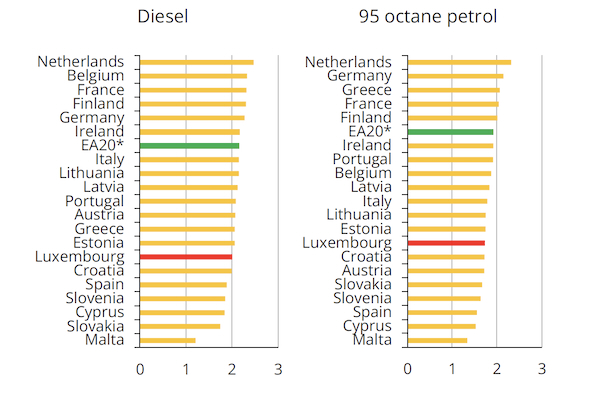
 Fuel prices at the pump on Monday 13 April 2026 (in EUR/L);
Credit: STATEC
Fuel prices at the pump on Monday 13 April 2026 (in EUR/L);
Credit: STATEC
On Tuesday 22 April 2026, STATEC published its latest Conjuncture Flash report, noting that against a backdrop of deteriorating expectations regarding the general economic situation, consumer confidence has reduced but business expectations have risen strongly, reaching their highest level since September 2022.
STATEC reported that in March, inflation in the eurozone reached 2.6%, up from 1.9% in February and attributed this acceleration specifically to energy prices, which rose by 5.1% year-on-year. It did however state that the impact of rising oil prices on inflation varies across the eurozone, with fuel prices and tax levels vary significantly from one country to another. Some countries have taken measures to limit the rise in fuel prices: a reduction in VAT in Spain, a cut in excise duties in Italy, a decrease in energy tax in Germany, a cap on profit margins in Greece and caps on pump prices in Croatia.
In the March survey, consumer confidence in Luxembourg fell sharply (to its lowest level in a year), against a backdrop of deteriorating expectations regarding the general economic situation and the financial situation of households. Their inflation expectations have risen strongly, reaching their highest level since September 2022. These factors are also reflected in consumer sentiment across the eurozone as a whole.
Sales of passenger cars rose slightly in Luxembourg in 2025, by 1.1%. STATEC observed this increase is similar to the one recorded in the eurozone, where there are, however, marked differences between Member States: very positive figures come from the south, notably Spain (+13%), Portugal (+7%) and Greece (+5%), whilst France (-5%), Italy (-2%) and Belgium (-7%) weighed on the overall result.
As for businesses in Luxembourg, recent events appeared to have had little impact so far. Manufacturers’ confidence increased in March for the second consecutive month, driven in particular by an influx of orders in the metalworking sector. Confidence among construction professionals fell only slightly but remained on an upward trend. In the services sector (retail trade, other non-financial services), business sentiment improved again slightly in March.
Rising uncertainty surrounding the conflict in the Middle East and its potential impacts had a quite sharp but brief downward effect on the main stock market indices, which fell in March and have been recovering since. By mid-April, the European Euro Stoxx 50 index was up by 5% compared with the end of 2025, whilst the UK’s FTSE 100 index had gained 7% and the S&P 500 3%. The sector that has seen the strongest growth is energy, driven mainly by rising oil prices.
According to STATEC, at the start of 2026, cross-border employment was significantly more dynamic (+2.0% year-on-year in the 1st quarter, preliminary figures) than domestic employment (+1.2%). However, trends varied depending on the country of residence of the cross-border workers: a sharp rise on the French side (+3.5% year-on-year in January, or +4,270 employees), a modest recovery on the Belgian side (+0.9%, or +430 employees) and a continued decline on the German side, which began in early 2024 (-0.7%, or -330 employees).
STATEC noted that among cross-border workers coming from Belgium, the number of Belgians has barely stabilised year-on-year, whilst Luxembourg and Portuguese nationals are notably driving the increase (+150 employees for these two nationalities year-on-year in January). The rise in French cross-border workers, however, remained driven primarily by employees of French nationality (+2,800). STATEC detailed that they are most often employed in retail, the financial sector and business services, but the strongest growth is recorded in health and social care. Luxembourgers living abroad, meanwhile, most often work in public administration and health and social care, whilst construction and administrative and support services employ the most non-resident Portuguese.
The full report is available at https://statistiques.public.lu/en/actualites/2026/conjflash-04-26.html.