 Credit: Ievgenii Karanov, Chronicle.lu
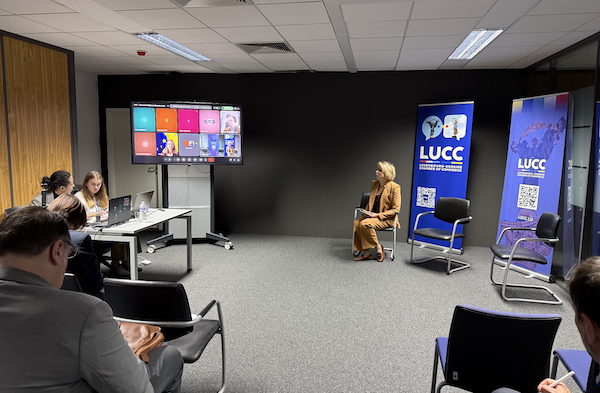
On Tuesday 13 October 2026, the Luxembourg-Ukraine Chamber of Commerce (LUCC) hosted its "Luxembourg Finance for Resilience – Executive Dialogue" event at Coworking LBP in Luxembourg-Hamm, bringing together approximately 30 participants in person and more than 140 online.
The event featured two panel discussions focusing on mobilising private capital for Ukraine's recovery. The first examined how public institutions, international financial institutions and development partners could reduce investment risks through guarantees, blended finance and risk-sharing mechanisms. The second focused on the conditions needed to attract private investment, including investment readiness, insurance, regulatory conditions and investor confidence.
Mobilising Capital for Ukraine's Recovery
LUCC President Evgenia Paliy moderated the first panel discussion, entitled "Public–Private Partnerships: Mobilising Capital for Ukraine’s Recovery".
Joining the discussion online, Serhiy Derkach, Ukraine's First Deputy Minister for Recovery, Infrastructure and Transport, stressed that public budgets and international financial support alone would not be sufficient to finance Ukraine's reconstruction. He highlighted public-private partnerships (PPPs) as a means of attracting private investment, pointing to changes in Ukraine's legal framework intended to provide greater protection for private partners. Serhiy Derkach also presented a portfolio of proposed PPP projects covering ports, roads, railway infrastructure, logistics hubs and municipal utilities, including the Chornomorsk container terminal, the Lviv Northern Bypass and water infrastructure projects in Dnipro. He added: "We have already seen the interest of huge international companies who are eager to invest in Ukraine right now, even during the war, even under the risks."
Violaine Silvestro von Kameke, Head of the Public Sector Unit of the Ukraine Investment Team at the European Investment Bank (EIB), outlined the bank's support for Ukrainian communities in transport, energy and housing, including financing for social housing and the repair of war-damaged residential buildings. She stressed the importance of technical assistance in helping municipalities, particularly smaller ones, prepare and implement projects in line with EU standards. Violaine Silvestro von Kameke also explained how the EIB combines its loans with EU grants to reduce the financial burden on municipalities and encourage private-sector participation. She explained: "We manage to improve the project affordability and increase the municipality's willingness to participate in these operations."
Charles-Antoine de Crombrugghe de Picquendaele, representing the European Commission's Directorate-General for Enlargement and the Eastern Neighbourhood (DG ENEST), outlined the role of the Ukraine Investment Framework, established in 2024, which he said had already allocated nearly 90% of its resources. He stressed the need to mobilise private finance alongside public investment and highlighted the use of guarantees, loans and equity financing to reduce investment risks. He also referred to a €300 million support mechanism for renewable electricity, intended to provide investors with greater certainty through long-term price stabilisation contracts.
Annabelle Gastal, representing the Multilateral Investment Guarantee Agency (MIGA) of the World Bank Group, explained how political risk insurance could help attract foreign private investment into Ukraine, particularly for long-term public-private partnerships. She reported that MIGA had issued $679 million in guarantees supporting Ukraine since the start of the war, as of September 2026, including support for lending to small and medium-sized businesses and investments in logistics infrastructure. Highlighting the agency's role in reducing risks for investors, Annabelle Gastal explained: "MIGA could come into play by providing political risk insurance guarantees to these private foreign investors." She also noted that such guarantees could cover risks associated with war and civil disturbance.
Viktor Nestulia, Director of Ukraine Support at the Open Contracting Partnership's DREAM Project Office, highlighted the need to improve the preparation of investment projects in Ukraine. He explained that the DREAM digital public investment management system currently contained more than 20,000 project initiatives submitted by over 1,300 local authorities, regional administrations and ministries. According to Viktor Nestulia, the system allows potential investors and financing partners to assess projects, monitor their implementation and access information on budgets, procurement and funding sources. He stressed that the main challenge was not a lack of project ideas or potential partners, but the availability of sufficiently prepared and reliable projects that could attract financing on the scale Ukraine requires.
Maryna Khlystun, CEO of UkraineInvest, the country's Investment Attraction and Support Office, outlined the development of war-risk insurance mechanisms to support private investment. She referred to guarantees provided by MIGA and the US International Development Finance Corporation (DFC), as well as insurance solutions for commercial property and logistics. Maryna Khlystun also highlighted Ukrainian government programmes aimed at reducing insurance costs and compensating businesses for damage. However, she acknowledged that existing measures remained insufficient: "But of course that's not enough." She added that the Ukrainian government was working to establish additional funds, potentially with contributions from international partners, to expand access to insurance for investors.
Attracting Private Investment to Ukraine
Olena Sukmanova, Partner and Head of Dispute Resolution at Sayenko Kharenko law firm, President of the SAFE UKRAINE 2030 Fund and former First Deputy Minister of Justice of Ukraine, moderated the second panel discussion, entitled "What Will Make Private Capital Invest in Ukraine?"
Andrii Nosok, Managing Director and Head of Private Equity at Dragon Capital, discussed the challenges of attracting private investment into Ukraine. He noted that the company had raised more than €600 million across three funds focused on infrastructure and private equity investments, primarily from international development finance institutions. According to Andrii Nosok, private investors continued to face significant obstacles, including war-related security risks, perceptions of risk among those unable to visit Ukraine, institutional restrictions on investing in countries at war and uncertainty over exit opportunities.
Elisabeth Szeli, Policy Officer at the European Commission's Directorate-General for Enlargement and the Eastern Neighbourhood (DG ENEST), outlined the Commission's efforts to reduce investment risks through the Ukraine Investment Framework. She explained that EU budget guarantees enabled international financial institutions and commercial banks to provide loans to Ukrainian municipalities and businesses on more favourable terms. Elisabeth Szeli also highlighted provisions designed to protect borrowers against war-related losses. Using the example of an industrial park destroyed by a missile strike, she explained that the EU-backed guarantee could allow the outstanding loan to be written off rather than recovered from the affected company. She clarified: "It's not war risk insurance in the strict sense, but it serves the same purpose to de-risk the investment of this company."
Iraklii Baramia, Commissioner at Ukraine's National Securities and Stock Market Commission, outlined legislative initiatives aimed at attracting domestic and international private capital. These included a proposal to introduce individual investment accounts with tax benefits for long-term investments, legislation on securitisation and covered bonds, simplified procedures for issuing municipal bonds and proposed changes to the registration of securities issues. He explained that these measures were intended to encourage investment in financial instruments and facilitate financing for housing, infrastructure and reconstruction projects.
Juliette Leusink, Senior Officer in the Private Sector and Blending Unit of the Ukraine Investment Team at the European Investment Bank (EIB), explained how the bank supports private-sector projects through local financial institutions and investment funds. She noted that smaller investments, including those involving small and medium-sized enterprises, were generally financed through local banks rather than directly by the EIB. Juliette Leusink also highlighted the bank's focus on energy and transport projects, explaining that investment assessments in Ukraine must take account of additional factors, including security risks, construction locations and contractors' ability to implement and maintain projects.
Yevhen Metzger, Chairman of the Board of PJSC Ukrainian Housing Finance Company, discussed plans to attract private investment into Ukraine's housing market through mortgage refinancing and capital market instruments. He explained that the company aimed to become a secondary mortgage institution, refinancing mortgage portfolios held by banks rather than issuing loans directly to borrowers. Highlighting the company's changing role, Yevhen Metzger stated: "We started as a usual state support programme service, but now we are becoming a bridge between the mortgage market and the capital market." He also outlined plans to use securitisation and covered bonds to attract long-term institutional investment. According to Yevhen Metzger, the company's network already included ten partner banks, more than 150 developers and over 400 residential projects across Ukraine, providing potential investors with access to market information and local partners.
Prasad Ananthakrishnan, a climate finance expert and former Adviser and Chief of the Climate Finance Policy Unit at the International Monetary Fund (IMF), explained how IMF programmes could help attract private investment by supporting macroeconomic stability and structural reforms. He emphasised that the IMF does not finance individual investment projects directly: "The IMF does not lend directly to investors or to specific projects." Instead, he described how IMF programmes support economic stability and encourage other international financing. Referring to Ukraine's four-year IMF programme, he cited $8.1 billion in committed financing, including approximately $2.2 billion already disbursed, as part of a broader $136 billion international support package for 2026-2029. Prasad Ananthakrishnan also highlighted reforms addressing debt sustainability, corruption, regulatory predictability and alignment with EU standards, which he identified as important conditions for attracting long-term private investment.
Returning to the discussion, Elisabeth Szeli highlighted the European Commission's €50 billion Ukraine Facility, under which Ukraine must implement reforms to receive quarterly budget support payments. She explained that these reforms also aimed to improve the country's business environment, including measures to tackle corruption, while supporting Ukraine's EU accession process. Elisabeth Szeli noted that Ukraine had made significant progress despite the ongoing war but stressed the importance of maintaining the reform process to attract private investment and secure further financial support.
The programme concluded with a session titled "From Dialogue to Action", followed by an informal networking reception bringing together representatives of public institutions, international financial institutions, development partners, investors and business leaders.