 Credit: respect.lu
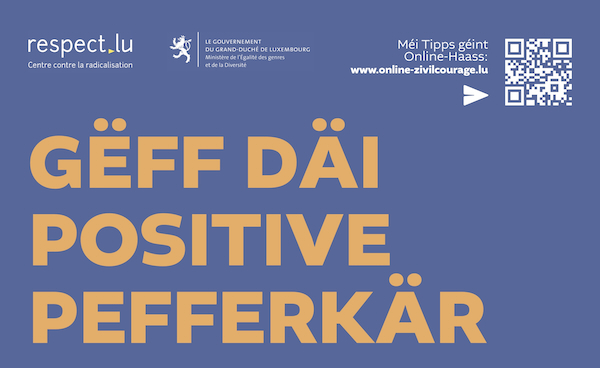
On Monday 23 November 2026, Luxembourg’s Ministry of Gender Equality and Diversity, and respect.lu – Centre Against Radicalisation officially launched the “Gëff däi positive Pefferkär!” campaign as part of the “ZIVIL COURAGE AMNETZ” project, which focuses on combating online hate speech.
According to the ministry, the launch took place at Lycée technique de Lallange (LTL) in Esch-sur-Alzette and included a video address by Yuriko Backes, Minister for Gender Equality and Diversity, followed by a panel discussion on online civic courage featuring representatives from the fields of online safety, media, diversity and civil society.
The event was attended by students, LTL management and interested guests, highlighting the wider societal impact of online hate.
The ministry highlighted that hate speech is a daily reality to which our society is exposed through the regular use of social networks and online media. This is particularly true when certain current affairs topics or events provoke negative reactions targeting specific groups, such as the LGBTIQ+ communities during the submission and debate surrounding Public Petition No. 3198[1]. Following this episode, MEGA and respect.lu pooled their expertise to develop an initiative aimed at strengthening online civic courage and promoting a digital space based on empathy and mutual respect.
The campaign and the project aim to promote “counter-speech”, using positive and factually accurate messages to challenge hate speech on social media. Without diminishing the responsibility of the platforms themselves, the campaign and project seek to mobilise civil society to support people targeted by online hate and encourage bystanders to take action.
The project is based on three main pillars:
1. The “Gëff däi positive Pefferkär” (“Add your positive grain of pepper”) social media campaign.
Launched on 23 November 2026, the campaign aims to raise public awareness of the importance of demonstrating civic courage in public spaces, including the digital environment. It also includes the creation of the website www.online-zivilcourage.lu, which provides practical advice and information on how to take action against online hate, as well as campaign materials.
2. Workshops
Developed by respect.lu, these workshops each address a different topic and are aimed at civil society organisations, municipalities, secondary schools and anyone interested in participating. Topics include counter-speech strategies, reporting options, the Luxembourg legal framework, the analysis of real-life situations, psychological well-being, support services and the moderation of online hate campaigns (so-called “shitstorms”).
3. A multidisciplinary Steering Committee
The committee is responsible for overseeing the project and identifying concrete strategic approaches to combating online hate speech.
Minister Yuriko Backes emphasised that online hate frequently targets individuals, communities and organisations that are already subject to value-based judgements and discrimination, and which are committed to promoting peaceful coexistence in our society through respect and dignity. According to the minister, “it is important to stand together against these trends through counter-narrative strategies based on factual information and promoting respectful and supportive exchanges on social media. Hate speech has no place in our society.”
Karin Weyer of respect.lu added: “In the face of online hate speech, it is essential to equip those who witness it or are targeted by it with the tools and confidence they need to respond. Through the campaign launched as part of the ZIVILCOURAGE AM NETZ project, we want to mobilise and support civil society so that it can actively stand up against online hate. Online civic courage is both an individual and a collective responsibility.”
All information about the campaign and project, including workshop bookings, is available at www.online-zivilcourage.lu.
 Credit: respect.lu