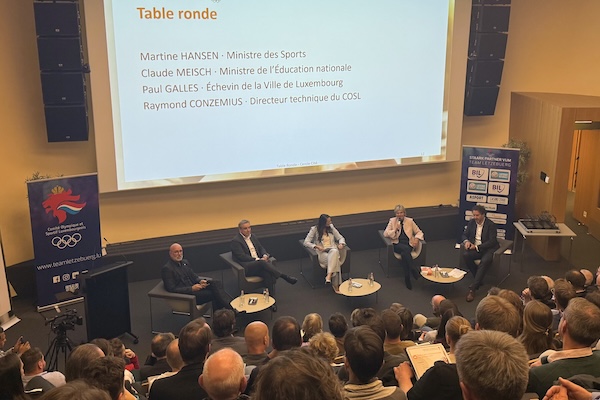
 Credit: Ievgenii Karanov, Chronicle.lu
On Wednesday 25 November 2026, the Luxembourg Olympic and Sports Committee (COSL) hosted an event titled "School and Sport: Building an Active Generation Together" at Cercle Cité in Luxembourg-Ville as part of its Integrated Concept 2.0 for sport in the Grand Duchy of Luxembourg.
The event brought together more than 150 guests, including Grand Duke Henri and Grand Duchess Maria Teresa, Luxembourg’s Minister of Sport, Martine Hansen, and Minister of Education, Children and Youth, Claude Meisch, as well as representatives of Luxembourg’s sporting and educational sectors and representatives of sportscotland.
In his opening remarks, COSL President Michel Knepper outlined the three main objectives of the Integrated Concept 2.0 under the vision "Lëtzebuerg lieft Sport" ("Luxembourg Lives Sport"): strengthening society through physical and sporting activities, ensuring that all members of society are physically active and increasing the number of Luxembourg athletes who are competitive at international level. Highlighting the development of a comprehensive culture of physical and sporting activities within educational and childcare structures as a key action point, he stressed that "school is the only place where all children come together", regardless of their family background or involvement in sports clubs.
Michel Knepper emphasised the importance of cooperation between schools, childcare facilities (maisons relais), school sports associations (LASEP and LASEL), sports clubs and municipalities to promote physical activity beyond school hours. He presented several initiatives, including the IMPULS project, which saw participation in "Meng Gemeng lieft Sport" grow from four pilot municipalities to 36 municipalities, and "De Léiw an Dir", an Olympic values education project involving twelve pilot classes during the 2026/2027 school year. He also described COSL’s role as a neutral partner working alongside ministries, municipalities and sporting organisations to strengthen existing initiatives and develop a common strategy linking education and sport.
Scotland’s Active Schools programme
Michel Knepper then invited Ailsa Wyllie of sportscotland, Scotland’s national agency for sport, to deliver her keynote address titled "Active Schools: building the bridge between education and sport in Scotland". Established in 2004, the Active Schools programme operates across all 32 Scottish local authorities through a network of more than 400 managers and coordinators. The programme receives annual funding of approximately £16 million (€19.1 million), comprising £12 million (€14.3 million) from the Scottish Government through sportscotland and £4 million (€4.8 million) from local partners. It provides free, inclusive sporting and physical activity opportunities before, during and after the school day, primarily through a volunteer-led model.
Presenting figures from the 2025/2026 national report, Ailsa Wyllie noted that 288,964 children and young people, representing 42% of Scotland’s school population, participated in 270,824 activity sessions, recording more than 5.2 million attendances. Of the 20,756 people delivering activities, 92% were volunteers. Referring to the findings of an independent evaluation of the programme, she said: "More than half of Active Schools participants said they would be much less active without Active Schools." She added that young people reported feeling healthier, more confident and happier, while schools reported improvements in pupils’ behaviour, engagement and, in some cases, attendance.
Ailsa Wyllie also addressed the challenges facing the programme, including inequalities in participation, particularly among girls and young women, children with additional support needs and those facing socio-economic barriers. She outlined three priorities for the coming years: engaging children and young people least likely to participate, strengthening pathways into club and community sport and developing young leaders, coaches and volunteers. More than 1,000 schools in Scotland currently have at least one link with a sports club, although approximately two-thirds of these links involve football or rugby, highlighting the need to broaden the range of sporting opportunities available to pupils.
Sport and physical activity initiatives in Luxembourg
The keynote address was followed by a series of short video presentations and comments from project coordinators, showcasing eight initiatives promoting sport and physical activity among children and young people in Luxembourg.
These included WibS-Booster and "MoVe – deng Vakanz, däi Sport", presented under the Ministry of Education, Children and Youth’s Screen-Life-Balance initiative, as well as "Meng Gemeng lieft Sport / SPODI Déifferdeng", "De Coordinateur sportif", "Mamer Kinneksbond", "ClevermovePlus" at Lycée Edward Steichen Clervaux, "Beweegungsfreed Bissen" and the Luxembourg Basketball Federation’s "Hoops for Schools" programme.
Strengthening cooperation between education and sport
The subsequent roundtable discussion, moderated by Fabienne Zwally, brought together Minister Martine Hansen, Minister Claude Meisch, City of Luxembourg Alderman Paul Galles and COSL Technical Director Raymond Conzemius.
Minister Hansen noted that Scotland and Luxembourg shared similar objectives in encouraging people to become physically active and remain active throughout their lives. She acknowledged that Luxembourg already had numerous initiatives in place and stressed the need to improve coordination between existing projects while taking local circumstances into account. She also highlighted the potential of childcare facilities (Maisons Relais) to encourage children to enjoy physical activity from an early age.
Minister Hansen emphasised the importance of combining sporting expertise with pedagogical skills among those working with children. She also addressed the reform of subsidies for sports clubs, efforts to support their professionalisation and the need for appropriate sporting infrastructure. She identified municipal sports coordinators as key stakeholders in bringing together schools, childcare facilities, sports clubs and other local partners to develop a coherent local sports policy.
Minister Meisch stressed that sport must have its place within the school curriculum, highlighting the importance of encouraging children to enjoy physical activity and recognising its benefits for health, personal development and learning. He also pointed to opportunities to expand sporting activities beyond regular school hours, particularly during school holidays, through cooperation between schools, childcare facilities and sports clubs. In this context, he referred to the positive experience of the MoVe programme and the potential to extend its offering.
Minister Meisch also addressed the training and specialisation of teaching staff, including opportunities for teachers to develop additional competencies in physical education. He advocated greater openness within schools to qualified external partners, while emphasising teachers’ responsibility for educational provision. He noted that closer cooperation between the two ministries and stakeholders from different sectors could help develop further opportunities for pupils.
Paul Galles highlighted the ability of sport to bring together children from different socio-economic backgrounds and foster a sense of belonging. Drawing on the experience of the City of Luxembourg, he noted that 27 staff members were involved in the provision of school sport and underlined the importance of ensuring quality across formal, non-formal and informal educational settings.
Raymond Conzemius expressed particular interest in Scotland’s Community Sport Hubs, which bring together different stakeholders at local level, and its youth leadership programmes. He emphasised the importance of placing trust in young people, giving them opportunities to assume responsibility and encouraging their active participation in society through sport.
Closing remarks
Nicole Kuhn-di Centa, Chair of the COSL Promotion Office and member of the COSL Board, reiterated the shared vision of "Lëtzebuerg lieft Sport" and referred to the initiatives developed under the Integrated Concept 2.0. She emphasised COSL’s role as a politically neutral partner facilitating cooperation between sports federations, clubs, municipalities and ministries.
Claude Scheuer, Chair of the COSL Sport and Education Commission, concluded the evening by highlighting the importance of bringing together stakeholders from formal, non-formal and informal education. Referring to the eight initiatives presented during the evening, he stressed the value of continuing this cooperation and building on existing practical experiences.