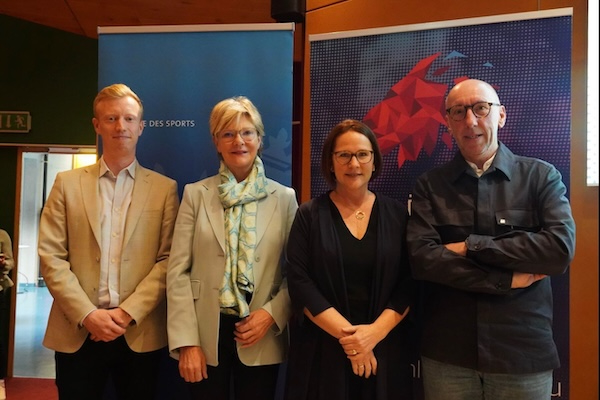
 (L-R) Loïc Hoscheit, Director of ALAD; Martine Hansen, Luxembourg Minister of Sports; Yuriko Backes, Luxembourg Minister for Gender Equality and Diversity; Michel Knepper, President of COSL;
Credit: COSL
(L-R) Loïc Hoscheit, Director of ALAD; Martine Hansen, Luxembourg Minister of Sports; Yuriko Backes, Luxembourg Minister for Gender Equality and Diversity; Michel Knepper, President of COSL;
Credit: COSL
On Thursday 19 March 2026, Luxembourg’s Minister for Sport, Martine Hansen, Minister for Gender Equality and Diversity, Yuriko Backes, the President of the Luxembourg Olympic and Sporting Committee (COSL), Michel Knepper, and the Director of the Luxembourg Anti-Doping Agency (ALAD), Loïc Hoscheit, presented the national policy on integrity in sport to Luxembourg’s sports federations.
According to the Ministry of Sport and Ministry for Gender Equality and Diversity, this policy is intended to structure and strengthen actions aimed at ensuring fair, safe and credible sport in Luxembourg.
During the presentation the Minister Hansen recalled that sport is far more than simple competition: it reflects society and embodies fundamental values such as respect, loyalty and fair play. The minister remarked that these values lie at the heart of the sporting system and underpin the trust that athletes, clubs, federations and the public place in sport.
The ministries noted that in a context where integrity-related challenges are becoming increasingly significant, Luxembourg is establishing a clear national framework aimed at protecting athletes, strengthening the credibility of sport and consolidating trust in sporting structures.
Four complementary pillars
The national policy on integrity in sport is based on four complementary pillars:
• ethics;
• safeguarding (protection of individuals);
• the fight against doping;
• the fight against the manipulation of competitions.
The ministries detailed that the implementation of this policy is based on a clear allocation of responsibilities. The State and the Luxembourg Olympic and Sporting Committee (COSL) provide political and strategic leadership, in particular through the drafting of the national charter of ethics in sport and the establishment of a National Commission for Ethics in Sport.
The operational implementation of several aspects of integrity will be ensured by the Luxembourg Agency for Integrity in Sport (ALIS), resulting from the evolution of the Luxembourg Anti-Doping Agency (ALAD). ALIS will in particular be responsible for actions relating to safeguarding, the fight against doping and the prevention of competition manipulation.
The national charter of ethics as a reference document
For the “ethics” pillar, the national charter of ethics in sport constitutes the reference document. Its purpose is to provide sports federations, affiliated clubs and any other entity promoting physical and sporting activity with guidance enabling them to organise their activities in compliance with values and human rights, such as self-respect and respect for others, equality, accessibility, inclusion and exemplary conduct.
A future National Commission for Ethics in Sport (CNES) will issue reasoned opinions and recommendations on matters relating to the national charter of ethics in sport, in order to guide decision-making by stakeholders faced with ethical issues.
The CNES will have a multidisciplinary composition, bringing together, in particular, legal experts, specialists from the sporting world, medical professionals, scientists, ethicists and human rights specialists.
Furthermore, the principles set out in the charter of ethics are intended to be progressively translated into practical tools, such as:
• codes of conduct;
• guides to best practice;
• specific recommendations for federations and stakeholders in sport.
The development and governance of these tools are ensured primarily by the Ministry for Sport and the COSL, in cooperation with the relevant ministries depending on the subject matter and are made available to sporting stakeholders for adaptation where necessary to their specific needs.
From the perspective of the Ministry for Gender Equality and Diversity, the establishment of a national integrity policy in sport is necessary in a challenging context for issues relating to gender equality, diversity and inclusion.
The ministries highlighted that movements which call human rights into question are gaining ground at all levels. The integrative and inclusive strength of sport, involving all stakeholders, provides an important counterbalance in promoting an equal society based on the values of respect, equality, non-discrimination and non-violence.
From ALAD to ALIS
The ministries revealed that ALAD will evolve into the Luxembourg Agency for Integrity in Sport (ALIS) and said this historic development equips Luxembourg, for the first time, with a body possessing extended powers in this field. Beyond anti-doping efforts, ALIS now places safeguarding and the fight against competition manipulation at the heart of its work. Its mission is to support stakeholders in the sporting movement in their efforts to promote integrity in sport. To this end, a safeguarding charter has been developed to provide clear guidance on preventing, detecting and addressing all forms of interpersonal violence, abuse or inappropriate behaviour in the context of physical and sporting activities. It also provides for the establishment of an appropriate reporting procedure.
A collective commitment
At the end of the meeting, the ministries recalled that this policy aims to provide sporting stakeholders with a clear framework, make practical tools available, offer training and awareness-raising activities, and build a shared vision for the future of sport.
Sports federations, as well as their affiliated clubs, have also been invited to contribute actively to the implementation of this policy by developing codes tailored to their target audiences, covering either one of the four pillars of integrity or all of them. As key actors on the ground, they play an essential role in promoting safe, respectful and principled sport.
The objective is to progressively foster a genuine culture of integrity across the entire sporting movement, from grassroots to the highest level.