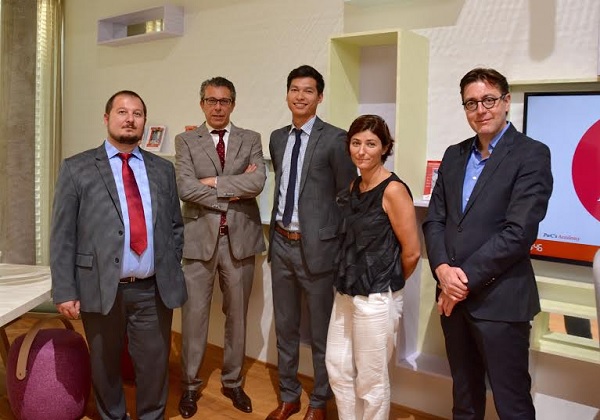
PricewaterhouseCoopers (PwC) Luxembourg today reported that their Sustainability team gathered architects, members of the construction sector, developers and consulting firms for their recent 'Breakfast of Sustainable Development' on 7 July 2015, in order to discuss the environmental certification of residential real estate.
The 'Breakfast of Sustainable Development' meeting saw experts presenting the main results of a survey on sustainable construction in the residential sector and related potential opportunities. Benefitting from a favourable economic climate and an ever growing appeal, the housing market in Luxembourg has achieved significant growth in the past ten years. Buoyed by economic development and population growth, residential real estate will continue to expand by 30% between 2014 and 2020.
"The demand for housing, which is raised, remains higher than supply, and yet is still growing," expleined Laurent Ruach, Partner and Sustainability Leader, PwC Luxembourg. "The market is under pressure, and the excellent quality of housing, due to stringent regulations, does not encourage builders and developers to commit time in an environmental certification of their products. This could change in the future because it is a real opportunity."
The regulatory framework developed in the early 2000s for the energy sector aims to mobilise actors in the real estate sector to improve the energy efficiency of buildings. As PwC reports, some of these actors made the voluntary choice to go further in their energy efficiency plans, quickly making Luxembourg quickly the spearhead of sustainable construction: over 14% of office buildings are now certified to the highest rate in Europe.
Energy consumption, currently included in the regulation, is already one of the many criteria evaluated by environmental labels. Certified building must also meet the stated requirements in terms of water consumption, air quality, brightness, sound-insulation and mobility. Adapting building development according to sustainable certification is therefore an advantageous next step.
"Certified housing will guarantee reduced costs, greater comfort, a faster sale or indeed an increased valuation over time. It is the 'green' value which helps develop certification," added Laurent Ruach.
However, the construction professionals interviewed were still hesitant to engage in the movement, citing the additional cost as compared to a non-certified programme as the main obstacle to certification.
Despite this, Manager at PwC Luxembourg Nicolas Gavoille claimed that: "The habitat in Luxembourg has already reached a very high quality, both in terms of comfortand energy performance. We spoke with Luxembourg construction industry experts to gain a better knowledge of their practices in sustainable construction. Triple glazing or solar protection, ie solar panels, are available in most new housing programmes. The additional cost of certification would be limited."
The complexity of certification implementation was also mentioned as a stumbling block. "The certification can be complex in the beginning, when it comes to setting up new ways of working. But once this is done, the benefits are many. It allows us as both builder and manager to anticipate future environmental regulations," explained Emmanuelle Abeya, Director of Development and Heritage in Moselis, Office Public Housing at the head of a heritage of more than 12,000 homes in Moselle.
Speaking on the potential of future buyers and tenants to initiate change, Laurent Ruach concluded:
"The more sensitive to and better-informed of environmental issues customers becomes, the more they are willing to pay more to get superior quality, which was one of the lessons of our investigation. There are opportunities to be seized here for real estate professionals who could anticipate this underlying trend."
Photo by PwC (L-R: Nicolas Gavoille (PwC Luxembourg) ; Laurent Rouach (PwC Luxembourg) ;Sardar Azimov (Cerway) ; Emmanuelle Abeya (Moselis) ; François Thiry (Polaris Architects - CNCD))