 Credit: MENEJ
Luxembourg's Ministry of Education, Children and Youth has announced that the school dropout rate remained stable (and even decreased slightly) during the 2019/20 academic year despite the COVID-19 pandemic.
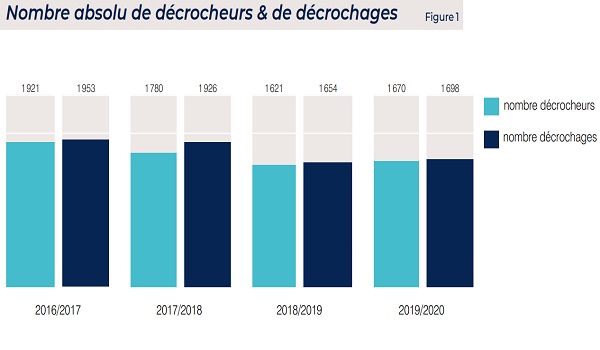
In its new report on school dropout in Luxembourg, the Education Ministry confirmed that the dropout rate had fallen from 9.29% (i.e. 1,921 students) in 2016/17 to 8.16% (i.e. 1,670 students) in 2019/20.
Despite the pandemic and its consequences on the school system, the dropout rate remained stable in 2019/20 compared to previous years. The trend will be confirmed in the analysis of the 2020/21 data, which will make it possible to assess the impact of the support measures implemented since autumn 2020.
The Education Ministry pointed out that the dropout rate is below the 10% threshold set as a target by the European Union (EU) as part of its “Europe 2020” strategy.
The local branches of the National Youth Service (Service national de la jeunesse - SNJ) managed to contact and offer support to 1,323 young people who dropped out of school in 2019/20.
According to the report, certain groups of students are at greater risk of dropping out. These include:
- students having been held back at least two years (as was the case for 90% of students who dropped out);
- male students, who represent around 60% of dropouts each year;
- students in the third and fourth years of secondary education, who represented over 46% of dropouts in 2019/20;
- students attending a vocational aptitude diploma (Diplôme d'aptitude professionnelle - DAP) class, which still represent the largest proportion of dropouts, depending on the level of education; nevertheless, a decrease was observed between 2016/17 (almost 29%) and 2019/20 (almost 22%);
- students in the lower grades of general education, who represented nearly 17% of dropouts in 2016/17 and 20% in 2019/20.
The reasons most often cited by students who drop out of school were as follows, in descending order:
- not having an apprenticeship contract (for vocational training students);
- a lack of interest in the training path followed;
- health problems.
However, knowledge of the reasons for dropping out remains incomplete: less than a third of the students answered this question asked by the SNJ agent who contacted them. For 2021/22, in-depth exit interviews with students who drop out of school are planned in order to be able to more systematically understand the reason for their decision.
To remedy the difficulty of finding a training company, made even more acute by the health crisis, the Education Ministry authorised the National Centre for Continuous Vocational Training (Centre national de formation professionnelle continue - CNFPC) and secondary schools to provide the practical part of vocational training in 2020/21. From the start of the school year, the CNFPC has been providing reinforced support to young people looking for such a company. A bonus was also granted to companies offering apprenticeship positions.
The 2020/21 school dropout report will be published at the end of this year.