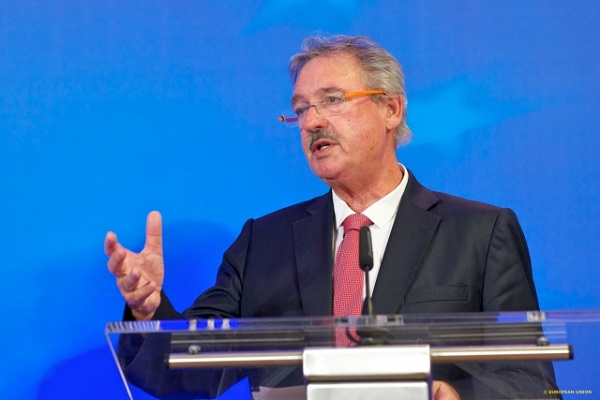
On Monday 14 September 2015, Luxembourg Minister for Foreign and European Affairs, Minister for Immigration and Asylum, Jean Asselborn was in Brussels to preside over the extraordinary meeting of the 'Justice and Home Affairs' Council under the Luxembourg Presidency of the Council of the EU.
The refugee crisis was at the heart of discussions, with the EU and UN agencies present suchas Frontex, the European Asylum Support Office (EASO), Europol, IOM and UNHCR detailing to the ministers the latest developments at EU borders and the situtaion on the ground.
The ministers evaluated the progress made by measures, such as the EUNAVFOR MED mission, aimed at saving lives at sea and improving the management of migration flows, before discussing future programming in the presence of the European Commission which presented the new proposals on migration.
Following the favourable opinion of the European Parliament, the JHA Council formally adopted a decision establishing a temporary relocation mechanism for refugees who have already arrived in the EU, moving 40,000 refugees in dire need of international protection from Italy and Greece to other Member States.
"Concretely, this means that the first relocations to Member States will begin in the coming days and that 'hotspots' will start operating as quickly as possible in Italy and Greece," explained Minister Asselborn.
The meeting also led to a large majority of Member States agreeing on the further relocation of 120,000 people in need of international protection from Member States exposed to mass migration.
Minister Asselborn continued: "The Commission proposal will provide a basis to work on an agreement; our Presidency will give high priority to this task and we are aiming for an adoption at the JHA Council of 8 October".
The Council also moved towards the decision to increase the EU's support of the UNHCR, in order to allow it effectively and humanely manage its refugee camps, especially in Syria's neighbouring countries.
The meeting highlighted the importance of a return policy, as previously emphasised by Minister Asselborn, and readmission whilst focusing on effective external border controls in order to help manage migration flows. In this regard, the decision was taken to deploy Rapid Border Intervention teams (RABIT) in the field.
The Council committed itself to supporting Greece's efforts to strengthen its asylum system, its reception facilities and the management of external borders; to bolster EU cooperation with Turkey; and to actively support the West Balkans countries, which currently represent the main transit route.
Migratin issues will be discussed further at the JHA Council of 8 October and the European Council on 15 and 16 October 2015. In addition, a special summit will be held in the presence of African states in Valletta in 11 and 12 November 2015.
Photo by European Council (Jean Asselborn)