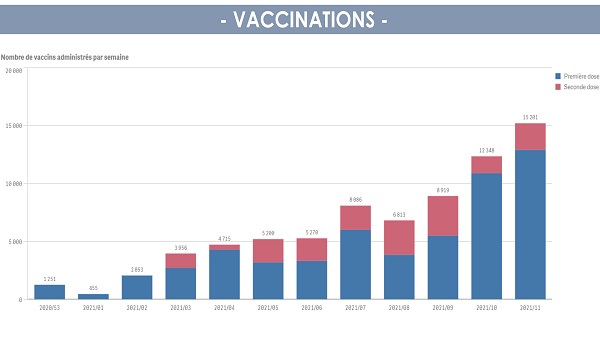
 Blue: first vaccine dose; pink: second dose;
Credit: MSAN
Blue: first vaccine dose; pink: second dose;
Credit: MSAN
In its latest COVID-19 report, Luxembourg's Ministry of Health confirmed that the number of COVID-19 cases had gone up 25% last week compared to the week before.
For the week of 15 to 21 March 2021, the number of residents testing positive for COVID-19 increased from 1,240 to 1,564 people (up 25%) over one week. The number of identified contacts increased from 3,669 to 3,846 (up 4.8%). The number of PCR tests carried out over one week also increased from 62,517 to 63,501. Of 97 individuals with a positive rapid antigen test, 41 also had a positive PCR test.
As of Sunday 21 March 2021, the number of active infections stood at 3,069 (compared to 2,796 as of 14 March) and the number of people having recovered from the virus increased from 54,438 to 55,709. The number of weekly deaths remained stable at 28, with the average age of those who died standing at 81.
There was a slight increase in hospital admissions, with 99 COVID-19 patients being treated in normal care and 21 in intensive care, compared to 95 and 27 respectively the previous week.
The two COVID-19 consultation centres (CCC), located in Luxembourg-Kirchberg and Esch-sur-Alzette, have recorded a total of 10,261 visits to date, including 722 visits last week (compared to 583 the previous week). From Friday 26 March 2021, the CCCs will be open between 09:00 and 15:00, including on Easter Monday; they will be closed on Easter Sunday.
For the reference period, the effective reproduction rate (RT eff) increased slightly to 1.13 (compared to 1.05 the previous week), as did the positivity rate on all tests carried out (2.46% compared to 1.98% the week before; average over the week).The positivity rate on tests performed through a doctor's prescription (people with symptoms) increased from 5.11% to 5.89%.
The incidence rate was 250 cases per 100,000 inhabitants (up from 198) over seven days. Compared to the previous week, the incidence rate increased across all age groups. The 75+ age group recorded the largest increase (up 46%) over one week, followed by the 30-44 age group (up 32%). The 60-74 age group continued to have the lowest incidence rate with 149 cases per 100,000 inhabitants. In all other age groups, the incidence rate ranged between 254 and 285 cases per 100,000. The average age of people diagnosed with COVID-19 increased slightly to 37.4.
For the week of 15 to 21 March, 2,745 people were in isolation (down up 5.8%) and 4,699 were in quarantine (up 26%).
The family circle remained the most frequent context of transmission of COVID-19 infections (43.1%), followed by the workplace (7.8%), the education environment (6.5%), the healthcare sector (4.0%) and the leisure environment (3.4%). The source of infection was not clearly attributable in 30.2% of cases.
Vaccinations
For the week of 15 to 21 March, a total of 15,201 vaccine doses were administered in Luxembourg: 12,902 people received their first dose whilst 2,299 people received their second dose. At present, the Luxembourg authorities expect to have enough doses to vaccinate a total of 123,829 people by the end of April 2021. Allowances are likely to be adjusted from week to week according to the production capacities of manufacturers and deliveries.
From Monday 29 March 2021, the opening hours of the vaccination centres will be extended: Monday to Saturday, from 07:00 to 19:00.
COVID-19 Variants
For the week of 8 to 14 March 2021, population sequencing coverage was 20.8%, thus significantly higher than the obtimal rate of 10% recommended by the European Centre for Disease Prevention and Control (ECDC) to have a representative sample.
The British variant (B.1.1.7) represented 63.5% of cases among the 260 samples carried out by the National Health Laboratory (Laboratoire National de Santé - LNS) during this period. The South African variant (B.1.351) represented 20.4% of cases.
Wastewater Monitoring
The latest CORONASTEP report drawn up by the Luxembourg Institute of Science and Technology (LIST) indicated a continued high prevalence of the virus in wastewater nationwide. However, the situation appears to have stabilised over the past two weeks. Analyses in the coming weeks should confirm this trend.