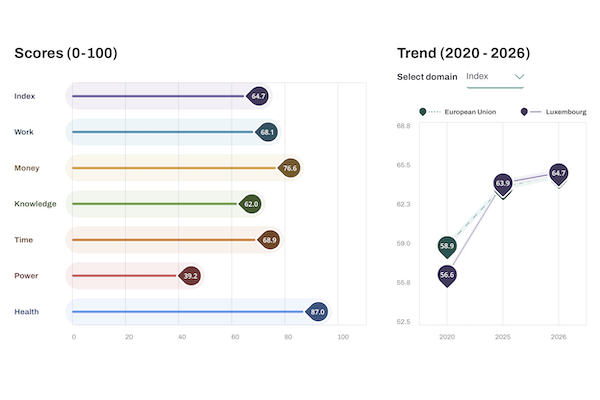
 The Gender Equality Index gives the EU and the Member States a score from 0 to 100. A score of 100 would mean that a country had reached full equality between women and men;
Credit: European Institure for Gender Equality
On Tuesday 17 November 2026, Luxembourg’s Ministry of Gender Equality and Diversity reported that in the 2026 edition of the Gender Equality Index, published by the European Institute for Gender Equality (EIGE), Luxembourg scored 64.7 out of 100.
According to the ministry, the country has recorded an improvement of 8.1 points since 2020, including a 0.8-point increase over the past year.
It said this positive development is primarily driven by progress in the areas of money and power. The money domain recorded the largest improvement over the year (+2.2 points), while the power domain also saw significant progress (+1.9 points), particularly as a result of better representation of women in social decision-making bodies (+4.0 points).
Luxembourg also continued to perform well in several other areas. Its strongest performance is in the domain of knowledge, where it ranks fourth in Europe with a score of 62.0 points. The country also ranks second in the European Union in the sub-domain relating to educational attainment and participation in education.
Luxembourg stands out particularly for its first-place European ranking in social activities (85.3 points), reflecting high levels of leisure time among both women and men, as well as the absence of a gender gap in participation in voluntary activities.
Despite this progress, several significant challenges remain. The domain of work represents Luxembourg's greatest opportunity for improvement. With a score of 68.1 points, the country ranks only 22nd in Europe, primarily due to persistent occupational segregation and disparities in job quality.
The domain of power, meanwhile, remains the lowest-scoring area, at 39.2 points, despite the progress achieved. Considerable room for improvement remains, particularly in the economic sphere: women hold only 24% of board seats in the largest listed companies, a proportion that remains among the lowest in the European Union.
From an economic perspective, although Luxembourg has the highest median annual earnings in the European Union for both women and men, the gender pay gap in median annual earnings remains among the largest in Europe. The gender pension gap also remains high, although it narrowed from 33% to 31% over the past year.
Despite the overall progress recorded by Luxembourg, the Grand Duchy has dropped one place compared with the previous year in the EIGE's overall ranking, placing tenth while remaining above the European average.
Commenting on the publication of the 2026 edition of the Gender Equality Index, Luxembourg’s Minister for Gender Equality and Diversity Yuriko Backes welcomed Luxembourg's progress: "Luxembourg is confirming its progress in gender equality and remains above the European average. These results are encouraging and show that the efforts undertaken are bearing fruit. However, persistent inequalities in the labour market, income and pension gaps, as well as the under-representation of women in economic decision-making bodies, remind us that equality can never be taken for granted. We must continue our efforts to guarantee women and men the same opportunities at every level of our society."
Further information can be found at https://eige.europa.eu/gender-equality-index/2026/country/LU.