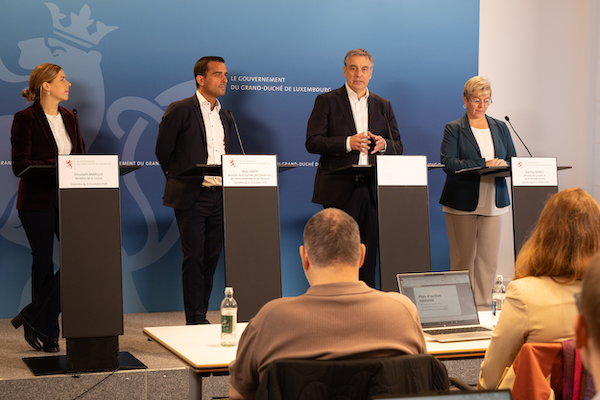
 (L-R) Elisabeth Margue, Minister of Justice; Max Hahn, Minister for Family Affairs, Solidarity, Living; Claude Meisch, Minister of Education, Children & Youth, Minister of Housing & Spatial Planning; Martine Deprez, Minister of Health & Social Security;
Credit: SIP/ Claude Piscitelli
(L-R) Elisabeth Margue, Minister of Justice; Max Hahn, Minister for Family Affairs, Solidarity, Living; Claude Meisch, Minister of Education, Children & Youth, Minister of Housing & Spatial Planning; Martine Deprez, Minister of Health & Social Security;
Credit: SIP/ Claude Piscitelli
On Monday 12 October 2026, Max Hahn, Luxembourg’s Minister of Family Affairs, Solidarity, Living Together and Reception; Elisabeth Margue, Luxembourg’s Minister of Justice; Claude Meisch, Luxembourg’s Minister of Education, Children and Youth and Minister of Housing and Spatial Planning; and Martine Deprez, Luxembourg’s Minister of Health and Social Security, presented the third National Action Plan for the implementation of the Convention on the Rights of Persons with Disabilities (PAN CRPD).
According to the respective ministries, with 50 objectives and 119 concrete actions, this new plan continues Luxembourg’s commitment to an inclusive society based on human rights, equality, non-discrimination, autonomy and the full participation of persons with disabilities.
The new National Action Plan is not solely a plan of the Ministry of Family Affairs, Solidarity, Living Together and Reception. It is an action plan for the entire government, involving all 20 ministries.
“The fact that all 20 ministries are represented in this plan underlines that inclusion is a cross-cutting and essential issue that concerns every aspect of life. Implementing the rights of persons with disabilities is a shared responsibility across the entire government,” emphasised Minister Hahn.
Continuing implementation of the United Nations Convention
Luxembourg ratified the United Nations Convention on the Rights of Persons with Disabilities in 2011. The new National Action Plan builds on the 2012–2017 and 2019–2024 action plans, while taking into account lessons learned from the evaluation of the previous plan, as well as the observations and recommendations of the United Nations Committee on the Rights of Persons with Disabilities.
According to the 2021 census, 14.6% of the population residing in Luxembourg, or more than 94,000 people, reported living with a disability.
Despite progress made in recent years, particularly in legislation, accessibility, governance and awareness-raising, physical, digital, communication-related, institutional and societal barriers persist.
“Nothing about us without us”
The ministries emphasised the participation of people directly affected was central to the development of the new National Action Plan, in accordance with the principle of “Nothing about us without us”.
Two major participatory workshops were held in October 2025, each bringing together more than 150 participants representing people with disabilities, civil society and the professional sector. Info-Handicap, the Higher Council for Persons with Disabilities and the GroSuivi PAN were also involved in the process.
However, this participation does not end with the development of the plan. It will continue throughout its implementation.
GroSuivi PAN: a key role in monitoring and oversight
The ministries highlighted that particular attention is being paid to governance and the monitoring of the implementation of the various actions.
In this respect, the PAN Monitoring Group (GroSuivi) plays a key role as an independent, participatory body responsible for monitoring and oversight. It brings together people directly affected, associations and the three independent human rights mechanisms: the Centre for Equal Treatment (CET), the Consultative Commission on Human Rights (CCDH) and the Ombudsman.
GroSuivi therefore provides an external perspective on the progress of the National Action Plan, brings forward the experiences and needs of people with disabilities, and supports its implementation through critical and constructive engagement.
This structure complements the work of the Interministerial Committee, which includes representatives from all 20 ministries and ensures operational coordination between the various ministerial departments.
The Ministry of Family Affairs, Solidarity, Living Together and Reception is responsible for overall coordination. An assessment of implementation will be carried out annually, and an external evaluation is planned after five years.
50 objectives and 119 concrete actions
The new National Action Plan includes a chapter on governance and seven thematic areas:
⁃ Equality and non-discrimination
⁃ Accessibility and participation in society
⁃ Autonomy and self-determination
⁃ Education, childhood and youth
⁃ Health, social security, rehabilitation and care
⁃ Work and employment
⁃ International cooperation
According to the ministries, the planned actions include the establishment of a one-stop shop for persons with disabilities, the development of personal assistance and individual budgets, and reform of legislation governing legal guardianship.
In education, the plan aims, among other things, to strengthen cooperation between formal and non-formal education, develop educational provision for pupils with behavioural disorders, reform decision-making bodies, and provide better support for newly arrived pupils with specific educational needs and their families.
In healthcare, the measures aim to ensure that everyone has equitable access to quality care tailored to their needs. The proposed measures seek to improve information and communication throughout care pathways, ensure that all professionals receive appropriate training, and ultimately promote and implement better access to prevention and screening. Particular emphasis is placed on strengthening care pathways for people with neurodevelopmental disorders.
In the field of work and employment, the plan provides, among other things, for reform of the status of employees with disabilities and inclusion assistants. It also aims to improve access to employment and training for persons with disabilities through reasonable adjustments during recruitment, training and examinations in the civil service.
International cooperation is a separate thematic area in its own right. The plan includes measures to better take into account the rights and needs of persons with disabilities in development cooperation and humanitarian aid.
A living and evolving plan
The ministries noted that, unlike its predecessors, the new National Action Plan is designed as a multi-year plan that can evolve over time. It can be adapted throughout its implementation to take account of emerging needs, feedback from partners and progress on the various actions.
This approach is intended to make the National Action Plan a living document whose implementation can evolve in response to realities on the ground.
The objective is to continue removing barriers and enable everyone, with or without a disability, to participate fully and on an equal footing in all areas of society.
With this third National Action Plan, the government is continuing the practical implementation of the United Nations Convention on the Rights of Persons with Disabilities.
The full Action Plan is available at: www.planhandicap.public.lu .