 Advocacy Coalition panel 1;
Credit: Chronicle.lu
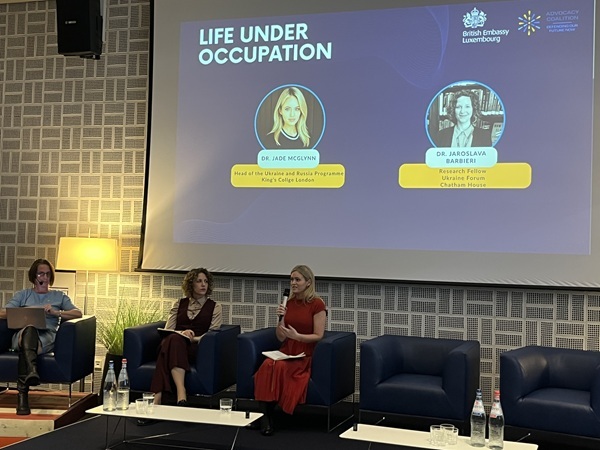
Advocacy Coalition panel 1;
Credit: Chronicle.lu
On Monday 12 October 2026, the British Embassy in Luxembourg organised an event as part of the Advocacy Coalition – Defending our Future Now initiative, held at the Bibliothèque nationale du Luxembourg (BnL) in Luxembourg-Kirchberg.
Under the tagline, “Ukraine: Two Realities, One Struggle”, the event attracted 165 people to the 3rd floor conference room where a strong panel of speakers had been lined up for an expert discussion examining the challenges of Russian aggression in the Temporarily Occupied Territories and in government-controlled Ukraine.
In the lead up to the event, split into two separate panels, the following information was shared with attendees: "Russia's war against Ukraine has created starkly different realities for Ukrainians living under occupation and those in areas under Ukrainian government control. Yet across the country, people continue to demonstrate extraordinary courage, resilience and determination. Bringing together leading experts from academia, government and civil society, the event will offer insights into the realities facing Ukrainians today and the implications for Ukraine's future.
Ambassador Joanne Olivier introduced the Advocacy Coalition project which was launched in February this year, with different embassies in Luxembourg organising monthly events, to share information on what is happening in the conflict. She said that sovereign nations have a right to protect their future, and for countries in Europe these principles matter profoundly. She that the question is how we build the future to prevent renewed aggression, mentioned upholding international law. She added that think-thanks of academic and other experts have a crucial role to play. She referenced the EU Foreign Affairs Council taking place in Luxembourg today, as well as Ukraine's Foreign Minister visiting the Grand Duchy today.
The panels featured distinguished speakers with extensive experience researching and working on Ukraine, offering first-hand insights into the challenges facing Ukrainians today and the country's future recovery.
Rebecca Loughna, MC for the afternoon event, addressed the attendees and explained that Ukraine is in a fight for its identity as a sovereign state; it is not simply about Russia occupying Ukrainian territory. Russia has shifted its focus away from the front line, with a significant increase in airborne attacks which has also increased the number of civilians killed and injured.
Panel 1: Life Under Occupation: Examining the experience of Ukrainians living in the Temporarily Occupied Territories, including the impact of occupation policies, identity, information control, and resistance.
Dr Jaroslava Barbieri: Research Fellow at the Ukraine Forum within Chatham House's Russia and Eurasia Programme, specialising in Ukrainian politics and society, Russian foreign policy, European security and cognitive warfare. She is a leading analyst of Russia's war against Ukraine and frequently contributes expert commentary to international media, including the BBC, CNN, Bloomberg and Deutsche Welle.
She talked about three main arguments: studying what Russia is actually doing on the ground, including destabilising Ukrainian state institutions and social cohesion, to destroying Ukrainian statehood altogether (post-2022); Russia's methods of occupations which she described as colonial in nature, including preparing Ukrainian children from occupied territories to fight in its war against Ukraine, as well as social engineering and seizure of property, grain, etc., and ecocide and resource exploitation including destruction of Ukrainian national identity and cultural heritage; the fate of the occupied territories has a global ripple and effect, including the cross-generational security threat that Russia poses, such as weaponising global food supplies.
Dr Jade McGlynn: Head of the Ukraine and Russia Programme at King's College London. A leading expert on Russian occupation policies, propaganda and information warfare, her research focuses on life in occupied Ukrainian territories and the societal dynamics of Russia's war against Ukraine.
She talked about presenting statistics and explained how she would use different characters to explain the architecture of what Russia is doing. She talked about the local militia becoming the only employer in occupied territories, and being a feeder from schools there, with young Ukrainians taught to fight against their own people. She talked about Russia becoming more cruel in their indoctrinisation practices. She explained that there is little infrastructure left in occupied territories, with hundreds of apartments given to Russians. The population of Mariupol had reduced from 450,000 to around 100,000 since the invasion; any Ukrainian who stays there, or comes back, is forced to get a Russian passport. Those who stay normally have no money to leave and nowhere to go.
Rev Geoff Read, Chaplain at the Anglican Church in Luxembourg asked about the state of religion, specifically Christians in the occupied territories. Dr Jade McGlynn explained that Russia used Russian Orthodox Churches (when annexing Crimea from 2014) to store arms, etc.; and on the issue of Church leadership, she explained that they "have all fled, at best". She added that around 3.6 million people are currently living in the occupied territories, although that figure is not certain.
Panel 2: Resilience in Free Ukraine: Exploring how communities, local authorities and civil society organisations across government-controlled Ukraine continue to adapt, deliver services and build resilience in the face of ongoing war.
Orysia Lutsevych: Head of the Ukraine Forum and Deputy Director of the Russia and Eurasia Programme at Chatham House, where she is a leading expert on Ukraine, democratic resilience and civil society in Eastern Europe. She is a widely cited commentator on the war in Ukraine and has advised governments and international organisations on democratic transition, governance and societal resilience.
She read a short poem that was written during the full-scale invasion, and talked about people living through it have so much resilience. She also talked about people in the White House trying to get Ukraine to capitulate to the Russian invasion. But this enormous sense of resilience is based on years and decades of pressure from Moscow, going back 400 years. Tis mindset will not change anytime soon. She talked about Ukraine reforming between 2013-22 during which time it was evolving, including adopting smartphone (digital) services. She also talked about European solidarity networks being so important for Ukraine, including twinning of cities. She concluded that we should look at Russia's assets, because "Russia must pay for it". She also said that Ukraine should be encouraged to join the European Union.
Dr Maryna Rabinovych: Assistant Professor at the Kyiv School of Economics and post-doctoral researcher at the UiT the Arctic University of Norway specialising in EU-Ukraine relations, decentralisation and local governance. She recently co-authored the ZOiS Report "Resilience Reconsidered: Lessons from Ukraine's Response to War", examining how Ukrainian communities and institutions have adapted to the challenges of wartime.
She talked about rethinking resilience in wartime Ukraine, asking how Ukraine has managed to survive the compound shock of Russia's full-scale invasion. The talked about three studies they undertook which looked at local governance, local government budget robustness and decentralisation under martial law. While she found it is very difficult to remain resilient after five years, she stated "What has proved particularly resilient is resilience as a narrative". She presented briefly three axes of (non-)resilience, mentioning Territorial (some places absorb and adapt to shocks much netter than others), Sectoral and Group-based (both where resilience is uneven).
Anna Novosad: Ukrainian education leader and former Minister of Education and Science of Ukraine. She is co-founder of the SavED charitable foundation, which works to restore access to education in communities affected by Russia's war.
She talked about restoring life in war-effected communities and stated that vivilians are human beings caught up in war. She presented some statistics, including more than one million students cannot attend school fully or at all in person; $14 billion is needed to restore Ukraine's educational infrastructure - over 3,700 educational institutions have been damaged by the war, and more than 390 have been destroyed, of which 222 are schools. She said that basically there is now a generation of Ukrainian school children who have never been in a school. There are now 755,000 fewer school children, with 30% of schools now either online or blended; 80% of schools have shelters and over 1 million textbooks have been destroyed. She also addressed the issue of social capital in schools, explaining that schools are important for social cohesion in the community.
Mark Neville: British photographer, humanitarian and co-founder of Postcode Ukraine. Based in Kyiv, he documents the experiences of Ukrainians living through the war and combines documentary storytelling with direct humanitarian assistance to communities affected by the conflict.
He showed a slideshow of photographs he took in Ukraine, from 2016 after being invited there to talk about his book on military trauma. He started photographing people and moved to Ukraine with the aim of publishing a book of his photographs, attempting to send it to world leaders. His book was published two weeks before the full-scale invasion in 2022, when he fled to Poland before deciding to move back to help the people of Ukraine. He helped found Postcode Ukraine (https://postcodeukraine.com) and loads up a car to deliver supplies to front-line towns, as well as giving out grants.
Rebecca Loughna summed up the event by talking about connections as it is important for the people of Ukraine to know that there are people outside the country that show solidarity. She also talked about Europe being abandoned by the United States, meaning that Europe needs to step up and support Ukraine.
Charlie Eliot, President of the Royal Air Forces Veterans and Friends Luxembourg Committee, asked what can we do about President Trump's decision to purchase Russia's diesel that will help fund Russia's war against Ukraine. Dr Maryna Rabinovych stated that it is likely that there is a personal connection, where the members of the president's family can benefit (financially); she also said that it is more important than ever the used European satellite technology to develop a pan-European defence system, so not to rely on other countries. She added that it is necessary to speak up about what the Russian regime really is as it is not only about Ukraine any longer. Anna Novosad said that while President Zelensky is massively unpopular within Ukraine at present, everyone has to support him and his aims of gaining international support. Dr Maryna Rabinovych said that many narratives are intertwined, and called for the destruction of more Russian data centres.
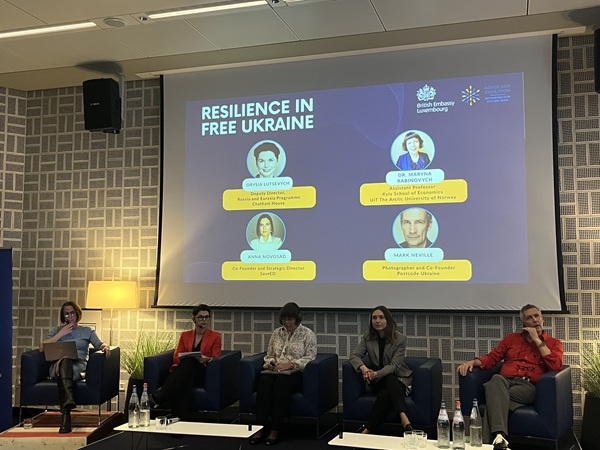
Advocacy Coalition panel 2, credit: Chronicle.lu