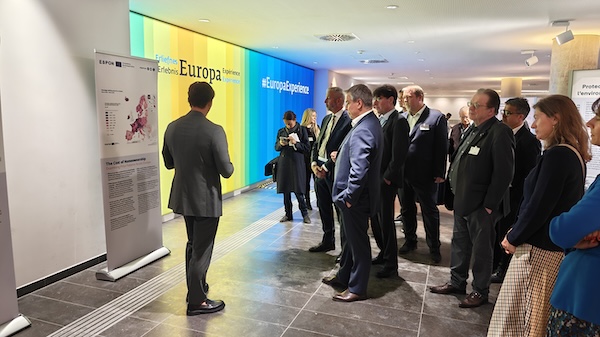
 (Centre) Claude Meisch, Luxembourg's Minister for Housing and Spatial Planning;
Credit: MLOGAT
(Centre) Claude Meisch, Luxembourg's Minister for Housing and Spatial Planning;
Credit: MLOGAT
On Monday 21 September 2026, Luxembourg's Ministry of Housing and Spatial Planning reported on the inauguration of the "Interreg. Together Beyond Borders – Exploring Success Stories of Interreg in Luxembourg" exhibition at Europa Experience in Luxembourg-Kirchberg.
The official opening, reportedly, brought together institutional representatives, European partners and local stakeholders, while speakers included: Claude Meisch, Luxembourg's Minister for Housing and Spatial Planning; Christoph Schroeder, Head of the European Parliament Liaison Office in Luxembourg; and Dennis Wernerus, Acting Representative of the European Commission in Luxembourg.
Organised by the ministry in cooperation with the European Parliament and European Commission as part of Interreg Cooperation Day 2026, the immersive exhibition is open from Monday 14 September to Monday 5 October 2026. It highlights 36 years of European territorial cooperation and fifteen years of Interreg Cooperation Day.
Launched in 1990, Interreg is a European programme aimed at strengthening territorial cooperation between regions across the European Union (EU). The programme has a budget of €10 billion for the 2021-2027 period and has supported projects in areas ranging from sustainable mobility and climate resilience to digital innovation.
The exhibition presents examples of Interreg projects through a number of interactive stations, including a trilingual quiz and an ESPON dashboard.
Minister Meisch, commented: "Europe is not just about treaties or institutions. It is also about concrete cross-border projects that simplify citizens' daily lives."
According to the ministry, more than 500 Interreg projects involving 2,400 European partners have been carried out in Luxembourg since 1990, representing a total investment of €1.4 billion in the Grand Duchy.
The exhibition also aimed at highlighting the role of Europa Experience in bringing the EU closer to citizens and presents cross-border cooperation as a means of sharing resources, coordinating activities and developing common solutions to challenges extending beyond national borders.