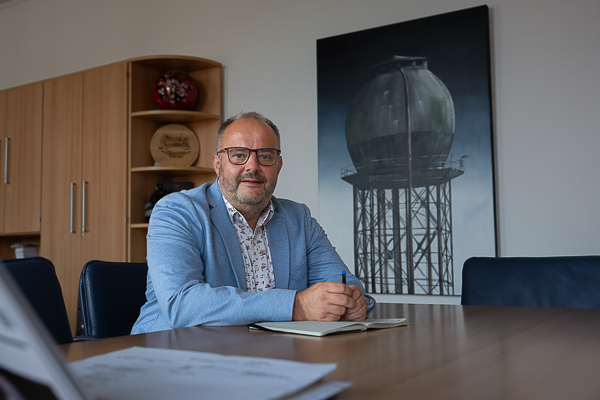
 Carlo Feiereisen, Mayor of Schifflange;
Credit: Ali Sahib, Chronicle.lu
Carlo Feiereisen, Mayor of Schifflange;
Credit: Ali Sahib, Chronicle.lu
The Grand Duchy of Luxembourg consists of twelve cantons made up of 100 municipalities. Each municipal council is elected directly by its residents in municipal elections held every six years. The municipality’s mayor is then appointed from among the elected members of the municipal council.
In this series, Chronicle.lu spoke to a selection of the country’s mayors to discuss the challenges within their municipality, their daily activities, how projects are prioritised and how they communicate with residents.
The fifth in this series features Mayor Carlo Feiereisen who represents the municipality of Schifflange.
Chronicle.lu: What is the size of your municipality, in population and number of nationalities?
Carlo Feiereisen: Schifflange counts around 11,700 inhabitants in 2026 and is home to around 109 nationalities, reflecting one of the most diverse demographic profiles in Luxembourg.
Luxembourgish nationals form the largest group with about 60% of the population. The second‑largest community is Portuguese (around 16–17%). Significant communities also include French, Italian, Cape Verdean, Montenegrin, Chinese and Indian residents. This demographic richness contributes to a vibrant cultural landscape and a highly active network of local associations.
Chronicle.lu: What are the main challenges currently facing the municipality (housing, mobility, infrastructure, environment, demographic growth, etc.) and how is the administration working to address them?
Carlo Feiereisen: Schifflange faces challenges typical of fast‑growing municipalities:
Housing and demographic pressure
The population has grown by more than 40% over two decades, creating pressure on housing availability and affordability. The municipality is developing new neighbourhoods (e.g., Metzeschmelz, Op de gielen Géieren) and expanding social and affordable housing.
Mobility and traffic congestion
Dense traffic at peak hours is a major concern. The municipality has invested in new parking infrastructure, including a 175‑space underground car park in the town centre.
Infrastructure capacity (schools, childcare, leisure)
Rapid demographic growth has created pressure on educational and childcare facilities. A long‑term masterplan for school and childcare infrastructure has been implemented since 2018, including expansion of the Maison relais and modernisation of schools.
Environmental protection and limited geographic space
Schifflange is small in area and densely populated, requiring careful land‑use planning. The municipality protects natural zones such as Am Brill and invests in sustainable development and modernisation of public infrastructure.
Chronicle.lu: Please describe the daily activities undertaken by you, as mayor of the Municipality of Schifflange and how you work in conjunction with the other members of your administration.
Carlo Feiereisen: As mayor, I oversee strategic planning, urban development, budgetary decisions and coordination of municipal services.
Daily work includes meetings with department heads, site visits to ongoing projects, consultations with citizens, and coordination with regional and national authorities.
I work closely with the College of the Mayor and Aldermen, which collectively manages portfolios such as education, social affairs, mobility, environment, culture and sports.
Decision‑making is collaborative: projects are prepared by technical services, reviewed by political bodies and validated by the municipal council.
I also have the honour of officiating civil weddings and partnerships, a role that allows me to accompany residents at one of the most meaningful moments of their lives. I am likewise responsible for officiating funeral ceremonies, which is a much less joyful part of the role, yet an important duty that allows me to support families during difficult times.
Chronicle.lu: Please describe the challenges of being mayor of Schifflange and what makes your municipality unique in Luxembourg.
Carlo Feiereisen: Being mayor of Schifflange means managing the realities of a municipality with one of the highest population densities in Luxembourg, where limited land availability requires careful and forward‑looking planning. The town’s strong demographic diversity also calls for inclusive policies and sustained intercultural dialogue to ensure that all residents feel represented and supported.
Another key challenge is balancing rapid urban development with the protection of natural areas, particularly the forests and environmentally sensitive zones that surround the commune. This requires constant coordination between development needs, environmental commitments and long‑term sustainability.
Schifflange stands out for its rich 150‑year history combined with a dynamic pace of modernisation that continues to shape the municipality today. The official celebrations for this anniversary began on Monday 6 July 2026, marking the start of a full year dedicated to honouring the commune’s heritage, identity and community spirit. 109 nationalities live together within its borders, supported by around 80 cultural and sports associations that foster integration, community life and social cohesion.
The commune is also characterised by a strong natural environment surrounding a dense urban core, offering both the vibrancy of a growing town and the proximity of protected green spaces that contribute to residents’ quality of life.
Chronicle.lu: As mayor, how do you select and prioritise which projects the municipality will undertake?
Carlo Feiereisen: Prioritisation is based on citizen consultation, including a major initiative launched at the start of the mandate to assess needs in sports, cultural, school and leisure infrastructure.
Decisions rely on population growth projections, technical assessments and budgetary feasibility.
Projects are evaluated for long‑term impact, sustainability and alignment with strategic development plans.
The municipal council validates priorities through democratic deliberation.
Chronicle.lu: What are the key projects, developments and upcoming events that will shape life in Schifflange over the coming months and years?
Carlo Feiereisen: Schifflange is currently shaped by several key developments that reflect both its heritage and its future ambitions. The historic Moulin Bestgen is undergoing a major renovation and transformation, preserving its architectural character while opening the way for new community‑focused uses.
At the same time, large‑scale neighbourhood projects such as Metzeschmelz and Op de gielen Géieren are being developed to meet growing housing needs and offer modern, sustainable living spaces.
The municipality is also investing heavily in education and childcare, with the ongoing modernisation of school infrastructure and the expansion of the maisons relais to support families.
A major milestone for the coming years will be the construction of a new public international school at Op de Fléierchen, which will form part of Luxembourg’s network of European Schools. The school will offer multilingual and multicultural education, with French and English sections planned initially, while Luxembourgish remains compulsory as the language of integration. It will eventually welcome around 500 pupils in the fundamental cycle and nearly 1,000 in the secondary cycle. In its final configuration, the public European School of Schifflange will be able to accommodate 980 students across 42 classes in the new building. It will offer the full secondary cycle (S1 to S7), preparatory pathway classes, as well as integration and orientation classes. The planned infrastructure is extensive and includes 68 classrooms, a dedicated space for the Jugendtreff, offices for the school leadership and administration, a school restaurant with a production kitchen, three sports halls, a multifunctional hall, and even a swimming pool. This major investment will significantly expand educational opportunities in Schifflange and reinforce the municipality’s role as a welcoming, multilingual and future‑oriented community.
Chronicle.lu: How does the municipality communicate with residents and encourage them to become involved in local life and decision-making? Do you use English in such communications?
Carlo Feiereisen: We communicate with our residents through a wide range of channels, including the municipal website, newsletters, social media, and public meetings, ensuring that information is accessible and that citizens can actively engage in local life and decision‑making.
We provide all our online communication in four languages—Luxembourgish, French, German and English—and we are currently developing a new municipal website that will allow users to switch seamlessly between languages.
To keep residents informed, we also distribute our printed Newsmag quarterly, mainly in Luxembourgish and French, and for our events, every household receives printed flyers available in all four languages. In addition, citizen‑focused initiatives are regularly launched to gather feedback on infrastructure, services and community needs.
The use of English has become increasingly important, reflecting Schifflange’s diverse population and our commitment to inclusive, accessible communication for all.
Chronicle.lu: Please describe any initiatives / projects the municipality has in place to strengthen community relations, integration and volunteering.
Carlo Feiereisen: Schifflange actively strengthens community relations, integration and volunteering through a wide range of initiatives.
Around 80 cultural and sports associations contribute daily to community life, offering residents opportunities to connect, participate and build social ties.
Intercultural initiatives developed under the intercultural Living-together initiative further promote dialogue and inclusion across the municipality’s diverse population. Citizen consultation programmes, like the forum for seniors or citizen workshops, ensure that residents can help shape infrastructure, services and future developments, reinforcing a sense of shared responsibility.
Environmental volunteering actions—such as clean‑ups, heritage projects and youth activities—encourage collective engagement while fostering pride in local spaces.
At the same time, the municipality continues to invest in inclusive public areas and cultural infrastructure, creating welcoming environments that support participation and strengthen the social fabric of Schifflange.
Moreover, the municipality is developing an action plan for sports and physical activities, which is scheduled to come into effect at the beginning of 2028. It is being developed through a participatory process in collaboration with the local community.