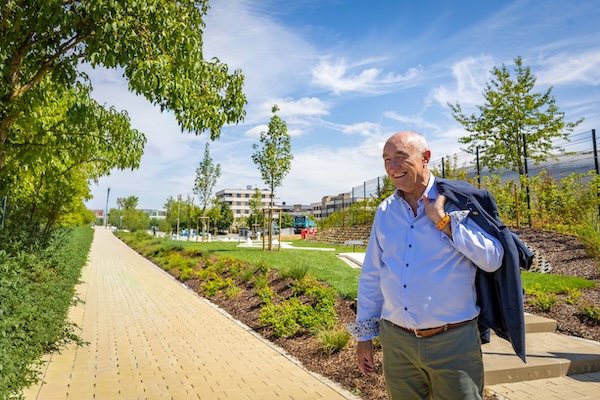
 Nico Pundel, Mayor of Strassen;
Credit: Municipality of Strassen
Nico Pundel, Mayor of Strassen;
Credit: Municipality of Strassen
The Grand Duchy of Luxembourg consists of twelve cantons made up of 100 municipalities. Each municipal council is elected directly by its residents in municipal elections held every six years. The municipality’s mayor is then appointed from among the elected members of the municipal council.
In this series, Chronicle.lu spoke to a selection of the country’s mayors to discuss the challenges within their municipality, their daily activities, how projects are prioritised and how they communicate with residents.
The fourth in this series features Mayor Nico Pundel who represents the municipality of Strassen.
Chronicle.lu: What is the size of your municipality, in population and number of nationalities?
The population is 11,000 citizens from 113 different nationalities.
Chronicle.lu: What are the main challenges currently facing the municipality (housing, mobility, infrastructure, environment, demographic growth, etc.) and how is the administration working to address them?
First of all is housing. Housing in Strassen, whether buying or renting an apartment or a house, is extremely expensive and there is not much available on the market. The rapid demographic growth has been slowed by the crisis in building new apartments.
Chronicle.lu: Please describe the daily activities undertaken by you, as mayor of the municipality of Strassen, and how you work in conjunction with the other members of your administration.
Nico Pundel: I am in the very fortunate position that, due to the size of the town, I am completely on political leave. This allows me to focus 100% on this job. As a result, I am at the town hall every day and maintain close contact with my staff.
Chronicle.lu: Please describe the challenges of being mayor of Strassen and what makes your municipality unique in Luxembourg.
Nico Pundel: Strassen is the second municipality in the country with the highest number of foreign residents. 60% are non-Luxembourgers, and of the remaining 40%, 30% hold dual citizenship. We are committed to ensuring that these residents feel safe and comfortable in Strassen. We therefore organise numerous events where we place special emphasis on the diversity of the population without losing sight of our own culture and traditions.
Chronicle.lu: As mayor, how do you select and prioritise which projects the municipality will undertake?
Nico Pundel: In the projects we carry out, we make sure they reflect the diverse age groups and family structures in our society. We organise projects for children and teenagers, but just as many for seniors. We ensure that families in our stressful world have enough opportunities to lead a balanced family life.
Chronicle.lu: What are the key projects, developments and upcoming events that will shape life in Strassen over the coming months and years?
Nico Pundel: We are currently finishing up our major projects in the area of youth and family. A new soccer stadium, a new large skate park (the second-largest in the country), a mini-golf course and a new youth centre—all located in a single, cohesive area—are nearing completion. We are now beginning construction on a new school and the expansion of the community centre.
Next on the agenda is the construction of a senior centre and another sports hall. We are also constantly working on projects to build affordable housing. These are the major construction projects. At the same time, however, we also organise a wide variety of cultural events in the fields of art, culture and sports. Here, residents can find something to do almost every day—activities that are tailored to the diversity of the population.
Chronicle.lu: How does the municipality communicate with residents and encourage them to become involved in local life and decision-making? Do you use English in such communications?
Nico Pundel: Communication is one of the most important—but also one of the most challenging—aspects of our work. How do I get this vast amount of information across to the citizens? No matter what events we organise, if the citizens do not receive the necessary information, most of our work is a waste of effort.
Over the past ten years, Strassen has become largely English-speaking, so we always publish our materials in Luxembourgish, French and English. Also, we always provide simultaneous translation into French and English at conferences and informational events for our residents.
Chronicle.lu: Please describe any initiatives / projects the municipality has in place to strengthen community relations, integration and volunteering.
Nico Pundel: For more than ten years now, we have had a person on our administrative staff whose sole focus is on integration. We have a very active Commission du vivre ensemble (Commission on Living Together) that organises events. We have a Café de Babbel (Language Café) that has been running very successfully for many years. In general, every event is planned to appeal to people of all nationalities. Of course, this starts with communication in different languages.
Volunteering, however, is a complex issue that is not limited to any one country or nationality but applies to society as a whole. Young people are often stressed out at work—and consequently in their family lives as well—and either cannot or are unwilling to set aside the necessary time to get involved in clubs or the community in general. Here, we still need to find the right approach, tailored to society’s needs, to unlock the door to volunteering; otherwise, it will become increasingly difficult to keep club life alive.