
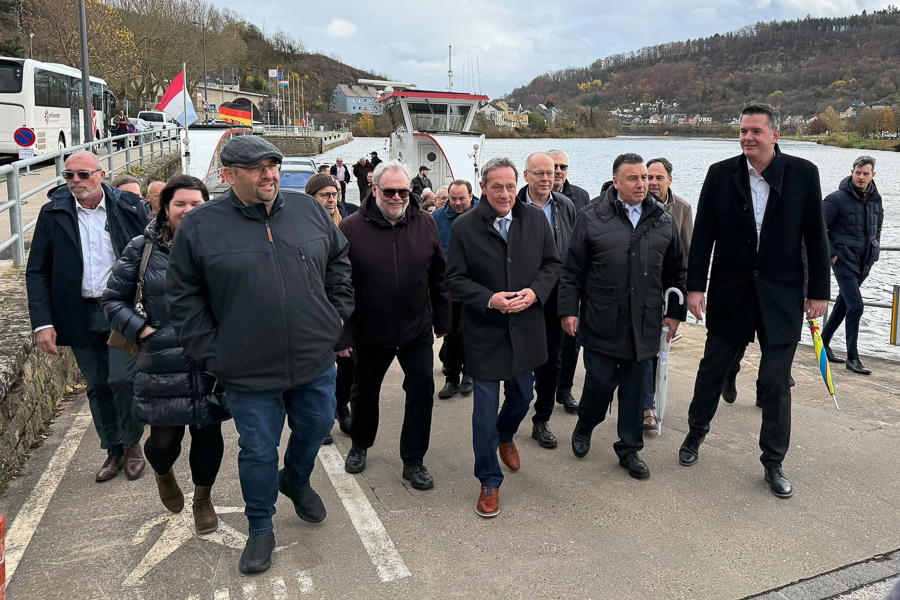
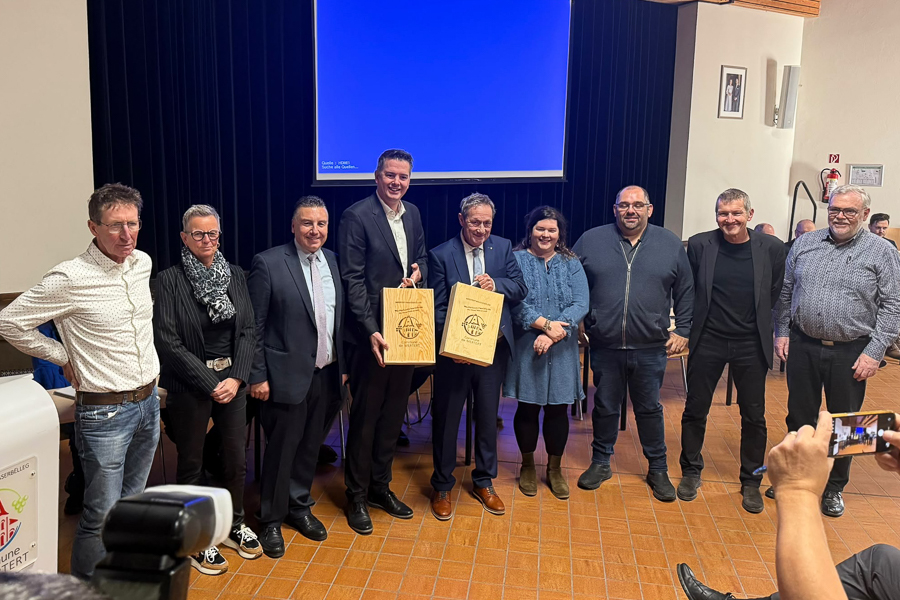
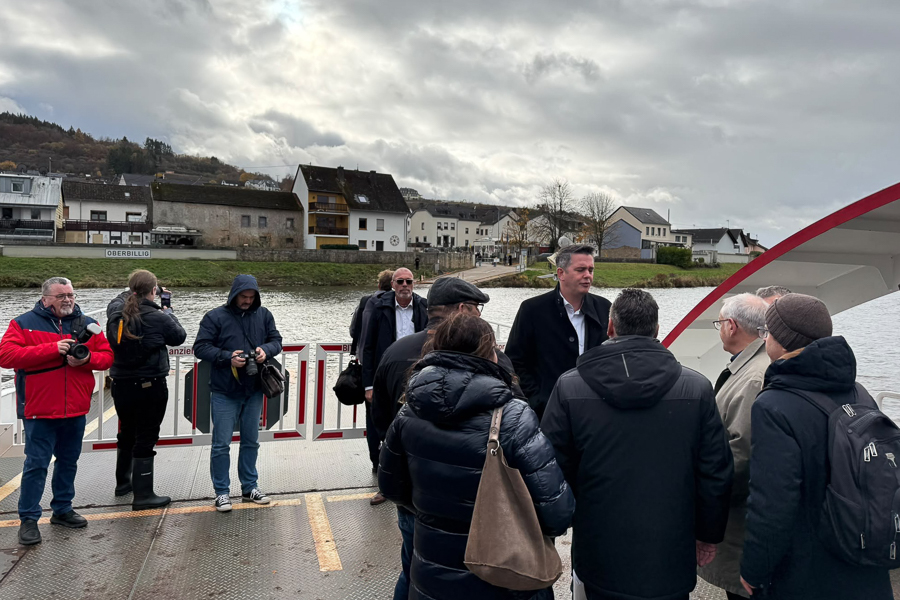
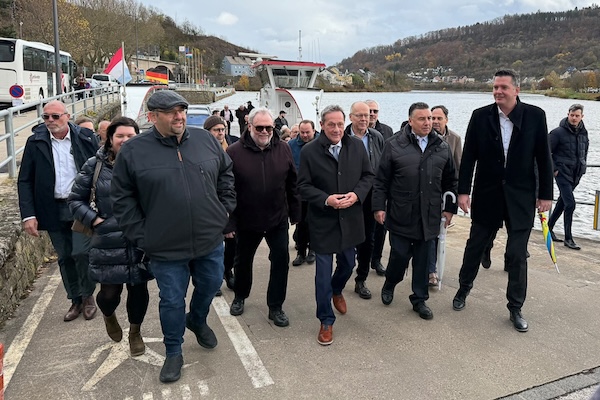
 (R-L) Luxembourg's Minister of the Economy, SMEs, Energy and Tourism Lex Delles; Jérôme Laurent, Mayor of Mertert; Andreas Beiling Mayor of Oberbillig; Achim Schwickert, Rhineland-Palatinate's Minister of the Interior, Integration and Transport; n/a; n/a;
Credit: Ievgenii Karanov, Chronicle.lu
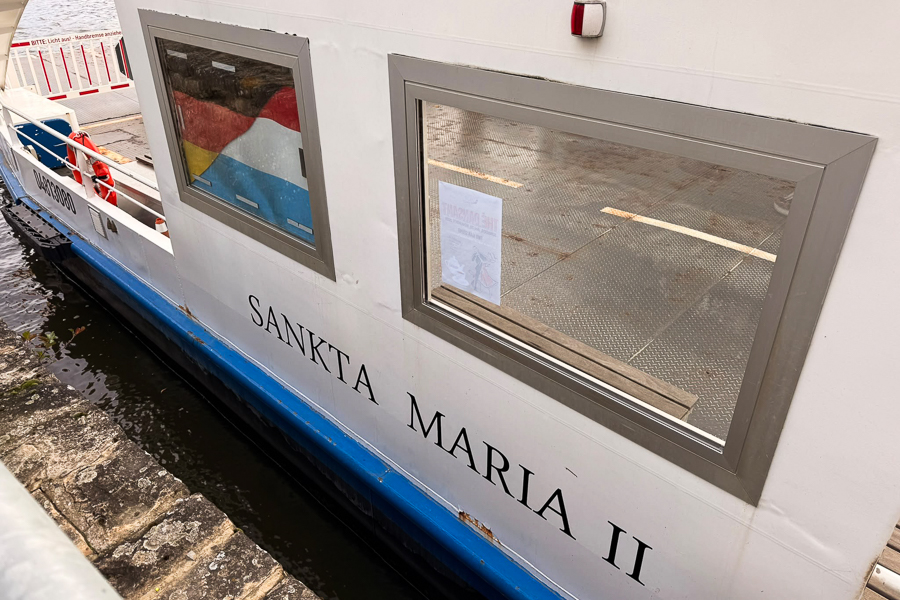
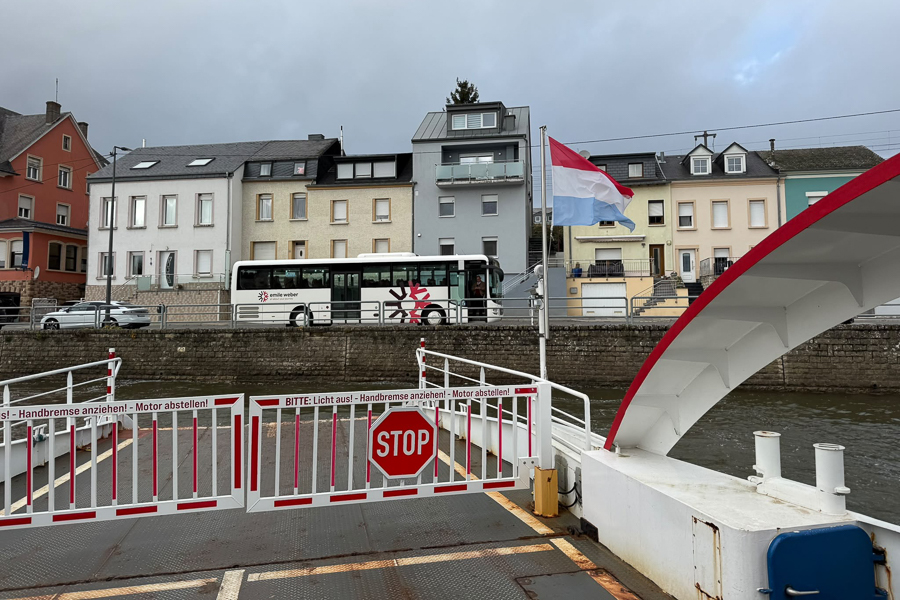
On Thursday 19 November 2026, Luxembourg's Minister of the Economy, SMEs, Energy and Tourism Lex Delles and Rhineland-Palatinate's Minister of the Interior, Integration and Transport Achim Schwickert attended the presentation of the AquaPilot cross-border project, aimed at progressively automating the electric ferry "Sankta Maria II" between Wasserbillig in Luxembourg and Oberbillig in Germany, at the Centre culturel de Wasserbillig.
The project has an initial budget of €1,960,900, with 60% financed by the European Union through the Interreg Greater Region programme. The Luxembourg and German ministries each contribute 15%, while the municipalities on both sides of the Moselle provide 5% each. Approximately 160,000 people use the ferry annually.
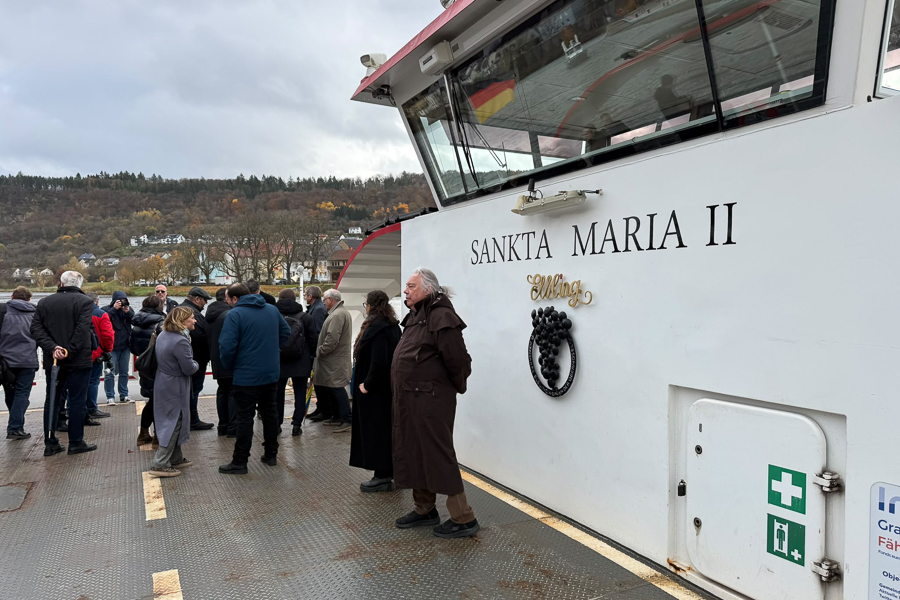
The presentation also brought together Mayor of Mertert Jérôme Laurent, Mayor of Oberbillig Andreas Beiling and other representatives from Luxembourg and Germany. Lex Delles attended the event on behalf of Luxembourg's Minister for Mobility and Public Works Yuriko Backes. Before the press conference, the delegations travelled aboard the "Sankta Maria II" from Wasserbillig to Oberbillig, where they collected the German representatives, before returning across the Moselle to Luxembourg.
Opening the press conference, Jérôme Laurent highlighted the ferry's importance for cross-border commuters, local businesses and tourism, noting that a cancelled crossing can turn a short journey into a detour of several kilometres. He recalled that ferry crossings between the two communities date back to the Middle Ages, while the fully electric "Sankta Maria II" entered service in 2017. Explaining the project's objective, Jérôme Laurent said: "With AquaPilot, we want to ensure that this connection remains reliable even when qualified ferry personnel are difficult to find. In the future, operators should be able to start the crossing at the press of a button. The ferry should depart, maintain its course and dock on the opposite bank automatically, while the crew supervises the journey and retains responsibility on board."
Lex Delles underlined the importance of cross-border mobility, noting that approximately 52,000 commuters travel to Luxembourg from Germany each day. He also linked AquaPilot to Luxembourg's national strategy for autonomous mobility and welcomed the opportunity to test innovative technology. The minister said: "We live the Greater Region here. We live Europe in everyday life. This is a very important connection between countries, municipalities and people."
Achim Schwickert welcomed the use of modern technology to address staffing challenges and maintain cross-border transport services. He stressed that automation could help preserve connections where qualified personnel are increasingly difficult to recruit, rather than simply replacing existing jobs.
Andreas Beiling highlighted the ferry's pioneering role as a fully electric inland ferry and the experience gained from its operation. He emphasised the historical connection between the two communities, noting that crossings across the Moselle date back to the Middle Ages.
Martin Güdelhöfer, representing the Entwicklungskonzept Oberes Moseltal (EOM), highlighted the importance of European funding and cross-border cooperation in supporting regional mobility. He noted that the ferry connects communities with public transport services and benefits commuters, businesses and tourists.
Automation under human supervision
Presenting the technical details, AquaPilot Project Manager Falk Fernbach of LuxMobility explained that the project aims to introduce Level 3 conditional automation, allowing the ferry to perform defined navigation tasks while remaining under the supervision of its operator. At the press of a button, the system would handle departure, navigation across the Moselle and docking, while detecting potential obstacles and responding to collision risks within defined operating conditions.
Falk Fernbach stressed that the operator would remain responsible for authorising automated crossings, monitoring operations and intervening whenever necessary. He explained: "The ferry does not decide for itself when it can depart. That decision is made by the operator, who monitors the entire operation, makes decisions in exceptional circumstances and can intervene manually at any time."
According to Falk Fernbach, AquaPilot aims to automate routine tasks rather than replace ferry personnel, allowing operators to concentrate on safety and unexpected situations. The project will also examine whether more precise navigation can reduce energy consumption and improve operational efficiency. In the longer term, successful automation could allow the ferry to operate for longer hours and offer more frequent crossings.
Responding to questions, Falk Fernbach clarified that qualified operators would remain essential in the coming years. Although the longer-term ambition is to develop a system capable of responding independently to dangerous situations, the project has not yet reached that stage.
Project delays and next steps
Falk Fernbach acknowledged delays in procurement procedures for the automation technology and landing infrastructure, explaining that both landing stages must be fully prepared before automated crossings can be tested. The delays are likely to require an extension under the Interreg programme, while the final cost could be slightly higher than initially planned, as the original estimates date back to 2023 and 2024.
Despite these challenges, Falk Fernbach expressed confidence that pilot operations could begin in 2028. Testing will take place in stages, starting with hardware and software checks and trials without passengers. Passengers and vehicles will only be allowed on board during automated crossings once the system has demonstrated that it can operate safely, potentially as early as 2028.