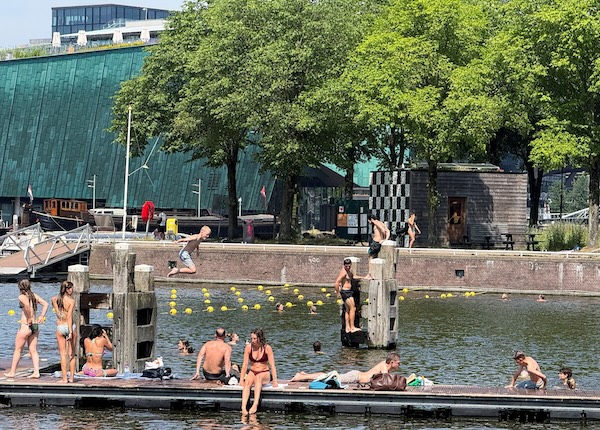
 People enjoy a swimming spot in Amsterdam, The Netherlands, where a rare red alert was issued for Friday during the ongoing heatwave in the country, 26 June 2026; Picture taken with a mobile phone;
Credit: REUTERS/Charlotte Van Campenhout
People enjoy a swimming spot in Amsterdam, The Netherlands, where a rare red alert was issued for Friday during the ongoing heatwave in the country, 26 June 2026; Picture taken with a mobile phone;
Credit: REUTERS/Charlotte Van Campenhout
PARIS/AMSTERDAM/LONDON (Reuters) - Health authorities across Europe were on high alert on Friday 26 June 2026 as a killer heatwave progressed across the continent, prompting alcohol bans and the cancellation of mass gatherings in France, melting road surfaces in Germany and twisting rail tracks in Sweden.
Scientists said the heatwave, which began on Saturday 20 June 2026, was the worst recorded in Europe, where the climate is changing faster than the global average.
Temperatures were peaking in France and United Kingdom (UK), where records for June have been broken. But in Italy, the heat was expected to intensify into the weekend, bringing the summer’s first readings of 40°C.
Paris hit a June record of 40.9°C on Wednesday 24 June 2026. Even though temperatures were expected to ease, authorities braced for more casualties.
"There will be consequences in terms of the number of additional deaths," French Health Minister Stephanie Rist told reporters.
Across the continent, cultural landmarks have been forced to close, and farming has suffered. In UK, doctors said the hot weather was affecting critical equipment such as MRI scanners in hospitals.
Paris police asked organisers of major events, including the Solidays music festival, to cancel. Organisers of the Pride festival said they would reschedule. In Belgium, a planned re-enactment this weekend of the 1815 Battle of Waterloo - which resulted in the defeat and exile of French emperor Napoleon Bonaparte - was cancelled as a result of the heatwave.
England and Netherlands at code red
Extreme heat caused the surface of the A2 motorway in Germany to buckle and rupture over several lanes on Thursday 25 June 2026 evening. In Austria, the national rail company warned that train tracks could buckle in the coming days.
Even Sweden was not immune from the ball of heat rolling across the continent; a cargo train derailed late on Thursday as high temperatures caused track buckling, stopping traffic between Stockholm and the country's second-biggest city, Gothenburg.
UK's Met Office extended a red heat alert, covering a large area of southern and eastern England, into a third day for the first time, while a temperature of 36.9°C meant the British record for the hottest June day had been broken on three successive days. Hundreds of schools remained closed and London's emergency services said calls for help were up 50%. A teenage boy died after entering a lake in central England, police said.
A red alert was issued for almost the whole of the Netherlands and many schools were closed as temperatures up to 40°C were expected, inflicting misery on visitors.
"I was expecting 'hot', but not this hot," 20-year-old New Zealander Ruby Prescott said, hoping for cooler air inside Amsterdam's main art gallery, the Rijksmuseum.
Electric fans flew off the shelves in UK, and Asian air conditioning manufacturers reported a European sales boom. In France, the state-owned power utility EDF pledged to spend €80 million on cooling systems for schools and day-care centres.
Most of the housing stock in normally chilly to mild northern Europe is not built to withstand such heat but rather, to keep it in. According to the most recent data from the International Energy Agency, issued in July 2025, household ownership of air conditioning in Europe remains relatively low, at around 20%.
'Omega block' heat bulge over Europe
The heatwave, which has pushed temperatures as much as 18°C above their seasonal average, according to the Reuters Climate Monitor, is being driven by a weather pattern known as an Omega block.
This traps a bulging ball of hot air over regions for extended periods, with cooler air on its fringes.
The present heatwave, which moved up from the Iberian Peninsula towards Western Europe, will begin shifting by the end of the month, hitting central Europe and the Balkans, the World Meteorological Organisation (WMO) said.
Scientists said the record-breaking heatwave would have been "virtually impossible" without manmade climate change, which has made this week's stifling night-time temperatures 100 times more likely than they would have been even two decades ago.
"Over the region studied, this heatwave is the most severe ever recorded," the World Weather Attribution group of climate scientists said in their latest analysis.
Hospitals feel the strain
For scientists, sweltering night-time temperatures are of particular concern. Temperatures overnight have not dropped below 22°C, depriving the human body of the ability to recover and shed the excess heat from the day, and which can drive excess deaths, John Kennedy, WMO Head of Climate Information said.
Hilary Williams, clinical vice president of UK's Royal College of Physicians, said overcrowding and heat in hospital wards were putting patients, staff and infrastructure under severe strain.
"People are far too hot," she told BBC Radio, adding that some critical equipment, including MRI scanners and cancer treatment machines, was being affected by the heat.
French doctors and hospital workers reported an increase in emergency calls and treatment.
Patrick Pelloux, a doctor for emergency services in Paris and president of the association of French emergency room doctors, confirmed that there had been 55 deaths in the care of emergency healthcare services in Paris in the space of 24 hours.
"Fifty-five is enormous," he told Reuters. "Normally it's three or four over 24 hours. It's really excess deaths (due to the heatwave), that is clear."