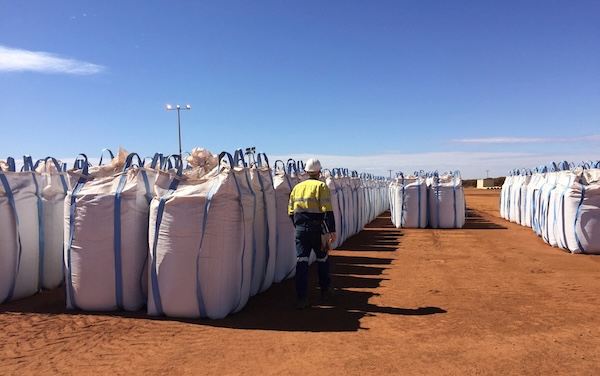
 A Lynas Corp worker walks past sacks of rare earth concentrate waiting to be shipped to Malaysia, at Mount Weld, northeast of Perth, Australia, 23 August 2019;
Credit: REUTERS/Melanie Burton
A Lynas Corp worker walks past sacks of rare earth concentrate waiting to be shipped to Malaysia, at Mount Weld, northeast of Perth, Australia, 23 August 2019;
Credit: REUTERS/Melanie Burton
MELBOURNE (Reuters) - France is among the countries poised to invest in Australian critical minerals projects, Australia's resources minister said on Thursday 25 March 2026, as Canberra's framework deal with the US prompts nations with advanced manufacturing sectors to secure access to supply.
Australia has been on a four-year mission to build an industry for minerals like rare earths that are key to future technologies such as electronics and defence, as countries look to diversify their supply chain away from dominant producer China.
As well as last October's critical minerals agreement with the United States, which included an $8.5 billion (€7.36 billion) pipeline of investments, Australia has inked agreements for sector cooperation with Japan, South Korea, India, France, Germany and Britain.
"Since the framework agreement with the US, that work has taken on new urgency from some other partners as they make sure they also have access to critical minerals," Australian Resources Minister Madeleine King told Reuters in an interview during the Minerals Week summit in Canberra.
"France is more and more keen," she said.
France has engaged at a policy and financing framework level, including through export credit agency Bpifrance Assurance Export, but unlike the US and Japan has not yet announced large-scale project funding for Australian critical minerals.
The French trade commission in Sydney did not immediately respond to a request for comment.
Australia is seeking billions of dollars more in investment for 49 mining projects and 29 midstream processing projects for a growing critical minerals sector that is forecast to produce A$18 billion (€10.8 billion) of export earnings in the financial year starting on 1 July 2026.
Australia this month joined the G7 Critical Minerals Production Alliance to help advance its growth objectives.
On Tuesday 24 March, Australia and the European Union signed a free trade agreement after eight years of negotiations, potentially easing EU access to Australian critical minerals but it stopped short of announcing a detailed list of investment projects as it did with the US
"Many other countries just aren't used to getting involved in mining and mining-style financing, but they're going to have to, if they want to ...have that secure supply," King said.
Decades of investment
Australia has provided A$28 billion (€16.8 billion) of financial support for the sector since the current government was elected in May 2022 and may need to be prepared to back the industry's development for decades, King said.
"If you want to compare timelines, it took (China) 40 years," she said. "We would like to do it quicker. But we do need to think of it as a long-term proposition."
The Australian government supported its giant iron ore and liquefied natural gas markets to get on their feet and, if anything, critical minerals might be more difficult, she added.
Australia is developing a A$1.2 billion (€721 million) strategic reserve that will focus on antimony, gallium and rare earths to supply to its partners and which is expected to be operational in the second half of this year.
The reserve will "no doubt" have an element of a floor price, King said earlier this week, but its agreements will be structured to ensure Australia will reap rewards if prices rise, she said.
"When there is an upside, the government should be able to get some of that benefit, but also exit this part of the arrangement," she added.
The US is also building a $12 billion (€10.4 billion) minerals stockpile, called Project Vault.
"And we see our reserve as being able to be the catalyst to feed into Project Vault," she said, adding details were still under discussion.