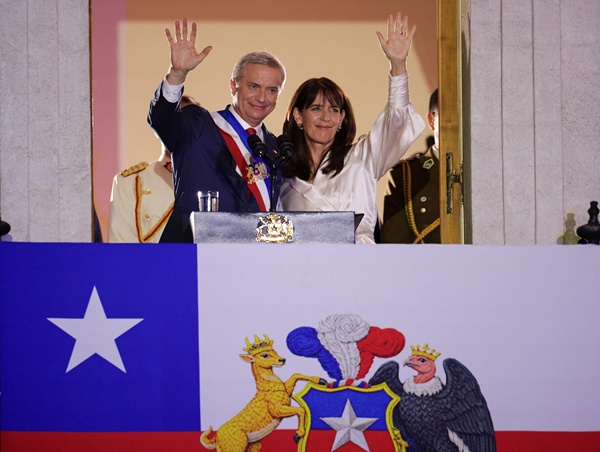
 Chile's President Jose Antonio Kast and his wife Maria Pia Adriasola wave from the La Moneda presidential palace, following his swearing in ceremony, in Santiago, Chile, 11 March 2026;
Credit: Reuters/Pablo Sanhueza
Chile's President Jose Antonio Kast and his wife Maria Pia Adriasola wave from the La Moneda presidential palace, following his swearing in ceremony, in Santiago, Chile, 11 March 2026;
Credit: Reuters/Pablo Sanhueza
VALPARAISO/SANTIAGO (Reuters) - Jose Antonio Kast was sworn in as Chile's president on Wednesday 11 March 2026, ushering in the country’s sharpest shift to the right in decades as voters, alarmed by rising insecurity, backed a broader conservative turn sweeping parts of Latin America.
In his first address to the nation, Kast described a country riddled with organised crime and weak finances and painted his administration as an emergency government aimed at fixing those problems.
"They've handed us a country in conditions worse than we imagined," Kast said, addressing a crowd of thousands of supporters who gathered outside La Moneda presidential palace in Santiago on Wednesday night. "To face those emergencies, in security, health, education, employment and more, Chile needs an emergency government and that's what we'll be."
Kast also called for unity and said the government would conduct audits across the government and crack down on crime, immigration and corruption.
"We're going to restore our country, we're going to restore our streets, we're going to restore our institutions. We're going to restore hope," Kast said. "We build the future together."
Before addressing the crowd, Kast signed a number of presidential decrees with several focused on improving border security in the country's northern desert region as well as a full audit of the state's finances.
Kast has promised to clamp down on migration and crime while boosting economic growth through deregulation, spending cuts and market-friendly policy.
Kast takes office from left-wing President Gabriel Boric - who beat him in 2021 - as Chile grapples with rising crime, economic jitters and global market turmoil sparked by the Iran war.
Protesters also gathered in Valparaiso and Santiago throughout the day, clashing with police and shouting chants against imperialism, capitalism, the United States and Kast before being dispersed by water cannons and tear gas.
A shooting that left one police officer brain dead earlier in the day in the southern city of Puerto Varas highlighted those security concerns and led Kast to send his new security minister, Trinidad Steinert, to the city.
"There's going to be a before and an after. Whoever attacks a [police officer] attacks Chile," Kast told reporters when asked about the shooting earlier in the day. "We're going to find them, judge them and apply the full force of the law."
Geopolitical challenges pose stiff political test
Kast's government plans to submit a tax reform bill in April 2026 that includes lowering taxes for business from 27% to 23% over four years and tax credits to incentivise employment.
"This is a government of hope. He advocates for work, for the working class. We're the ones who need it the most," said Patricia Vilches, a 68-year-old retiree who gathered outside La Moneda on Wednesday night.
Vilches said she owned a cafe that was ransacked during widespread protests against inequality in 2019 and feels that Boric's government failed to do enough for the working class.
The political transition also saw increased tensions between the incoming and outgoing administration over heightened pressure from the United States over a proposed Chinese undersea cable project.
Kast recently participated in US President Donald Trump's meeting in Florida to launch a new coalition against drug cartels dubbed "Shield of the Americas".
Chile is also the world's largest copper producer and China, the country's main economic partner, is the biggest purchaser of the metal.
"[Kast] will have to manage an increasingly challenging international geopolitical landscape," said Guillermo Holzmann, a political analyst from the University of Valparaiso, noting economic risks from the Iran war, the US' security strategy in the region and China's influence in Latin America. "These decisions will require sophisticated diplomacy and strategic medium- and long-term vision."
Kast will also face a divided Congress that could hamper an agenda he's vowed to deliver quickly.
"Speedy and effective delivery on his three priority issues - security, immigration and the economy - will be essential," said Nicholas Watson, managing director of Teneo consultancy, adding that "a barrage of initiatives is expected over the next three months."