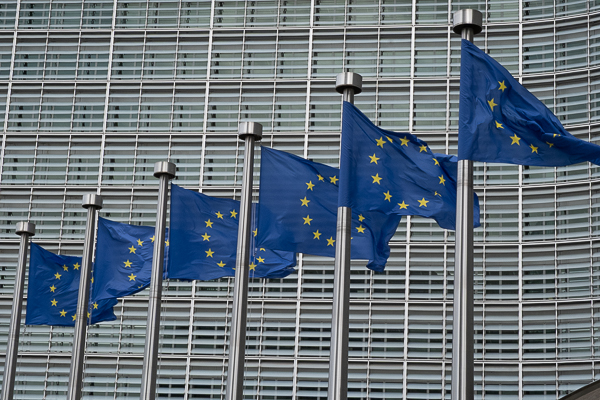
 EU flags in front of the Berlaymont building, headquarters of the European Commission, in Brussels, Belgium, July 2025;
Credit: Ali Sahib, Chronicle.lu
EU flags in front of the Berlaymont building, headquarters of the European Commission, in Brussels, Belgium, July 2025;
Credit: Ali Sahib, Chronicle.lu
The European Commission has reported that, on Wednesday 4 and Thursday 5 March 2026, its Emergency Response Coordination Centre (ERCC) supported EU Member States with the organisation of six repatriation flights, bringing European citizens safely back to Bulgaria, Italy, Austria and Slovakia.
Additional repatriation flights under the EU Civil Protection Mechanism are planned in the coming days, as an increasing number of EU Member States have activated it.
In response to recent developments in the region, the Commission said it is taking every possible step to ensure the safety of EU citizens by supporting Member States in coordinating repatriation flights from the Middle East. The priority is to assist Member States and to protect EU citizens stranded in the region and bring them safely back home, to Europe.
As of Thursday, ten Member States have activated the mechanism, namely Belgium, Bulgaria, Czechia, France, Italy, Cyprus, Luxembourg, Romania, Slovakia and Austria.
The ERCC coordinates logistically flights offered by the Member States. The Commission added that it is fully mobilised to assist them and remains in contact on this issue with EU Delegations and Member States' consular authorities in the region.
In addition to the coordination efforts, the European Commission can pay part of the financial costs of the repatriation flights. In particular, flights that offer seats to the citizens of EU Member States other than the Member State activating the mechanism are eligible for EU co-financing. Up to 75% of the eligible costs for the flights can be reimbursed by the EU if at least 30% of available seats are offered to citizens from other EU countries. The Commission can also book flights via the rescEU mechanism if no Member State can support a country requesting support to evacuate its citizens. In that case, the Commission can cover 100% of the costs.
The European Commission recalled that any country in Europe and beyond can request emergency assistance by activating of the EU Civil Protection Mechanism. The Commission then plays a key role in coordinating the disaster response and contributing to the transport and operational costs of repatriation flights. Following a request for assistance, the EU's ERCC promptly mobilises assistance and expertise.
Following recent developments in Iran and the wider Middle East, EU citizens have been stranded in the affected countries, as well as in parts of Asia-Pacific and Africa, due to the closure of key airports. In this context, EU Member States and participating states of the mechanism have started requesting assistance for repatriation support to their citizens.
Hadja Lahbib, Commissioner for Equality, Preparedness and Crisis Management, stated: "No European is ever alone in a crisis. Their safety always comes first. From day one, we have been fully mobilised to bring home the hundreds of thousands of Europeans stranded in the Middle East through our EU Civil Protection Mechanism. The EU stands by its people and will spare no effort to get them home safe and sound."