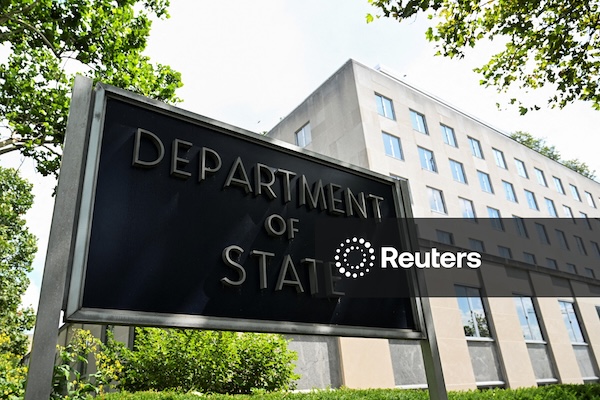
 A general view of a US State Department sign outside the US State Department building in Washington, DC, US, 11 July 2025;
Credit: REUTERS/Annabelle Gordon
A general view of a US State Department sign outside the US State Department building in Washington, DC, US, 11 July 2025;
Credit: REUTERS/Annabelle Gordon
WASHINGTON (Reuters) - The US State Department is pulling out non-essential government personnel and their eligible family members from the its embassy in Beirut, a senior State Department official said on Monday 23 February 2026, amid growing concerns about the risk of a military conflict with Iran.
"We continuously assess the security environment and based on our latest review, we determined it prudent to reduce our footprint to essential personnel," said a senior State Department official, speaking on condition of anonymity.
"The Embassy remains operational with core staff in place. This is a temporary measure intended to ensure the safety of our personnel while maintaining our ability to operate and assist US citizens," the official said.
A source at the US embassy said 50 people had been evacuated, while an official at Beirut airport said 32 embassy staff, along with family members, had flown out of Beirut airport on Monday 23 February.
The US has built up one of its biggest military deployments in the Middle East, with President Donald Trump warning on Monday 23 February that it will be a "very bad day" for Iran if no deal is reached to solve a longstanding dispute over Tehran's nuclear programme. Iran has threatened to strike American bases in the region if it is attacked.
"Should employees occupying emergency positions wish to depart post, please review alternative arrangements to fill the emergency position and consult with your regional bureau Executive Office as necessary," said an internal State Department cable on the pullout, which was seen by Reuters.
The State Department on Monday updated its travel advisory for Lebanon, repeating its warning that US citizens should not travel to the country. Remaining embassy personnel are restricted from personal travel without advance permission and additional travel restrictions may be imposed "with little to no notice due to increased security issues or threats," the advisory said.
American interests were repeatedly targeted in Lebanon in the 1980s during the 1975-90 civil war, during which the US held the Iran-backed Hezbollah responsible for attacks including the 1983 suicide bombing against the US Marines' headquarters in Beirut, which killed 241 servicemen and a 1983 suicide attack on the US embassy in Beirut that killed 49 embassy staff.
Talks on Thursday, divisions remain
Meanwhile, US Secretary of State Marco Rubio, who is scheduled to travel to Israel on Saturday 28 February and meet with Prime Minister Benjamin Netanyahu, was still planning to do that, but "the schedule remains subject to change," the US official said.
The United States wants Iran to give up its nuclear programme, but Iran has adamantly refused and denied it is trying to develop an atomic weapon. Washington views enrichment inside Iran as a potential pathway to nuclear weapons.
Iranian Foreign Minister Abbas Araqchi said on Sunday 22 February that he expects to meet with Trump's special envoy Steve Witkoff in Geneva on Thursday 26 February, adding that there was still "a good chance" of a diplomatic solution. A US official confirmed the meeting.
Both sides remain sharply divided - even over the scope and sequencing of relief from crippling US sanctions - following two rounds of talks, a senior Iranian official told Reuters.
"I am the one that makes the decision, I would rather have a Deal than not but, if we don’t make a Deal, it will be a very bad day for that Country and, very sadly, its people, because they are great and wonderful and something like this should never have happened to them," Trump said in a post on his Truth Social platform.
On Friday 20 February, citing officials on both sides and diplomats across the Gulf and Europe, Reuters reported that Tehran and Washington are sliding rapidly toward military conflict as hopes fade for a diplomatic settlement.
It would be the second time the US and Israel have attacked Iran in less than a year, following US and Israeli airstrikes against military and nuclear facilities in June 2025.
On Sunday 22 February, Witkoff said the president was curious as to why Iran has not yet "capitulated" and agreed to curb its nuclear programme.