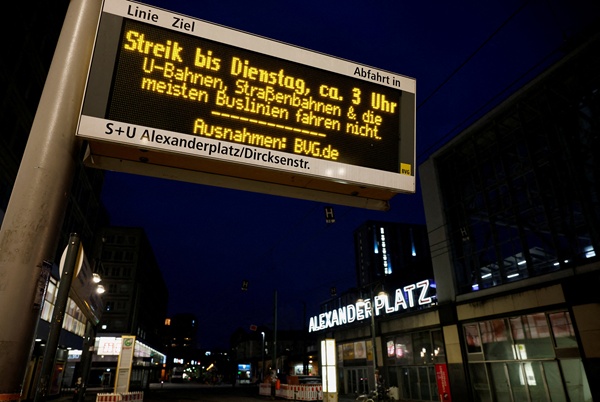
 A screen displays information about a nationwide BVG and other local public transport strike called by trade union Verdi, demanding higher wages and better working conditions, at Alexanderplatz station in Berlin, Germany, 2 February 2026;
Credit: Reuters/Axel Schmidt
A screen displays information about a nationwide BVG and other local public transport strike called by trade union Verdi, demanding higher wages and better working conditions, at Alexanderplatz station in Berlin, Germany, 2 February 2026;
Credit: Reuters/Axel Schmidt
BERLIN (Reuters) - Commuters across Germany faced freezing temperatures and empty platforms on Monday 2 February 2026, as tens of thousands of public transport workers walked off the job in a strike called by trade union Verdi, shutting down bus and tram services in most cities.
Verdi, which represents nearly 100,000 transport workers, called the strike after talks with municipal and state employers over working conditions stalled last week.
The union is demanding shorter shifts, longer rest breaks and higher pay for night and weekend work even as cities grapple with budget constraints.
The walkout affects about 150 municipal transport companies in all but one of Germany's sixteen federal states, including Berlin, Hamburg and Bremen.
One of the largest coordinated actions in local transport sector in years, the strike began as planned, Serat Canyurt, the leading negotiator for Verdi, told rbb radio on Monday, adding that public transport operators were now expected to return to the negotiating table.
Commuters seek alternative transport in frigid temperatures
In Stuttgart, Karlsruhe and Freiburg, services will grind to a halt for the entire day, union officials said.
Temperatures fell below zero in much of the country, worsening the situation for commuters forced to seek alternative transportation.
Still, Deutsche Bahn said Friday 30 January 2026 that its urban railway S-Bahn trains in cities including Berlin, Hamburg, Munich and Stuttgart, along with long-distance services, would run as normal on Monday as staff were not represented by Verdi.
Talks between Verdi and employer associations have been tense, with union leaders accusing municipalities of seeking to cut benefits and lengthen shifts.
In Berlin, Verdi negotiators said operators wanted workers to fund improvements themselves by giving up sick pay and flexible hours.
The next round of negotiations is scheduled for Monday 9 February 2026.
Union leaders warned that further industrial action could follow if employers do not offer significant concessions.