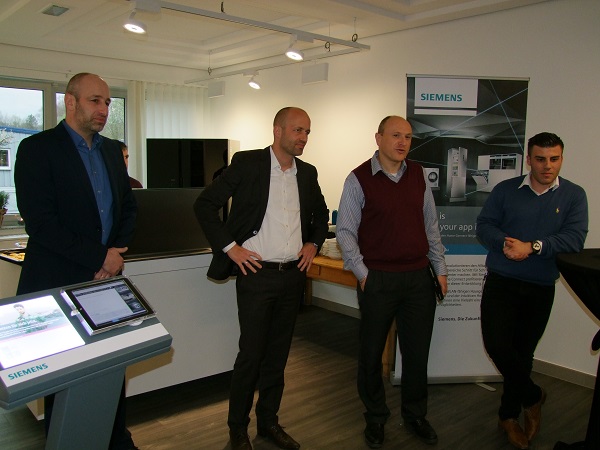
On Wednesday evening, BSH in Senningerberg hosted a demonstration of how the Internet of Things (IoT) has reached our homes.
With Buderus showcasing their connected heating boilers and BHS showcasing their connected kitchen and household appliances, those attending were treated to hands-on demonstrations on how mobile devices can control many home appliances from mobile devices.
Benoit Lespagnol, Managing Director of Ferroknepper Buderus SA in Luxembourg, explained how many people are afraid of configuring boilers; with smartphones and other mobile devices, it is easier to control the settings, from anywhere, e.g. in your home or even remotely, as long as one is connected to the Internet. He described how the control panel on the app is like a car dashboard, and that it also supports remote maintenance. Three years ago Buderus started with an app (Buderus EasyControl), which is now in its 4th generation and is supported with regular updates offering new features and functionality. It is now also possible to manage the settings via a mobile website.
While new Buderus Titanium boilers come equipped with a gateway offering Internet connectivity, older (compatible) boilers can be upgraded by adding a small module costing circa €200 which acts as an Internet gateway. Internet connectivity is achieved via a standard RJ45 cable connected to a router (cellars in Lux normally do not have wifi signal). Most boilers dating from 2004 onwards can be adapted, with the app/website interface in English, French and German; when installed, the connection is established with password-protection security over a VPN (virtual private network).
It can also connect to solar panels on the roof that partly power the boiler to see, for example, how many kilowatts have been produced in the month; the system can also be configured to allow the installer to also see and access the system remotely, which aids pre-diagnosis before responding to a call-out; another app also shows the status of the fuel tank and, in the future, will be able to predict when the tank needs to be refilled based on current consumption - similar to such systems currently available in on-board computers in passenger cars.
Stefan Tryba, CEO at BSH (Bosch Siemens Appliances) Electroménagers SA in Luxembourg (part of the Bosch group), and Mike Holzem, Marketing and Communications Manager at BSH, demonstrated the Home Connect app which is also available for free for mobile devices. Internet-connected kitchen appliances such as ovens, fridges and built-in coffee machines, as well as other large home appliances including washing machines, dryers and dish washers, have been available in Luxembourg for the past year. Connectivity is possible courtesy of a wifi connector which costs an additional €50.
The Home Connect app is owned and was developed by BSH in Munich; the company employs 40 people in Luxembourg. It works with new appliances that are Internet connected, with other appliances to be included later. Depending on the appliance, the app controls different features: with fridges one change the temperature, see its content (it takes photos every time it is opened and closed); with ovens, one can turn it on and off, operate the timer, etc. - all you need to do is put the food in first; with washing machines one can select programmes as well as on/off and timing (future features will measure detergent levels and issue orders to replenish). All such connected appliances are also linked to a technician in case of callouts. The app also contains training videos, etc., too.
With other IoT applications enabling control and management of lighting and air conditioning, these latest applications add to the range of options available to residential homes. With 94.5% of households having an Internet connection, Luxembourg is in 6th position world-wide of connected countries; 50% of households now have fibre optic Internet connectivity.
Photos by Geoff Thompson