 Credit: Ievgenii Karanov, Chronicle.lu
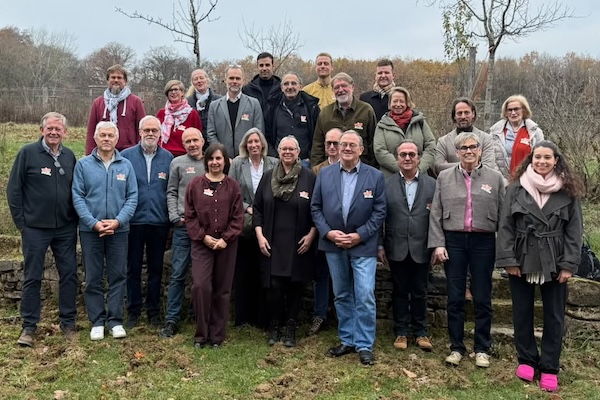
On Thursday 26 November 2026, Luxembourgish nature conservation NGO natur&ëmwelt and Citizens for Ecological Learning and Living (CELL) officially launched the "Rights for Nature" campaign in Luxembourg at the Haus vun der Natur in Kockelscheuer, together with around 40 initial signatories.
The campaign supports the European Citizens’ Initiative (ECI) "Rights for Nature: Empower Citizens to Represent and Protect Ecosystems", which launched at European level on 13 October 2026. The initiative calls on the European Union (EU) to recognise ecosystems as legal persons with intrinsic value and fundamental rights, including the rights to exist, regenerate their vital cycles and be restored. It also seeks to establish a mechanism granting citizens and communities the legal standing to represent and protect ecosystems.
Speaking to Chronicle.lu, Claudine Felten, Director of natur&ëmwelt, explained that the initiative aims to change how ecosystems are viewed and protected, emphasising that "they are really living systems with their own right to exist and to thrive". She added that citizens and communities living near ecosystems or interested in their protection should have the opportunity to defend them in court.
In his opening remarks, natur&ëmwelt President Roby Biwer highlighted the increasing pressure on nature and biodiversity and the importance of strengthening existing environmental protection mechanisms. Referring to the EU's Nature Restoration Law, he stressed the need to protect, improve and restore ecosystems, biotopes and habitats to halt and reverse biodiversity loss. He also expressed concern over developments at European level that could weaken existing nature protection legislation.
Roby Biwer underlined the importance of mobilising citizens across Europe and described the participation of the initial signatories as a symbolic start to the campaign in Luxembourg. Among the signatories were former environment ministers Carole Dieschbourg, Marco Schank and Alex Bodry, alongside representatives of environmental organisations, academia, civil society and the cultural sector.
During her presentation, Claudine Felten explained that existing nature protection legislation primarily regulates human activities and their impact on the environment. She noted that ecosystems currently have no legal standing of their own and that their protection depends on the enforcement of environmental legislation. The initiative seeks to address these structural gaps by complementing existing legislation and recognising the inherent rights of ecosystems.
The Mar Menor example in Spain
Thomas Giøe Brusendorff Nielsen of CELL presented the example of Spain's Mar Menor, a saltwater lagoon in the Mediterranean region which became the first ecosystem in Europe to receive legal personality in 2022.
He explained that, despite existing protection under the Ramsar Convention, the Barcelona Convention and the Natura 2000 network, the lagoon had faced decades of environmental pressure from mining, construction and agricultural pollution. Severe environmental degradation in 2019 and 2021 prompted widespread public mobilisation, including the formation of a 73-kilometre human chain and a citizens' initiative that gathered around 640,000 signatures.
The resulting legislation recognised the lagoon's rights to exist, evolve naturally, be protected, conserved and restored. Its guardianship is shared by a committee of representatives, a monitoring commission and a scientific committee. Spain's Constitutional Court upheld the law in November 2024 as an additional instrument within existing environmental protection.
Reflecting on the Spanish experience, Thomas Giøe Brusendorff Nielsen stressed: "When it comes from the bottom up and when it comes from the people, amazing things can happen." He highlighted the importance of establishing a legal framework that could help prevent similar environmental damage in Luxembourg and enable citizens to defend ecosystems in court.
Collecting one million signatures across the EU
The European Citizens’ Initiative requires one million valid signatures by 12 October 2027, with minimum national thresholds reached in at least seven EU Member States. If these requirements are met, the European Commission will be required to formally respond to the initiative.
In Luxembourg, any EU citizen aged eighteen or over can sign the initiative, with the national threshold set at 4,320 signatures.
Claudine Felten told Chronicle.lu that forests and wetlands in Luxembourg could benefit from stronger legal protection, highlighting concerns over exemptions allowing development projects in Natura 2000 areas on grounds of overriding public interest. Regarding the collection of signatures, she noted that the campaign had made an encouraging start, adding: "I hope that with this launch now we get more people interested."
The launch event concluded with a group photograph of participants, followed by a reception with finger food and drinks.
Further information and the possibility to sign the initiative are available at https://www.rightsfornature.eu.