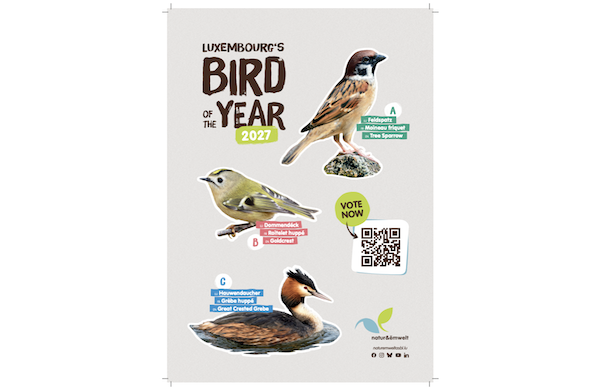
On Monday 21 September 2026, Luxembourgish nature conservation NGO natur&ëmwelt announced that, for the first time, it is holding a public vote to select the Bird of the Year for 2027.
According to natur&ëmwelt, there are three candidates to choose from: the Great Crested Grebe, the Tree Sparrow and the Goldcrest. The focus is not on whether a bird is well known, rare or endangered, but on the overall diversity of bird life. Each bird lives in a different habitat and has different needs. They therefore stand for more than just their own species; they represent their entire environment and, by extension, other species as well.
The Great Crested Grebe symbolises the protection of clean waters and healthy shorelines of lakes, ponds and flowing waters. Its brilliant white neck with colourful nape feathers and black crest makes the Great Crested Grebe a regal sight on any body of water — one that cannot be overlooked. It glides across the water’s surface and dives underwater to feed. It can stay underwater for up to one minute, searching for small fish and aquatic insects. The decline in reed beds — which the bird needs for shelter and nesting — is a major problem for this species.
With its chestnut-brown head, white collar and white cheeks with a dark spot, the Tree Sparrow is distinct from the House Sparrow. It is also slightly smaller than its relative and has brown-black plumage on its back. It builds its nest in tree hollows, cracks in walls or rock crevices, but also readily accepts nesting boxes. It is a symbol of the need to protect the cultural landscape — with its many hedgerows and extensive flower meadows — where it finds ample food. Across Europe, the Tree Sparrow’s population, like that of many open-country bird species, has declined by 60%. Flower strips with wild herbs, low-nutrient hay meadows and hedgerows in fields and farmland, as well as bird-friendly gardens, can help the Tree Sparrow.
The Goldcrest is only about 9 cm long and weighs only about 6 grams. This makes it the smallest and lightest bird in Europe. Its striking yellow-orange crown contrasts with the bird’s otherwise olive-green plumage. Its diet consists mainly of tiny arthropods, which the small bird finds on the undersides of branches, primarily of coniferous trees. Global warming and the associated heatwaves and drought have fuelled the mass proliferation of insect pests. As a result, many coniferous forests have disappeared, which also affects the Goldcrest’s population, since it depends on coniferous trees. Establishing healthy mixed forests is therefore crucial for this inconspicuous little bird.
To mark the 50th anniversary of the “Vull vum Joer” (Bird of the Year) campaign, natur&ëmwelt aims to involve more people in the decision-making process and thereby draw attention to important nature conservation issues.
The public can vote until Friday 23 October 2026 to decide which bird should be the Bird of the Year 2027. Further information and voting are available on the natur&ëmwelt website.