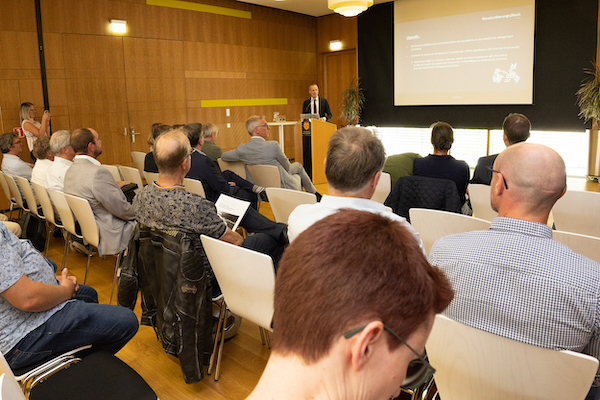
 Serge Wilmes, Luxembourg Minister of the Environment, Climate and Biodiversity, addresses attendees of the second national round table “Renaturéierungsdësch” in Mondorf-les-Bains;
Credit: SIP / Claude Piscitelli
Serge Wilmes, Luxembourg Minister of the Environment, Climate and Biodiversity, addresses attendees of the second national round table “Renaturéierungsdësch” in Mondorf-les-Bains;
Credit: SIP / Claude Piscitelli
On Tuesday 21 July 2026, Luxembourg’s Minister for the Environment, Climate and Biodiversity, Serge Wilmes, together with Minister for Home Affairs, Léon Gloden, and the Water Management Administration, organised the second national round table “Renaturéierungsdësch” in Mondorf-les-Bains.
The ministries reported that this second round table marked an important stage in the national consultation process launched in November 2025 to strengthen efforts to restore the natural state of rivers in Luxembourg. “By giving our rivers more space, we strengthen biodiversity, preserve our water resources and reduce the risks linked to the effects of climate change, particularly flooding and heatwaves,” said Minister Wilmes.
In his address, Minister Gloden recalled that resilience is a collective responsibility: “Resilienz geet jidderee vun eis eppes un!” (“Resilience affects each of us!”) He emphasised that developing a genuine culture of resilience is an essential investment to ensure the long-term protection of our country and its citizens in the face of tomorrow’s challenges.
In this context, Minister Gloden stressed the importance of coordinated preparation between national and local stakeholders in order to strengthen municipalities’ ability to anticipate, prevent and manage exceptional situations.
Minister Gloden also highlighted the role of the national building regulations, which incorporate new climate realities, notably through measures aimed at reducing urban heat islands, encouraging tree planting in public spaces and promoting permeable surfaces, particularly in car parks, in order to improve comfort and quality of life. In this context, river renaturation measures make a tangible contribution to resilience.
51 concrete measures to accelerate river renaturation
On this occasion, the conclusions of the three thematic working groups organised by the Ministry of the Environment, Climate and Biodiversity following the first round table were presented. Between February and May 2026, eight working meetings brought together 72 participants from 32 different entities. Discussions focused on land-related challenges, procedural and organisational obstacles, as well as information and awareness-raising needs.
This work resulted in a catalogue of 51 concrete measures aimed at strengthening cooperation between the stakeholders concerned, removing obstacles identified on the ground and accelerating territorial resilience in the face of extreme climate events, while promoting the restoration of aquatic ecosystems.
The catalogue is structured around five main areas: prerequisites for land negotiations, mobilisation of land, clarification of the roles and responsibilities of the stakeholders concerned, simplification of procedures and information and awareness-raising.
A concrete example of this commitment to facilitating the implementation of projects is the adaptation of the legal framework. The amended Water Act of 19 December 2008 now provides for the mechanisms of “silence vaut complétude” (“Silence is completeness”) and “silence vaut accord” (“Silence means agreement”), which simplify administrative procedures, reduce the time required to process applications and accelerate the delivery of renaturation projects.
Moreover, this adaptation also strengthens the role of river partnerships in implementing measures on the ground.
Towards the rapid implementation of recommendations
The catalogue of measures will be submitted to the Government Council in autumn, together with the National Water Resilience Strategy. Several recommendations are already being implemented, notably through the reform of the Water Act, which aims to simplify, accelerate and digitalise administrative procedures.
“This catalogue is the result of close cooperation between the State, municipalities and the main interest groups. By joining forces around a shared vision, we are laying the foundations for faster and more effective implementation of river renaturation projects,” said Minister Wilmes.