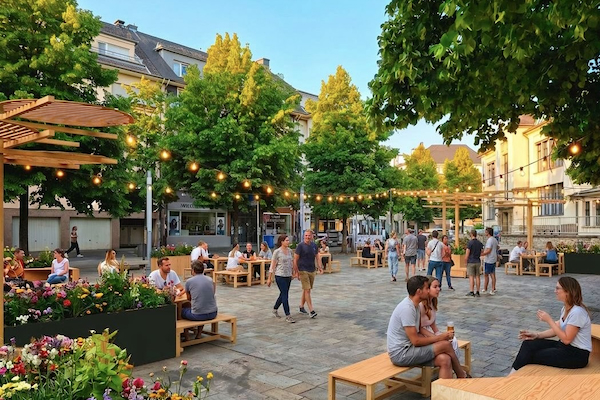
 Concept for green zone on Place Léon XIII in Luxembourg City;
Credit: VDL / Noé Barthel Design Studio
Concept for green zone on Place Léon XIII in Luxembourg City;
Credit: VDL / Noé Barthel Design Studio
On Wednesday 8 July 2026, the City of Luxembourg (VdL) announced it will implement a comprehensive greening concept aimed at dealing with the growing challenges of climate change and sustainably improving the city’s residents’ quality of life.
The VdL said that faithful to its commitments set out in the 2023–2029 coalition declaration, it is taking a new step in its environmental policy with the adoption of a comprehensive greening concept. Developed by the consultancy firm Zeyen+Baumann as part of the mandate entrusted to it in May 2024, and supported by the momentum created by LUGA 2025, this concept provides a long-term strategic framework aimed at addressing the growing challenges of climate change while sustainably improving residents’ quality of life.
The VdL’s greening concept is based on five objectives:
• promote urban development incorporating the principles of sustainable water management and flood protection, in order to regulate the hydrological system, improve the microclimate and create resilient urban infrastructure;
• improve the quality of the urban environment through the implementation of targeted greening measures aimed at reducing heat islands, improving air quality and promoting as well as protecting green spaces suitable for relaxation;
• enhance its urban landscape by harmoniously integrating vegetation into public spaces and the existing built heritage, thereby strengthening the city’s attractiveness;
• strengthen quality of life in residential neighbourhoods by creating and enhancing green spaces, parks and playgrounds designed as genuine places for living, meeting and wellbeing, while facilitating residents’ access to these nearby natural spaces;
• connect green spaces in order to strengthen biodiversity, protect flora and fauna, encourage the movement of cool air flows and provide an opportunity to create new routes for active mobility.
To achieve these objectives, the VdL plans a broad range of interventions. These include, in particular, the creation of new ecological corridors, tree planting, the development of new local parks and green spaces, the renaturation of certain waterways, as well as actions in favour of urban biodiversity. The concept also provides for increased greening of buildings and infrastructure through the development of green roofs, green façades and other solutions promoting the presence of nature within the city.
Methodology
The concept is based on an in-depth analysis of the municipal area and existing national and local strategies, while incorporating various projects and planning initiatives already underway. This diagnostic phase made it possible to identify areas with particular greening potential, as well as areas requiring priority attention, notably due to phenomena such as heat islands, the risk of flooding and erosion, a lack of ecological connections, low tree cover density or the limited presence of nearby green spaces.
A total of 37 sites were identified and classified according to the complexity of their implementation and the progress of any existing projects. Various constraints, such as the availability of a certain number of public spaces required for major events, were also taken into account.
Key projects to launch implementation
Based on the analyses carried out, seven key projects spread across different districts of the capital have been identified. These are: the redevelopment of the Bonnevoie centre, the transformation of Place de France, the creation of relaxation areas near the garden city, the greening of the façade of the Rocade administrative building, the redevelopment of the entrance to Grand-Rue and Rue Notre-Dame on the Boulevard Royal side, phase three of the renaturation of the Pétrusse Valley and the greening of the Bonnevoie Rocade.
Selected for their environmental benefits, their significant contribution to local quality of life or their ability to respond to proposals made by citizens during the Apéri’tours, these projects will mark the first concrete stages in implementing the greening concept. It should be noted that temporary interventions will shortly be implemented on Place Leon XIII, Place de France and in the garden city as part of the “Mäi Quartier – Meng Plaz” project. These interventions will make it possible to test the first greening measures.
Designed to be continuously evolving, the greening concept is intended to adapt and develop over time. It also includes other projects already being planned, such as the greening of the playgrounds at Henri VII and Demy Schlechter schools and the square commonly known as Op der Schmëtt in Grund, as well as various initiatives already being implemented.
These include, in particular, the planting of Tiny Forests, genuine biodiversity islands in urban environments, as well as the “Trees in the City – Business in Action” initiative. These projects contribute to the ambitious objective of planting 30,000 trees by 2030, of which nearly 14,000 trees have already been planted.
Beyond public spaces and municipal buildings, the strategy also includes initiatives encouraging citizens themselves to contribute to the greening of the city, through façade greening workshops, practical information sheets published on the VdL’s website, the green roof potential register and the corresponding subsidies, among other measures.
Measurable effects
To ensure the monitoring and evaluation of the actions undertaken, the greening concept includes measurable indicators, such as an increase in tree cover, stronger ecological connections between green spaces, improved access to green spaces and an increase in the surface area of green roofs and façades.
By adopting a comprehensive greening concept, the VdL said this confirmed its commitment to making nature a structuring element of urban development and to building a greener, more resilient city for current and future generations.