 Credit: OECD
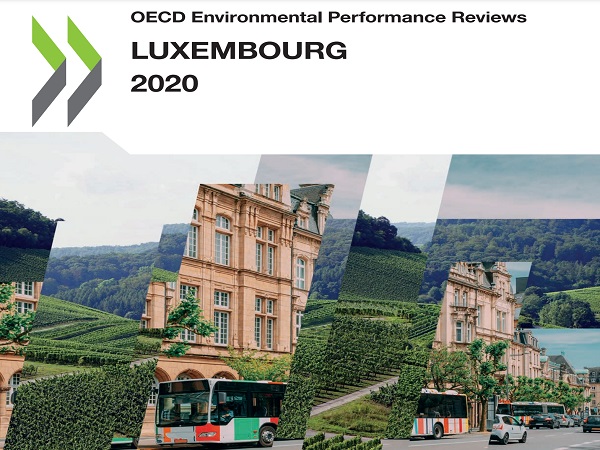
During a virtual conference, Rodolfo Lacy, Director of the Environment Division of the Organisation for Economic Co-operation and Development (OECD), presented the final report of the third environmental review of Luxembourg, in the presence of Carole Dieschbourg, Luxembourg's Minister of the Environment, Climate and Sustainable Development, as well as OECD representatives and the press.
OECD environmental reviews assess the progress countries are making in meeting their environmental goals. They promote peer-to-peer learning, hold governments to account for their policies and make targeted recommendations to improve countries' individual and collective environmental performance. The analyses are based on a wide range of economic and environmental data. During each cycle of reviews, the OECD reviews all of its member countries as well as selected partner countries.
Luxembourg is one of the founding countries of the OECD. The country's previous environmental reviews were published in 2000 and 2010. This third report assessed Luxembourg's environmental performance since 2005. It is the result of a constructive dialogue between Luxembourg and the other countries participating in the OECD working group on environmental performance, particularly with the two reviewers: Belgium and Switzerland. The working group examined the 40 recommendations presented in the report at its meeting on 25 February in Paris and approved them on 27 October 2020. They aim to help Luxembourg adopt a greener and more inclusive economic model and improve governance and management of the environment. The report has two detailed chapters on air quality and sustainable mobility and on biodiversity.
Results
The review of Luxembourg's environmental performance was carried out before the COVID-19 epidemic. The OECD has predicted that the pandemic could reduce gross domestic product (GDP) by 7.7% in 2020 if the virus resurfaces, with a recovery of 0.2% expected in 2021.
According to the OECD report, Luxembourg is a dynamic economy characterised by strong international interdependence, an attractive labour market and a large number of cross-border workers. Up until the COVID-19 health crisis, it experienced faster economic and demographic growth than the average for OECD countries. This went hand in hand with high levels of consumption and growing needs for mobility and infrastructure. This resulted in a lot of pressure on the environment. In this context, the country is pursuing a transversal and ambitious environmental policy. It has a strong legal and institutional framework to conduct and coordinate its policies for sustainable development and has made significant progress in environmental matters over the past decade.
Howeverm the progress made is not enough to alleviate the ever-increasing pressures from economic development, urbanisation and road traffic, nor to restore a natural environment conducive to the conservation of biodiversity. To successfully reorient its economy towards a greener and more inclusive model, Luxembourg will have to accelerate the implementation of measures in favour of a low-carbon and circular economy, while reviving its economy after the COVID-19 crisis.
Rodolfo Lacy summarised: “Luxembourg has made significant environmental progress, but the pressures exerted by economic development, urbanisation and road traffic are strong. The years to come will be decisive. Luxembourg has many assets for making a successful transition to a greener economy, developing sustainable finance and restoring a natural environment conducive to biodiversity".