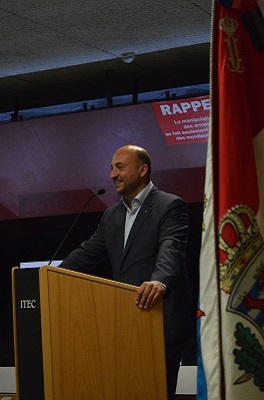
Under the proposal of Deputy Prime Minister, Minister for the Economy Étienne Schneider, the Governing Council of Luxembourg today adopted a Grand Ducal draft regulation which introduce a specific compensation for electricity generated by collective photovoltaic installations.
The aim of the regulation is to achieve the ambitious targets set by the European Union (EU) for reducing greenhouse gas emissions and improving energy efficiency and renewable energy by 2020. Luxembourg itself holds a national target of 11% renewable energy in finaly energy consumption in 2020 and intends to develop this goal, particularly with regards to solar energy, through the draft regulation.
Current regulations ensure injection rates for a period of fifteen years, and only for photovaltaic installations whose electrical power is less than or equal to 30 kW. In order to allow individuals to participate in communal projects aimed at developing renewable energy in the country, the adopted Grand Ducal draft regulation will introduce compensation in the form of injection rates for collective photovoltaic plants with a power of between 30 and 200 kilowatts. The beneficiary of this aid, which will come into effect from 1 January 2016, must be in the form of a cooperative society composed exclusively by individuals, of which there must be at least ten.
"Through this specific remuneration for collective installation, we actively support cooperatives in solar energy production," stated Deputy Prime Minister, Minister for the Economy, Étienne Schneider. "We are encouraging more renewable energy production by private individuals and mobilising citizens' investment capabilities."
Other changes introduced by the Grand Ducal draft regulation will also come into force on 1 January 2016. Among these will be legislation concerning the remuneration to be granted to new electricity generation facilities from renewable energy sources with a power greater than 500 kW, respective to 3 MW or 3 production units for wind energy.
Photo by Sarah Graham (Deputy Prime Minister, Minister for the Economy Étienne Schneider)