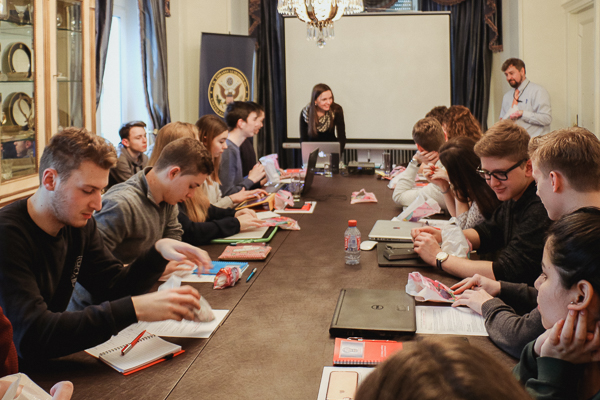
This Thursday evening, 26 students from six different Luxembourg high schools will present their pitches for the US Embassy Start-Up 4.0 Lëtz go Social Pitch Night and Awards Ceremony, sponsored by the US Embassy in Luxembourg and Lux Future Lab.
The students have been busy building on what they learned in February this year during a series of intensive workshops led by professional entrepreneurs. Among them, Sheena Lindahl, the CEO and founder of Empact, a firm that fosters entrepreneurialism all over the world, is a woman whose life has been defined by entrepreneurialism and all its possibilities since she herself was 17 years old.
Speaking to Chronicle just after the workshops, Sheena said the experience is as much about creating a mindset as it is about planting the seeds for future businesses.
“Even if the students don’t start something now, or even in the future, they can still apply the skills they’ve learned to anything in their lives. Building your brand, network, skills and knowledge will always bring returns, no matter where you are or what you’re doing.
“A lot of that comes from being willing to go outside your comfort zone,” she added.
“Lots of people think they need to be qualified to do something, or that adults have all the answers. But it’s not the case. These students have insights that their elders can’t possibly have.”
The theme chosen for this year’s Start-up was social entrepreneurialism, encouraging the students to look at innovative projects with broader social impacts.
“There are so many great ideas that young entrepreneurs come up with, and so many needs in the world. If we can match these up so they can make a difference, it’s a great way to channel that energy,” said Sheena.
Daniel Pattarini, public affairs officer for the US Embassy, agreed.
“It didn’t take the students long to see that social entrepreneurialism can happen all around them. There are challenges and issues, and the solutions, we believe, are going to be found with the next generation,” he said. Indeed, this is one of the reasons the Embassy chose to go with a social theme this year.
And while some may think social entrepreneurialism is something that happens in hot, far-away places, the two were keen to point out that it has a place everywhere.
“Social entrepreneurialism can be about poverty, but it can be closer to home too,” said Sheena.
“It can be a challenge in a country like Luxembourg where the state assumes greater responsibility,” added Dan. “But I would amplify great local examples, like Hariko and Digital Inclusion, where Luxembourgers saw a need and moved to address it. They saw that they could make a real difference.”
This touches on a vital contrast between European and American ideas about entrepreneurism, a contrast that can’t be measured.
“So much moves from the belief that you can do something,” said Sheena, adding that a lot of that belief comes from watching others who have gone before you. Immersed in a culture that celebrates and promotes entrepreneurialism, that doesn’t stigmatise failure, it can be easier for American entrepreneurs to overcome one of the most fundamental hurdles to success.
“The fear of failing, of feeling stupid, of ‘I’m not cut out for this’, that’s universal,” she said. “But when you have the examples to inspire you, it’s easier to take the first steps, and say you think I’ll do it anyway.”
On the other hand, considering the entrepreneurial landscape in Luxembourg, Sheena said she has noted a substantial difference even since last year.
“There is definitely more going on,” she said. “There are more conversations, more questions, more sharing, more passion. When I asked about it, people agreed.
“Last year, 12,500 people joined the 1-1-1. They're creating the critical mass that’s allowing people to be braver and get out there and do it. I feel Luxembourg is at a critical point where there could be an explosion on this.”
But it can still be tough for people to even know where to begin. For this, Sheena recommends two first fundamental steps.
“First, get a mentor to guide you through the process, and this is becoming easier now. Second, break it down. When you have a big and grand idea, it can be really daunting. You have to turn it around and reduce it to ‘what am I capable of?’, ‘what can I do?’, ‘what do I need?’” she said.
She cited the case of one of the student groups in February’s workshops who had started out with the idea of sending books to Africa. Needing a bus to transport and distribute the books, they started researching how to get one but in the process discovered that internet access is actually very strong. Suddenly the idea for the bus was out, their expenses consequently dramatically reduced and they moved to finding a publisher who may want to sponsor sending digital materials.
For Sheena, entrepreneurialism is like any other trait. Some have a particular gift it’s true, but with dedication and training it can be fostered in anyone.
“Like being a teacher, for example,” she said. “We can all agree there are certain qualities that are good and not too good. Then when they train they learn specific things, specific approaches that they are able to rely on when they need them.
“Entrepreneurship is the same. Some have more practice expressing it, and by doing that they can pull it out of themselves more easily. Others don’t and it can get buried under other traits and negative influences that create resistance.”
At the headquarters of BGL BNP Paribas on Thursday evening, the students will pitch their projects to a panel of judges and professionals from the embassy, entrepreneurs and business professionals as well as the grand prize winners from last year. Prizes include a fully paid trip to the US for an entrepreneurship camp, as well as small grants, iWatches, gift vouchers and more.
Last year's winners went on to take part in a pitching contest in the United States, and proceeded to win that too.
Sheena’s own curiosity about entrepreneurialism seems limitless, no doubt explaining a substantial part of her own success.
“I believe everyone has something unique to give to the world, and it’s almost a responsibility to give that,” she said. “Look for your advantages. There’s so much you can do right now.”
Image: Sheena Lindahl and Daniel Pattarini leading a Start-up 4.0 workshop session in February this year. © US Embassy in Luxembourg