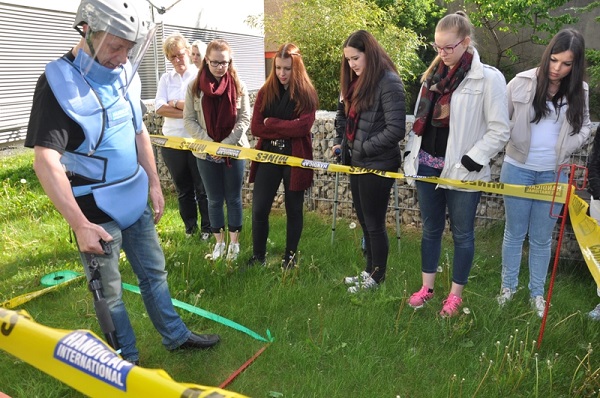
From 10 to 13 May 2016, Handicap International Luxembourg will educate young students regarding the dangers posed by landmines, cluster munitions and explosive remnants of war through humanitarian demining workshops.
This is an opportunity for students to become aware of the problem, to have a true reflection on the suffering inflicted on civilians and to measure the importance that represents the fight against these weapons.
Over the four days, Handicap International will be visiting over 300 children in four schools in the Grand Duchy; Lycée Michel Lucius in Luxembourg-Limpertsberg; Ecole Privée Sainte-Anne in Ettelbruck; Lycée Technique d’Ettelbruck and École Privée Fieldgen in Luxembourg-ville.
It has been 7 years since Handicap International Luxembourg last offered high school students the opportunity to attend awareness sessions in humanitarian demining, proof that interest in the topic does not weaken. Over the past 6 years, nearly 5,000 students have participated in these educational events along with teachers who see their students gaining an opportunity to create a real awareness.
Although the situation remains alarming in many countries, things are moving in the right direction: the universalisation of the Ottawa Treaty is satisfactory as more and more countries have ratified the Treaty. However, the universalisation of the Oslo Treaty banning cluster bombs has stagnated and, unfortunately, some states have recently used cluster bombs (Syria, Libya, Yemen, Ukraine in particular). Other practices were also deployed in relation to current conflicts, including the massive bombings of civilians. Handicap International intends to fight in the continuity of its historical action against mines and cluster bombs. Students will therefore also aware of this problem during these clearance sessions.
Between 2011 and 2014; explosive weapons have killed or injured nearly 150,000 people, 78% being civilians. When used in populated areas such as cities or villages, the proportion of civilian casualties reached 90%. Today, across the world, 92 countries and territories have been affected by explosive weapons.
Photo © C. Chibaeff, Handicap International