Tony Gibb, Investment Director at Fidelity, explained that we gave experienced significant market volatility which has not been since the fall of Lehman Brothers; July and August saw a realignment in the market which he explained was driven by dividends, yet earnings have fallen; the devaluation of the Chinese currency and investor concerns at emerging markets were the main reasons leading to a significant market correction.
Chinese growth has been affected by a shift to a consumer model. Interestingly, fund managers no longer see the possibility of a Eurozone break-up as one of the largest risk factors facing them. There has been a steady decline in fixed asset investment in China over the last few years, illustrating a move away from an industrial economy.
Overall, Emerging Market concerns have dominated market leadership, with TelCis and HealthCare driving the way. Chinese leadership has been aggressive to stimulate consumption and stave off inflation. House sales are rising in China and retail sales have stabilised. Likewise central banks in Europe are also interested in stimulating economies.
Looking at where we are now, he explained that valuations are fair in absolute terms, yet earnings need to pick up. While the market as a whole is not exceptionally good value, there are certain equity classes which are very attractive, particularly when compared to other asset classes such as fixed income and real estate.
The industrial and consumer export sectors in the EU have benefitted from the fall in the Euro, with lending opportunities rising. US consumer confidence remains strong. Germany continues to do well as the main beneficiary of low interest rates. While unemployment in certain parts if Europe is still high, it is coming down, with wage growth being experienced too, leading to increased consumer confidence. While the peak of the sovereign debt crisis is a few years behind us, its fall-out will be felt for many years to come. Total debt across the Eurozone has continued to rise, which limits how much interest rates rise.
Mergers and Acquisitions has been a significant driver of global markets with 2015 expected to he the best since 2007, with corporate activity levels buoyant where mid-cap are vastly outperforming large-cap companies.
The market has been open to volatility as it has been driven by multiple expansion; M&As are still attractive, particularly in large-cap companies.
On the Fidelity Alpha Funds SICAV, Anas Chakra, Portfolio Manager at Fidelity, talked about the Global Alpha Fund and the FAST Europe Fund which leverage Fidelity's worldwide network of 25 investment offices and where returns are generated predominately by an equity long / short strategy which also relies on opportunistic hedging at stock, sector, macro or market level.
With a focus on valuation he revealed that he us an early buyer and early seller of stocks, not waiting for over-valuation as this approach is high risk. He presented some case studies including Wells Fargo, an actor in the luxury goods sector and an Australian food retailer.
He talked about portfolio construction and explained his risk reduction strategy as based on industry spread, stressing that risk is investing with insufficient margin of safety. The objective is to have high single digit returns.
He revealed that top long positions include Nestlé at 4.1%, Roche at 4.1% and Williams-Sonoma at 4.0%.
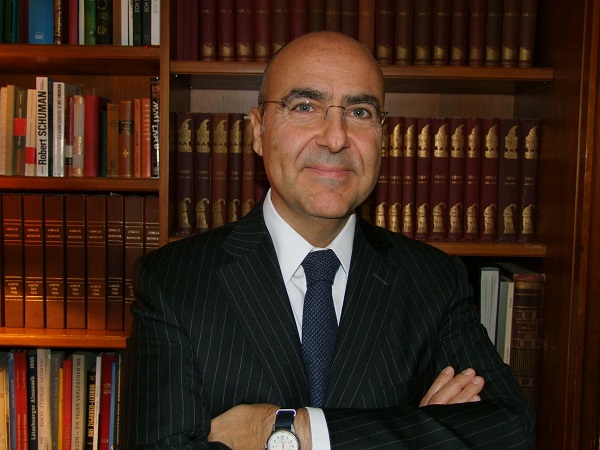
Tony Gibb and Anas Chakra of Fidelity in London, was addressing a group of around 60 people on the topic of Equity Market Backdrop, a macro-economic overview, at an investment presentation at the Cercle Munster on Tuesday, hosted by Fidelity.
Photo by Geoff Thompson: Anas Chakra