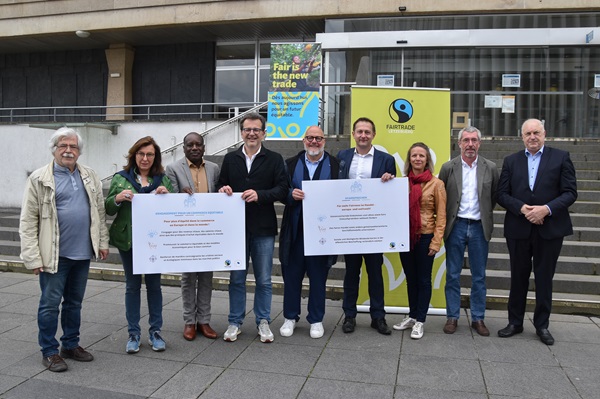
 Credit: ©Fairtrade Lëtzebuerg
The non-profit organisation Fairtrade Lëtzebuerg has launched an appeal entitled "Commitment to fair trade" to the leading candidates of the Luxembourg political groups.
Considered the largest transnational vote in the world, the European Parliament elections from Thursday 6 to Sunday 9 June 2024 will take place in a context of inflationary crisis, climate change and geopolitical instability. The European Union, as a major player in global trade governance through its membership of the World Trade Organization, will need to address many issues in this sector, such as human and environmental rights, social inequalities, systemic poverty and sustainable development, Fairtrade Lëtzebuerg stressed.
The appeal included three demands to be taken into account to ensure greater fairness in global trade. By signing this appeal, the leading candidates of the respective political groups publicly commit to greater fairness and sustainability in European politics.
Nine political groups have signed the appeal "Commitment to Fair Trade". These were: Déi Gréng, DP, Piraten, Déi Lénk, KPL d’Kommunisten, LSAP, Zesummen-d’Bréck, CSV and Fokus.
3 demands for more fairness and sustainability in European politics
The three aforementioned demands issued by the NGO Fairtrade Lëtzebuerg to the leading candidates of the Luxembourg political groups include: the commitment to living incomes, living wages and fair purchasing practices worldwide; the promotion of fair trade and economic models for the common good; the binding reinforcement of minimum social and ecological criteria in public procurement.
Regarding the first demand, note that living incomes and living wages are a human right. To achieve living incomes and living wages, Fairtrade Lëtzebuerg emphasised that the European Union will need to put in place a thorough strategy, such as assessing the EU at the level of its policies (such as trade agreements or directives) to determine to what extent they contribute or oppose the creation of a living income in the region or sector concerned in the Global South.
To promote fair trade and business models for the common good, the non-profit organisation stressed it is necessary to improve market access by reducing customs duties and compensating for price disadvantages, among other measures. Currently, exploitative business models, which offload many of their costs onto the community, enjoy price advantages, while environmentally and socially sustainable companies face price disadvantages. This system is not sustainable and needs to change, according to Fairtrade Lëtzebuerg.
Fairtrade Lëtzebuerg emphasised the need for binding minimum social and ecological criteria in public procurement. They stated that by systematically adopting a sustainable public procurement policy, public authorities would make an important contribution to the socio-ecological transformation that is urgently needed. Fairtrade Lëtzebuerg also highlighted that public procurement must be used as a strategic instrument to achieve sustainability goals.
Faced with all the above-mentioned challenges, the Fairtrade Movement highlighted its support for producers and workers in these times of crisis. Through stable minimum prices, the Fairtrade Premium, training and prevention programmes and its policy on the right of vigilance in human rights matters, the Fairtrade Movement aims to help producers become more resilient in the face of various global crises. The Fairtrade Movement also advocates for living wages and incomes, acts on legal regulations that promote sustainability (such as the Corporate Sustainability Due Diligence Directive and the EU Deforestation Regulation) and empowers producers to produce their goods in compliance with these laws.
Fairtrade therefore offers sustainable solutions, but it also needs support from the political sphere, the association emphasised. After a historic start to the year marked by the adoption of the Corporate Sustainability Due Diligence Directive (CSDDD) by the Member States of the European Union (which, despite last-minute changes, represents a major advance and significant progress in protecting human rights and the environment from corporate harm) EU Member States will face the challenge of moving from ambitious legislation to effective implementation. Moreover, during the 2024-2029 legislature, the future European Parliament will need to commit to a fair global social and ecological transformation, the non-profit association underscored. New EU legal frameworks with global reach will need to be implemented effectively, taking into account the needs of millions of small producers and workers in the Global South, who are particularly affected by the current crises and whose livelihoods are more threatened than ever, Fairtrade Lëtzebuerg concluded.