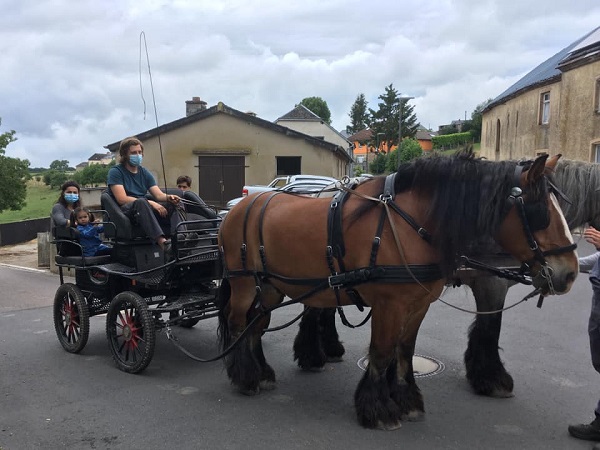
 Credit: Liewenshaff - Päerd's Atelier asbl
Chronicle.lu recently had the opportunity to speak with Renée Lotz, a psychologist at Liewenshaff - Päerd's Atelier asbl, about the mission and activities of the Liewenshaff socio-educational centre located in Merscheid in north-western Luxembourg.
The origins of Liewenshaff date to 1990 when social workers at the “Centre d’Intégration Scolaire” (a centre where children with behavioural problems were admitted due to their perceived inability to follow traditional schooling) founded a non-profit organisation called “Päerd’s Atelier” (“horse’s workshop” in English). They had seen that the children in this centre often remained dependent on help after the age of fifteen and decided to set up an organisation catered specifically to their needs. The initial idea was to help reintegrate these young people into society by offering them experience with horses – hence the name of the non-profit.
On 22 October 1992, the municipal administration of Heiderscheid leased a plot of land and a house (“Graf” house) to Päerd’s Atelier asbl to support its mission. It was here that the non-profit set up the Liewenshaff training centre for young people aged sixteen and over who struggled with social and professional integration. The centre was named “Centre propédeutique professionnelle - Liewenshaff". As Renée Lotz explained: “The meaning of the name is pretty straight forward: ‘Liewen’ meaning life, and ‘Haff’ meaning farm – it’s a former farm dedicate[d] to the development of a fulfilled and happy life by supporting the young adults regarding their professional and personal goals”. In 2021, the centre was renamed the "Centre d'insertion professionnelle -Liewenshaff".
As part of the "Liewenshaff" project, the non-profit aims to achieve the following goals, among others:
• to employ young people who find it difficult to integrate into working life;
• to offer young people socio-educational and cultural goals;
• to organise and offer leisure activities with draft horses.
Regarding the evolution of the centre over the years, Renée Lotz said: “Throughout the whole history of ‘Liewenshaff’, one factor always remained the same: young adults come to us on a voluntary basis”.
“Over the years, ‘Liewenshaff’ has grown more and more. Apart from the initial occupational field of farming, other training areas have arisen: the kitchen, professional cleaning, metalworking and landscape gardening. ‘Liewenshaff’ nowadays is able to offer this variety of work areas, which helps the students to specialise in a specific field of their choice”, she continued. “Additionally, with the help of the Lycée du Nord, we were able to offer a special tuition to our students: within a reduced programme, they get the chance to catch up on essential academical knowledge catered to their individual professional paths”.
In terms of the impact of COVID-19, Renée Lotz lamented that the pandemic “has slowed down our progress”. She elaborated: “Due to decisions of the [education] ministry, ‘Liewenshaff’’ and other schools nationwide had to close on several occasions for multiple weeks. Not only [did] the virus-induced anxiety emotionally drain our students leaving them with worries regarding their future and health, the lack of structure, social contacts and meaningful occupation set back some of the progress they had previously made. It took a lot of work from our staff’s side to overcome these issues, stabilise the students’ emotional state and reintroduce them into their usual work rhythm”.
Initially created “by and with the help of volunteers, who were compensated for their work at the time”, Liewenshaff no longer works so much with volunteers or trainees, with the exception of holiday camps for younger children. Renée Lotz elaborated: “We want to create a stable work environment for our students with persons of trust they can build relationships with. This is of high importance as a lot of our students suffer from attachment disorders or dysfunctional relationship patterns, which we want to counteract through functional and sympathetic experiences”.
The team is currently composed as follows: one supervisor, Jean Fetz, President of Päerd’s Atelier and initiator of the Liewenshaff project, as well as project manager at Luxembourg’s Ministry of Education, Children and Youth; one director and one deputy director, Yves Weisen and Nancy Specchio, respectively, both of whom are qualified social education workers; three school staff members; nine staff members working in training areas; four psychosocial assistance staff members, including Renée Lotz; two property management staff members; one secretariat and bookkeeping staff member; two employee representation staff members; five psycho-pedagogical and social commission staff members.
Renée Lotz explained that the main beneficiaries of the centre “are and always will be our students”. Referring to these adolescents and young adults who show behavioural problems, she explained: “Often they have already been supported and accompanied by other social institutions who were unable to offer a solution for them”.
“Central to the educational work in the facility is the socio-educational group as a place of life education where all important decisions are prepared and made. Above all, it is a place where conflicts arise that result from the gathering of young people with behavioural problems. The aim is to work through the emotional deficits in the group and create stability and new social skills”, Ms Lotz continued. “The students are encouraged by the staff to stay, to make use of the learning opportunities (school, boarding school, cultural activities, social skills groups, autonomy groups and youth groups) and to get involved in one of the five learning fields offered. The deviating social behavior is positively controlled, reflected and changed in the group context. The socio-pedagogical work is framed by teachers, social pedagogues, a psychologist and a social worker who work with the students individually or within a group context”.
Alongside this socio-pedagogical work, “the preparation for the professional world is firmly anchored in the facility”, Ms Lotz added. “It serves to enable young people to plan their lives independently and to secure them economically in the future. The core of professional socialisation is more than just acquiring the knowledge and skills required for the practice of a profession. It is also about learning ‘abstract work virtues’ such as presence, punctuality, attention, responsibility, technical understanding, reliability, organisation, social skills in the work environment, self-control, accuracy, speed regulation, etc. The acquired knowledge and skills release lead to encouragement, which rewards the young adult with a corresponding sense of achievement and contribute to his or her inner stability”.
Concerning the upcoming jazz and blues festival, which Liewenshaff has been organising since 1999 (with a COVID-19-related two-year break), Renée Lotz noted: “The main goal of the event (and also our work in general) is to reintegrate our students into society. One resource to do so are cultural activities, as these create an exchange between people. Due to their social difficulties, most of our students are outcasts with little to no exchange with others. Through these kinds of events, we want to build a bridge between people and give our students the chance to take the first step towards this goal”.
“Additionally, we would like for our students to get in touch with art, widen their spectrum and get to know music genres which are not necessarily represented in mainstream media. This is why we have been collaborating with the Blues Club Luxembourg”, she added. “Another aim of this festival is to call people’s attention to the Liewenshaff, as we realise that our project is still unknown to a lot of people who might be in need”.
Ms Lotz also explained how the festival has grown in popularity over the past 22 editions. “Especially after the two-year-break which had to be done due to the COVID-19 pandemic, we are glad to continue this trend and host the long-awaited festival for our guests, artists and students”, she said. “The Liewenshaff has always been supporting local artists by inviting them alongside international musicians. We also note a constant progression in the line-up”.
The festival is not the only public event organised by Liewenshaff. “We offer funfairs, Christmas markets, Easter markets, art exhibitions (with the help of the LAC), and dinners with live music acts covering all different kinds of music genres”, explained Ms Lotz. “One of our highlights are theatre [plays] and cabarets in the amphitheatre of our public park. The park itself is open all year round and offers a spectacular view on multiple sculptures that have been created by local and international artists. Also, our student’s band gets a regular platform to perform their hard work within the music lessons”. She concluded: “In addition, advanced trainings, meetings and congresses, as well as private events, such as weddings or birthday parties, can be hosted within our premises”.