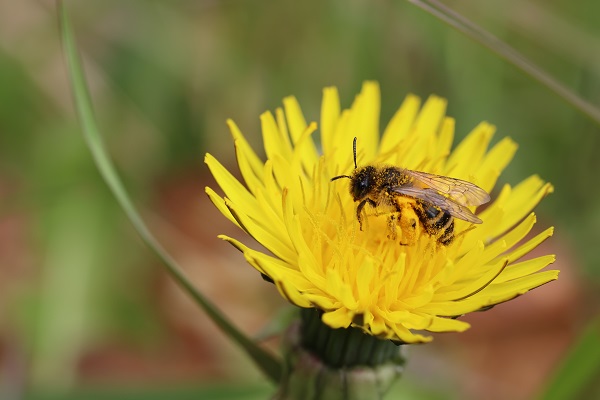
 Credit: Bee Together
Bee Together, a group of volunteers whose mission is to raise awareness of the importance of pollinators and biodiversity to the environment and our well-being, has announced several upcoming events.
With the warmer weather, the wild flowers are starting to bloom and the queen bumble bees, hornets and wasps have left their winter hibernation hiding places to search for new homes for the season.
Bee Together recalled that wasps are pollinators and they play an important role in ecosystems by controlling insect populations, although sometimes they decide to make their home in unwanted places. To discourage them from living in the roller shutter boxes, Bee Together stressed the need to raise and lower your blinds on a regular basis from March to end May. Additional advice and a hotline telephone number are available on the natur&ëmwelt website.
A series of events is organised by natur&ëmwelt and their partners, including Bee Together, from 1 April to 31 August. The programme in French and German can be found here. For each event, the languages spoken are indicated (including English for some of them).
City Nature Challenge (CNC) 2022
The CNC is an annual international event (citynaturechallenge.org), motivating people worldwide to find and document wildlife around them. For the third year, the National Museum of Natural History (natur musée) is part of this global challenge and coordinates the efforts in Luxembourg. From 20 April to 2 May 2022, all observation made using the iNaturalist network anywhere in the Grand Duchy will count towards the final results. More information, including the programme of events can be obtained here.
During CNC 2021, 5,341 observations of 888 animal and plant species were made by 268 users in Luxembourg. More details can be found here.
natur&ëmwelt's Wasp Network
The Wasp Network is a group of volunteers who provide free advice to the public about insects and can be reached vua tel.: 29 04 04 344 or email: berodung@naturemwelt.lu.
With the arrival of warmer weather in spring, the wasp and hornet queens emerge from their hibernation sites and set out to create a new nest. Sometimes they choose places around houses, such as roller blinds, under the eaves, covered terrace and garden shed.
To discourage them from living in the box of roller blinds, it is important to raise and lower blinds twice a day from March to the end May. During this same period, it is important to check weekly for nests under the eaves, in covered terrace and garden shed.
Bee Together also recalled that the firefighters no longer come to remove wasps and other insects.
As wasps and hornets play an important role in the ecosystem, pollinating and controlling insect populations, it is desirable to find a solution to live with them.
The Wasp Network will likely ask you to take a photo of the insect and of the nest, if it is safe to do so.
Honey bees living without humans
One of the insects may be around the house and in neighbourhood is the honey bee (Apis mellifera). They live in hives, sometimes managed by beekeepers, but also in cavities in trees and in buildings. They are often referred to as free-living honey bees.
Bee Together request the public that the they find honey bees living in trees and human-made structures (except beehives) in Luxembourg, to contact thgem via email: honeybeewildlux@gmail.com or via tel.: 661 15 52 50 in order to Honey Bee Wild (HBW) to monitor them over the years to determine on average how long they live in these cavities.