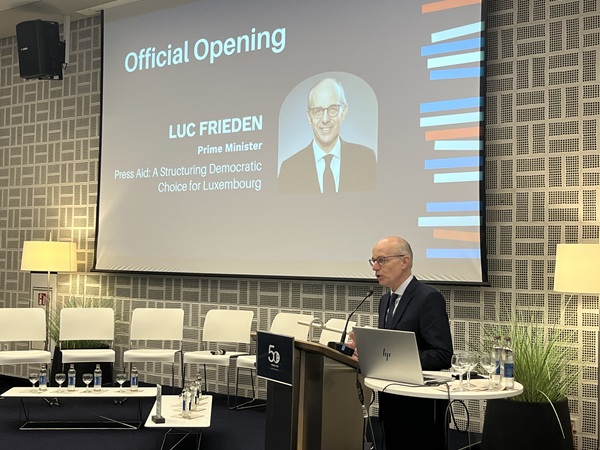
 Prime Minister Luc Frieden speaking at the Media Pluralism 50th anniversary conference;
Credit: Chronicle.lu
On Wednesday 25 November 2026, the Bibliothèque nationale du Luxembourg (BnL - National Library) in Luxembourg-Kirchberg hosted a conference on the topic of "Safeguarding Pluralism: 50 Years of Commitment – and What Comes Next?"
Around a hundred people attend the event which marked the 50th anniversary of public support for the press in Luxembourg and brought together policymakers, media professionals, researchers and digital experts to discuss the future of independent journalism, media pluralism and quality information in the digital age.
Media pluralism is defined as having diverse voices, viewpoints, information sources and media types in a society's media landscape which gives the public access to different perspectives so people can form their own opinions and participate in democratic debate.
Official Opening
Christophe Langenbrink of the SMC (Service des médias, de la connectivité et de la politique numérique) moderated the event and welcomed everyone. Some presentations were in French with others in English.
Luc Frieden, Prime Minister, talked about strengthening democracy in which press have an important role to play, with press aid strengthening democracy by promoting debate. 50 years ago this was a political choice, one which "we have always supported" through different governments, he explained. We went on to say that today we are facing new challenges, from social networks to artificial intelligence, the latter which he said he views as a challenge. He said that journalists still need to research and check facts. He referenced European discussions on disinformation campaigns in other countries and explained that we must be able to use technological tools the right way. He concluded by stating: "Having a strong press results in a strong democracy".
Claude Conter, director of the BnL, talked about its extensive digitalisation programme involving certain Luxembourg news publications. He said that the national library is committed to the free and fair access of the Luxembourg press, acting within a European framework. He addressed copyright concerns over AI data harvesting activities, and called for a clearer legal framework to protect the accessibility of press archives related to GDPR. He referenced the proposed derogation of the press related to the right to be forgotten which has yet to be adopted into Luxembourg law.
Misch Pautsch, president of the Press Council, talked about resilience and asked how long can society survive without free information, citing the example of an Internet outage. He referenced misinformation site, bots and AI, describing them as "enemies of democracy", citing Brexit as a prime example. He also mentioned the treat of media being bought up by tech billionaires. He equated resilience and press aid as the same thing, helping to create a "safe harbour" for readers who should not doubt their sources. He said that some media's roles have changed from informing to influencing public opinion. He said that Luxembourg is 9th in the democracy index; in the Grand Duchy, two out of three people trust the press, the opposite of statistics in other countries. He said that Luxembourg's press aid is modern and adaptable. He concluded by stating: "A free press is out best defence against disinformation".
Keynote Addresses
Alvin Sold, journalist and former publisher (at Tageblatt), spoke on "50 years of press aid in Luxembourg: From economic support to a policy for freedom of expression". He said that the press is one of the pillars of democracy and referenced the vote on press aid law in parliament on 11 March 1976. He chronicled Tageblatt's early days and its editors, with the press aid being introduced at a time of technological change. He also addressed the political landscape over the years, referencing the control that the Catholic Church had in the media (Wort), giving the debate on abortion as an example. He also talked about "information fatigue" nowadays and called for information be be free.
Elda Brogi, Professor and Deputy Director of the Centre for Media Pluralism and Media Freedom, spoke on "Press aid today: current state and prospects for development in a European context". She talked about seeing some developments and improvements over the decades in press aid and press freedom. She said that information evironment has changed substantially and talked about press freedom and press aid, AI and the European dimension. Se talked about the media performing an essential democratic function, but recognised they must be operated comercially. She talked about users receiving information without knowing / understanding its source. She said that the role of media should be to reverse such trends and imbalances, requiring updated policites on media pluralism which should adapt to new environments. She also addressed issues such as editorial independence and the threats of AI to the information ecosystem in Europe, and called for the EU to conceive a better media support landscape with regulatory oversight.
Diego Agundez, Deputy Head of Unit, Audiovisual Industry and Media Support Programmes at the European Commission, spoke on "News media under pressure: a European reality". He showed some data from an EU27 study undertaken every two years, showing advertising trends with online platforms increasing revenues since 2020, with tv radio and print almost static. On consumer spending, people are consuming less news, with subscriptions and memberships the priority revenue streams for publishers globally. There is a need for tech skills which is expected to increase. In Europe, most consumers consume news daily (53%) but do not pay for news (66%). Total revenues generated by EU news media is declining, down 8% from 2109. The total number of employees in media shrank by 7.5% between 2021 and 2023, yet material and staff costs have risen 13% and 14% respectively over the past ten years. Regarding media viability, Luxembourg is classified as low risk.
Camille Grenier, Director of the Forum on information and Democracy, spoke on "Safeguarding access to reliable information in the Age of AI". He talked about current issues and challenges, and the polarisation of public debate. He addressed the right to reliable, plural and independent information; since 2016 there have been challenges to the democratic process. He addressed international governance for democratic information ecosystems and referenced the international declaration on information and democracy in 2018, referencing obligations and the choice of algorithms on platforms such as Instagram and TikTok, etc., as well as their business models which attempt to keep you as long as possible. He talked about public debate being monopolised. He stated that copyright is not the only battle, and addressed AI safeguarding in social media spaces.
Cédric Manara, Director of Copyright at Google, spoke on "Artificial Intelligence and the Future of Journalism: A platform’s point of view". He talked about how technology has had an effect on consuming news, and how Google has learned from this evolution. He said that revenues on a whole are decreasing, while advertising costs are increasing. e recalled the journey from print in the 70s and 80s, through early web pioneers in the 90s, free press and mobile, then paywalls and mergers, through to what is described as "augmented journalism" in the 20s, which include podcasts, social media embedding and generative AI. He describe the Google - press ecosystem as "win-win" as Google benefit from content and news sites benefit from click-throughs (from Google). He also talked about Google piloting an update of Extended New Previews (ENP) methodology to provide more data points to publishers - Google's ENP deals cover more than 5,000 publishers in the EU, with the Google News Showcase now available in 33 countries worldwide, including most EU Member States.
Martin Senftleben, Professor of Intellectual Property Law at the University of Amsterdam, spoke on "The role of copyright in ensuring remuneration and prominence of quality journalism in the Age of AI". He talked about the "discourse erosion", based on fake news, etc. He addressed countermeasures based on remuneration and prominence. He explained that readers may need help in understand quality media. From a copyright perspective, he talked about an "interest triangle" of media companies, journalists and AI services. He also touched on journalists / content creators being exposed to replacement risk and income loss. He addressed the issue of regulatory challenge in copyright, where protection is confined to individual expression, and offered a solution based on tracking AI "news" back to the human news story.
Elisabeth Margue, Minister Delegate to the Prime Minister for Media and Connectivity, spoke on "The future of independent journalism". She talked about "time is money" and needing to take time to go deeper (in a story). She recognised that the traditional economic models are changing, and the system of press aid implemented 50 years ago is important. She said that it is important for readers to choose between different newspapers, with the value of different information being important, as is the understanding that there is a cost to journalistic work. She also recognised the role of advertisers, as well as journalists have an important role themselves. She acknowledged the challenges of copyright issues, freedom of speech and AI, all of which offer opportunities to journalists, as long as the autonomy of editors is respected. She stressed the importance for AI not to recognise untrustworthy information, with regulation need in this area. She concluded by stating that education for the media and high quality journalism are very important, preserving media pluralism.
Pia Rehnquist, Head of Bonnier News Local, spoke on "Who pays for news? Taking journalism into the Future - Lessons from Sweden". She presented some statistics about Sweden, where 52% trust news, with 32% paying for news (only Norway is higher, at 40%). Se stated there there are 800+ journalists in Bonnier News Local, with 46 editors-in-chief. Ten years ago they had 20,000 digital subscribers: now the figure is 315,000, stressing that newspapers cannot rely on advertising money. She said that digital reader revenue had doubled since 2021, from 301 to 617 million SEK. She emphasised that readers pay for what they cannot get anywhere else, clarifying the difference between information and facts, and journalism. She advocated that competitors can become partners, and talked up the concept of bundled subscriptions. On the issue of AI, she said that it is changing "who meets the reader", with an increase from 3% to 7% of Swedes who use AI chatbots for news every week. She said that permission, transparency and enforcement are crucial regarding AI.
This was follows by a panel discussion on "Who will finance information tomorrow ? Platforms, responsibility and the future of pluralism", and a networking reception.