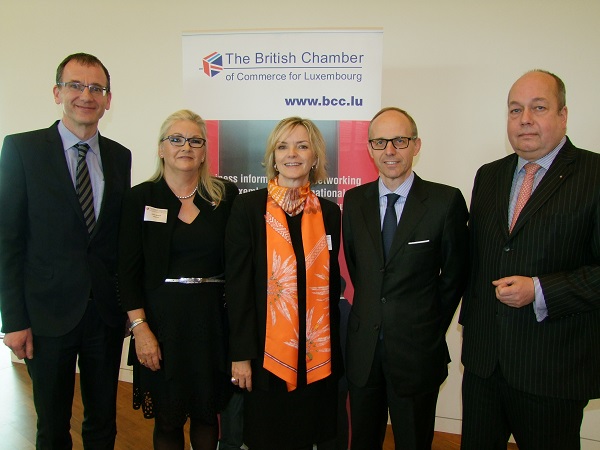
Alison MacLeod, Chairman of the BCC, introduced Friday's Chamber Luncheon by explaining that when Britain declared that it would be holding a referendum on whether to remain in or to leave the European Union, that it would be appropriate to address the issue of the Future of Europe at a chamber event, with Luc Frieden as special guest.
Luc Frieden, former Minister of Finance of Luxembourg, and more recently working as Vice-President at Deutsche Bank in London, and soon-to-be appointed Chairman of BIL, addressed the issue of "The Future of Europe" in front of over 100 members of the British Chamber of Commerce in Luxembourg at La Table du Belvedere in Luxembourg-Kirchberg on Friday.
He addressed the issue of sovereignty and also referred to the book he has written recently addressing how to address the issue of growth in Europe. He said that growth is still needed and that the crisis is still with us. It is very difficult to finance improvements, but a "better growth" is needed, to be stimulated by government as well as individuals. If the environment for growth and investment is not there, then investors will look elsewhere.
He highlighted the example of the issue of digitilisation, stressing that infrastructure is crucial for long-term growth.
He referred to the Lisbon Treaty of over 10 years ago which set an aim of having governments investing 3% of GDP in Research, the key element to encourage growth; to date, the average in the EU is around 2%. As a result, it has then been up to private industry to step in and play their part. He talked about most people in Europe - Luxembourg is atypical in this regard - staying within their country's borders.
He also stated the need to review tax regimes; he stated that it may be easy to change taxes, but to do so it is crucial to look at the long-term impact of doing so - as organisations look at tax issues before taking decision on where and how to invest. In this global economy, he mentioned three areas to take into account: digitilisation; looking at countries within the global economy; and how do we finance pensions and encourage young people to benefit societies in years to come?
In developing Europe in a better way, he acknowledged that the Single Market can certainly be improved; while it is better than it was 20 years ago, there are still issues that can be improved, in relation to the free movement of citizens and goods, e.g. registration of vehicles and setting up bank accounts.
He said that those from outside, including the US and China, etc., look at Europe as a whole, as access to 500 million consumers.
Most companies that have consolidated (vertically) in the past have become champions by acquiring other companies, including those creating jobs in Europe and exporting outside of Europe. For smaller companies, however, consolidation is almost impossible. But both co-operation and consolidation are both required.
He also argued that no single European country, small or large, can solve major issues by themselves including, for example, energy and migration, but must work together in developing solutions.
He concluded by stating that the European Union is still worth fighting for and stated that macroeconomic policies are crucial for growth in Luxembourg and in Europe.
In the Q&A after his presentation, Luc Frieden acknowledged that if Brexit does indeed happen, then it could be that other countries could follow suit, for example France if the far right gain power. He did refer to his regret that British government ministers in the past have not done what ministers from other countries have done, i.e. present the positive outcomes of many EU councils and other meetings, as the British government is now facing the difficulty now, in the run up to the referendum on 23 June, of trying to convey these positive reports which should have been done at the time.
On relations between Britain and the EU, he illustrated the fact that flights between Luxembourg and London are normally always full, a great indicator of business and collaboration between the two countries.
Photo by Geoff Thompson (L-R): Johm Marshall, British Ambassador to Luxembourg; Alison MacLeod, BCC Chairman; Sophie Kerschen, BCC; Luc Frieden; Patrick Birden, BCC