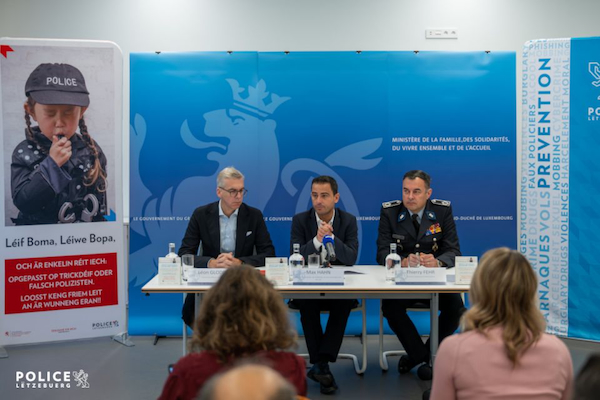
 (L-R) Léon Gloden; Max Hahn; Thierry Fehr;
Credit: CGDIS
On Monday 16 November 2026, Luxembourg’s Minister for Family Affairs, Solidarity, Living Together and Reception of Refugees, Max Hahn, Minister for Home Affairs, Léon Gloden and the Central Director of the Administrative Police, Thierry Fehr, presented an awareness campaign highlighting the different types of scams targeting older people.
According to the CGDIS, the aim is to remind people of the main risks and the appropriate precautions to take to better protect themselves against attempted fraud.
The launch of the campaign, entitled “Dear Grandma, Dear Grandpa, Don't Let Yourselves Be Fooled!”, aims to raise awareness of the various forms of fraud and remind older people of the precautions they can take to protect themselves. With fraudulent methods becoming increasingly varied, prevention and information remain essential in recognising suspicious situations and avoiding falling victim to scammers.
Recognising Scams and Taking the Right Precautions
Fake police officers, bogus tradespeople, suspicious telephone calls, promises of winnings and online fraud: scammers use a variety of methods to gain their victims' trust and obtain money or personal information from them. They do not hesitate to impersonate family members, representatives of official institutions or professionals, often exploiting a sense of urgency, fear or trust.
The CGDIS said this campaign therefore draws attention to several potentially dangerous situations: unexpected visits from strangers at home, suspicious telephone calls during which money or personal information is requested and attempted online fraud. In response to these situations, it highlights several essential precautions: always verify the identity of the person you are dealing with, do not allow strangers into your home without checking who they are, do not give in to pressure, and never disclose personal or banking details to unauthorised individuals.
Although the campaign is primarily aimed at older people, it also seeks to raise awareness among their families and wider social circles, who can help increase understanding of the different types of scams and how to protect against them.
Long-Term Preventive Measures
The prevention of scams is also part of a broader initiative by the Ministry of Family Affairs, Solidarity, Living Together and Reception, which supports several initiatives through its partner organisations aimed at strengthening the safety, independence and confidence of older people.
The Seniore-Sécherheetsberoder project, initiated by the Ministry, coordinated by GERO asbl and carried out in close cooperation with the Grand Ducal Police, is based on a peer-to-peer prevention approach. Specially trained older volunteers raise awareness among their peers about different types of scams and everyday risks. This approach encourages direct exchanges in an atmosphere of trust.
The Club Aktiv Plus centres also play an important role by encouraging social interaction, exchanges and participation among older people. By helping to prevent social isolation, they enable participants to share their experiences, obtain information and find support when faced with suspicious situations.
More broadly, initiatives supported by the ministry in the field of digital inclusion, such as Golden Me asbl, help strengthen older people's skills and raise awareness of the risks of online fraud, enabling them to use digital technologies more safely and independently.
These various initiatives complement the campaign's messages and demonstrate the importance of local preventive measures based on information, dialogue and maintaining social connections.
About the “Léif Boma, léiwe Bopa” Campaign
The campaign uses several prevention materials aimed at older people and those around them.
A door hanger provides a visual reminder of the precautions older people should take before opening their door to a stranger. A tabletop display sets out the main instructions to follow when receiving a telephone call from an unknown caller.
A leaflet, available in four languages (Luxembourgish, French, German and English), brings together the campaign's key messages. It can be distributed by local authorities, senior citizens' clubs and home help and care services.
All prevention materials can be ordered from the Police's National Crime Prevention Service (SNPC) by email: prevention@police.etat.lu or by telephone: 244-24-4033.
For more information about the different types of scams and preventive measures, visit the Grand Ducal Police website:
https://police.public.lu/fr/prevention/arnaques/arnaques-ciblant-les-personnes-agees.html.