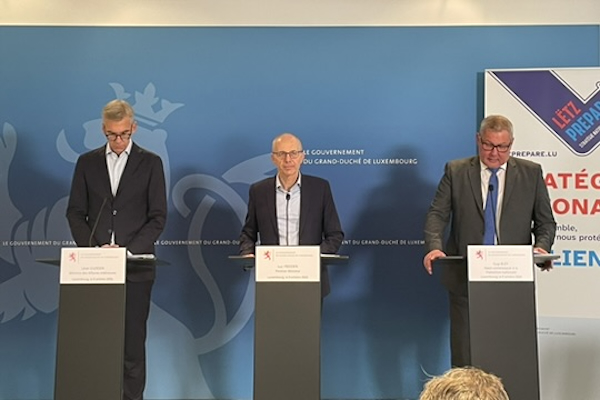
 (L-R) Luc Frieden, Luxembourg Prime Minister; Léon Gloden, Minister for Home Affairs; Guy Bley, High Commissioner for National Protection;
Credit: Steven Miller, Chronicle.lu
(L-R) Luc Frieden, Luxembourg Prime Minister; Léon Gloden, Minister for Home Affairs; Guy Bley, High Commissioner for National Protection;
Credit: Steven Miller, Chronicle.lu
On Friday 9 October 2026, the Luxembourg Government held a press conference in Luxembourg-Ville for the official launch of the preparedness guide “My Guide – 72 Hours of Self-Sufficiency”.
The press conference, led by Luxembourg Prime Minister Luc Frieden, included contributions from Minister for Home Affairs Léon Gloden and High Commissioner for National Protection Guy Bley.
The 50-page guide, which forms part of the government’s National Resilience Strategy (SNR), aims to strengthen Luxembourg’s ability to prevent, withstand and overcome the consequences of events that could affect the normal functioning of society, and is a response to the expectations expressed by citizens during the national risk perception survey conducted in spring 2026.
Available in print in Luxembourgish and French, and digitally in German, English and Portuguese, the guide has been structured around four main themes: understanding the risks, alert and information systems, the role of authorities in a crisis situation, and concrete measures to improve household self-sufficiency. It provides information on a variety of crises (flooding, cyberattack, terrorist threats, nuclear emergency, etc.), how the national public warning and information system (LU-Alert) will function under such circumstances, as well as details on how alert levels and warning channels function based on the impact and severity of significant situations requiring warnings or information to be issued.
Additionally, the guide includes a list of essential equipment, practical recommendations, and a personal emergency plan that incorporates communication, support for vulnerable individuals, and the safekeeping of important documents. The personal emergency plan covers issues such as “Eating and Cooking”, “Staying Warm”, “Self-Care”, “Stay informed, stay in touch” and “Documents”, and is intended to help households prepare resources in advance for the first 72 hours of any major disruption affecting essential services.
Prime Minister Frieden emphasised the importance of the guide, stating: “Resilience means being able to resist and this means being ready for any crisis. We have to be prepared, to think, to plan and to act. This applies to society as a whole. This is an important moment for all of us in the country. Not only in the state but also in the authorities and institutions.”
He cited the example of Finland and its preparedness for crisis situations, and stated: “We live in a time in which we as a country in Europe are often confronted with different risks and crises… We are not at war. We are still at peace. We go along with the crises, which are a consequence of geopolitical situations. We as a country have to prepare.”
He added: “Of course, the state has to do its job. The state, especially in the first hours, has to take care of a lot of things. It has to analyse, it has to help the vulnerable people and, therefore, it is important that everyone prepares what to do in the following two or three days. The guide will be helpful in very different situations.”
Minister Gloden added that the government is working with local authorities and the emergency services to prepare for significant disruptions and emphasised: “We are already resilient but we must be resilient for the next crisis.”
The government will begin physically distributing Luxembourg and French versions of the guide from Wednesday 14 October, with around 300,000 copies being sent to all households in the country. The digital and simplified versions of the guide can be downloaded from www.lëtzprepare.lu.
The Luxembourg Government also announced the launch of the 2026 edition of the national awareness campaign against online fraud as part of its National Resilience Strategy.