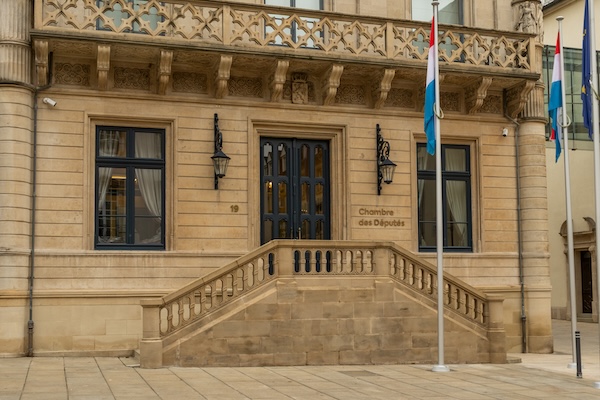
 Luxembourg Chamber of Deputies;
Credit: Ali Sahib, Chronicle.lu
Luxembourg Chamber of Deputies;
Credit: Ali Sahib, Chronicle.lu
On Thursday 1 October 2026, Luxembourg’s Chamber of Deputies presented its annual review of parliamentary activity, covering the period from October 2025 to September 2026, and detailed its priorities for the coming year.
Parliamentary activity
According to the chamber, during the period, it held 60 public sittings, amounting to 221 hours of debate. The Bureau met nineteen times, while the Conference of Presidents held sixteen meetings. Parliamentary committees and working groups met 483 times. A total of 238 meetings were broadcast live.
On the legislative side, 165 bills were submitted and 155 were adopted in public sittings. Parliament also received 22 private members' bills, although none were adopted. One constitutional revision proposal was adopted at the second constitutional vote.
Members submitted 1,725 parliamentary questions, including 74 urgent questions. Of these, 27 were recognised as urgent.
One public debate took place during the period, while three further debates were in preparation. Parliament received 347 public petitions and 92 ordinary petitions, for a total of 439 petitions.
Modernising parliamentary procedures
The chamber said it is continuing work on reforming and modernising its rules of procedure. The aim is to make parliamentary debates more dynamic and transparent.
Measures under consideration or being introduced include shorter speaking times in certain circumstances, the introduction of a current affairs debate, a trial phase for changes to government question time, clarification of the rules governing motions, resolutions and emergency procedures, and changes to the operation of parliamentary committees. Committee transparency and confidentiality rules are also being reviewed.
During government question time, deputies can now speak directly from their seats, with the aim of making public debates more fluid.
Scientific expertise for Parliament
The chamber noted that its scientific unit continues to provide independent research and expertise to support deputies in dealing with complex subjects. Its work has expanded to include shorter research notes, produced more quickly in response to specific questions from deputies, as well as a more formal network of external experts.
The scientific unit has also strengthened its international cooperation. This includes work with the International Francophone Network for Scientific Advice and the European Parliamentary Technology Assessment network.
The chamber announced that Luxembourg will hold the rotating presidency of EPTA in 2027, with an international conference planned in Luxembourg in autumn 2027.
Democratic 'stress test'
In March 2025, the chamber launched a project to examine how democratic institutions could respond to the possible arrival of an authoritarian regime in power. The scientific unit was tasked with carrying out the project. The first series of research notes was published in May 2026 and examined whether international law provides protection against authoritarian developments.
The second part of the project, concerning the strength of the institutional balance guaranteed by the Constitution, was published this week.
More than ten further notes are currently being prepared. A conference to present and conclude the project is planned for 2027.
Voting rights of Luxembourgers living abroad
The scientific unit reported that 160,116 Luxembourgers were registered as living abroad on 31 March 2026, representing 30.2% of all Luxembourgers.
The unit has also examined how other countries approach voting rights for citizens living abroad. The Institutions Committee has discussed the issue, with parliamentary groups and political sensitivities expected to present their positions in autumn.
Major issues debated
The chamber addressed a range of major social and political issues during the parliamentary year, including working hours, rising prices, the tripartite process, poverty and pensions.
Other topics included the healthcare system, demographics, end-of-life issues, climate change, persistent pollutants, security and the geopolitical situation.
Parliament also approved a constitutional amendment concerning the freedom to access voluntary termination of pregnancy, with more than two-thirds of deputies supporting the change by the required qualified majority.
Parliamentary committees increasingly open to the public
Since 15 September 2025, eighteen parliamentary committees have been broadcast live on the chamber's website, compared with five committees during the initial trial phase launched in April 2024. In total, 238 committee meetings were broadcast during the reporting period.
The broadcasts generated 77,034 replay views, an average of 323 views per broadcast. The Education Committee was the most-watched committee, with fourteen broadcasts and 6,778 replay views, averaging 484 views per broadcast.
New legal framework for three bodies
A proposed law, number 8764, seeks to establish a single and harmonised legal framework for three bodies attached to the chamber: the Ombudsman, the Ombudsman for Children and Young People (OKAJU), and the Centre for Equal Treatment (CET).
The proposal would bring the provisions governing the three bodies together in a single text while strengthening their independence, powers and resources and clarifying the responsibilities of the chamber and its bureau.
Among the proposed changes, the Ombudsman would receive new responsibilities relating to the protection of human rights. The Centre for Equal Treatment would be renamed the National Anti-Discrimination Centre.
Parliamentary diplomacy
The chamber reiterated that its international strategy focuses on strengthening multilateralism and cooperation with countries that share this approach.
Since September 2025, official visits have been made to Greece, Canada, Romania, Slovakia, China and the German-speaking Community of Belgium. Further visits to Türkiye and Poland are planned for the end of 2026.
Luxembourg currently holds the rotating presidency of the Benelux Interparliamentary Assembly until 31 December 2026. The Parliamentary Assembly of the Francophonie is due to hold its next plenary session in Luxembourg in summer 2027.
Luxembourg will also assume the presidency of the Interregional Parliamentary Council from 2027.
Financial oversight and digital security
The chamber's 2025 accounts are the first to undergo an audit by the Court of Auditors covering the legality and regularity of expenditure. Political groups and sensitivities will have their 2026 accounts subject to an initial review of compliance with financial management rules.
The chamber said it is also strengthening cybersecurity measures in response to continuing digital attacks.
In 2026, the chamber recorded two compromised passwords, nine DDoS attacks, one compromised server involving an intrusion into its IT network and seven incidents unrelated to attacks, such as technical problems affecting publicly accessible services.
Digital modernisation and artificial intelligence
The chamber said it is continuing to digitise parliamentary procedures. A new platform has been introduced to centralise parliamentary work and access for staff, deputies, groups and political sensitivities.
Eleven applications and processes are being replaced by a single system. The project is around 80% complete, with an investment of approximately €6 million over five years.
The chamber is also developing several artificial intelligence projects, including automatic subtitles for public sittings in multiple languages, a research assistant for users of chd.lu and an internal large language model.
Security and renovation
Over the past three years, significant work has been carried out to bring the Chamber's buildings into line with security standards. The projects have cost almost €23 million from the budget of the Public Buildings Administration.
Security improvements include controlled access systems at three buildings and renovation work at the Hôtel de la Chambre.
Support for parliamentary journalists
The chamber highlighted that it continues to adapt its facilities to the needs of journalists covering parliamentary affairs.
A workshop with media representatives and the Press Council was held on 25 May 2026 to discuss journalists' needs, including interview arrangements, facilities for the press and access to parliamentary documents.
A new subscription function on chd.lu also allows users to receive notifications about meetings and sittings, documents and questions, as well as forthcoming website articles and scientific research notes.
New visitor centre
The chamber announced plans to open the new 'Visitor Centre Chamber' at the corner of Rue du Marché-aux-Herbes and Rue de la Boucherie by the end of 2027.
The facility will provide interactive educational material about citizenship, host educational workshops and serve as an information centre for people interested in parliamentarism.
The chamber acquired the building for €12.7 million in mid-2026. Parliamentary staff and deputies have already begun working there, including the scientific unit and the déi gréng political group.
Youth and public visits
The chamber organised 145 guided visits for people interested in its work, an increase of 21 compared with the previous year despite a four-month suspension caused by renovation work.
The Zentrum fir politesch Bildung organised 55 workshops for school classes, involving around 1,304 participants and 112 teachers.
The Youth Parliament met at the chamber on 26 June 2026. Around 50 young people aged between fourteen and 24 years-old discussed issues including mental health at school, gender-based violence, homophobia, the geopolitical situation, greenwashing, defence and the voting age.
The 20th edition of the Jugendkonvent is scheduled for Saturday 14 November 2026, with around 100 young people expected to participate in four workshops on democracy.
Parliamentary history
The parliamentary history service, established in January 2025, has produced exhibitions and launched projects covering oral history and biographies of former presidents and deputies.
It has also published two editions of the Cahiers d'histoire parlementaire, covering Parliament during the Second World War and relations between the Chamber of Deputies and the monarchy.
European Heritage Days
The Chamber of Deputies and the Grand Ducal Palace will open their doors to the public on Saturday 17 October as part of the European Heritage Days.
The simultaneous opening will allow visitors to explore both institutions. The event will also highlight the collection of portraits of the Grand Dukes and Grand Duchesses of Luxembourg.
Admission will be free and no prior registration will be required. The event will run from 10:00 to 17:00, with the last entry at 17:00.
Parliamentary calendar
Parliamentary committee work resumed on Monday 14 September.
The 2027 state budget will be submitted and presented on Wednesday 7 October at 09:00.
Public sittings will take place on Tuesday 13 October and Wednesday 14 October, including the swearing-in of three new deputies.
The public Heritage Day will take place on Saturday 17 October.
Further information and the full parliamentary calendar are available at https://www.chd.lu/en/agenda.