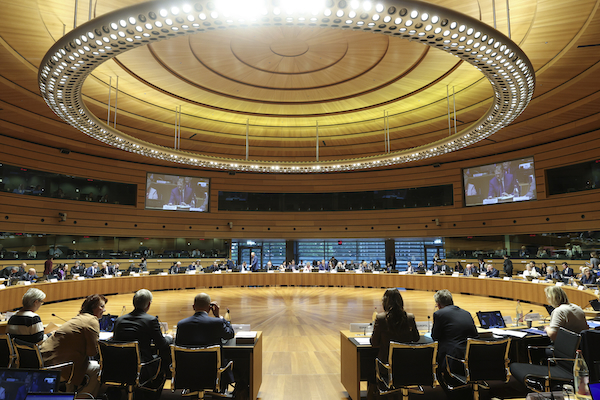
 The meeting of the Justice and Home Affairs Council (JHA) in Luxembourg on Thursday 1 October 2026;
Credit: The Council of the European Union
The meeting of the Justice and Home Affairs Council (JHA) in Luxembourg on Thursday 1 October 2026;
Credit: The Council of the European Union
On Thursday 1 October 2026, Luxembourg’s Ministry of Home Affairs reported on the participation of Minister for Home Affairs Léon Gloden in the meeting of the Justice and Home Affairs Council (JHA) on Thursday in Luxembourg.
According to the ministry, the first session was devoted to the Schengen Council to take stock of the situation in the Schengen area, follow up on the summer crisis in Ceuta and review progress in the exchange of police data and the development of new technologies. Commissioner Magnus Brunner explained the decrease in migratory pressure, the decrease in asylum applications and the initial progress on returns in the Schengen area. He then presented his five-point action plan to draw lessons from the crisis in Ceuta in order to better anticipate and manage situations involving mass migratory influxes.
During his intervention, Minister Gloden noted: “Our joint efforts are bearing fruit and, despite a decrease of around 32% in irregular border crossings compared with 2024, ten Member States still maintain controls at their internal borders.” He stressed: “We need an exit strategy and to rebuild mutual trust.” In Luxembourg, asylum applications decreased by 27% between 2024 and 2025.
The ministry said that regarding the follow-up to the crisis in Ceuta, Minister Gloden supports the deployment of monitoring in order to anticipate and counter disinformation encouraging mass influxes. “The Frontex agency must also become a rapid intervention reserve at the service of the Member States.”
As regards the exchange of police data and the development of new technologies, Minister Gloden stressed:“The internal security of the Schengen area relies on a smooth and effective exchange of information between the competent authorities of the Member States.” The Entry/Exit System (EES) is a success, as demonstrated by the recording of data from 210 million people and the refusal of entry to approximately 2,000 people who pose a risk to internal security in connection with terrorism, drug trafficking and organised crime. Minister Gloden believes that the Schengen area no longer needs new systems, but that existing systems need to be used more effectively: “A better sharing of information = a stronger Schengen = strong protection of our external borders.”
The ministry reported that the ministers then discussed improving returns by strengthening cooperation with priority third countries. Minister Gloden reported that the return rate in Luxembourg has increased significantly in recent years, with a total of 1,206 returns since 2024, representing an increase of 47%. “Voluntary returns are actively encouraged and promoted in Luxembourg and, as a result, are becoming increasingly important.”
According to Minister Gloden, at European level, “we should consider a more flexible approach to concluding readmission agreements. A method needs to be defined that allows for gradual progress with strategic partners, starting, where appropriate, with certain categories of people, such as convicted persons, and providing positive incentives, including legal migration. But in the event of a refusal to cooperate, the European Union must use the levers available in the areas of visas and trade.”
The afternoon session was devoted to the phenomenon of intimidation and violence linked to drug trafficking. On the basis of an example presented by Ireland, the ministers stressed the need for a multidisciplinary approach combining prevention, social action, public health, police cooperation and the judicial response. The discussion also highlighted the importance of strengthening the exchange of good practices between Member States and of raising awareness among the relevant stakeholders of a phenomenon that remains insufficiently identified in some parts of the European Union.
On the margins of the Council, Minister Gloden met the future Lithuanian President of the EU Council, Martynas Katelynas, to discuss the priorities of the JHA Council during the first half of 2027.