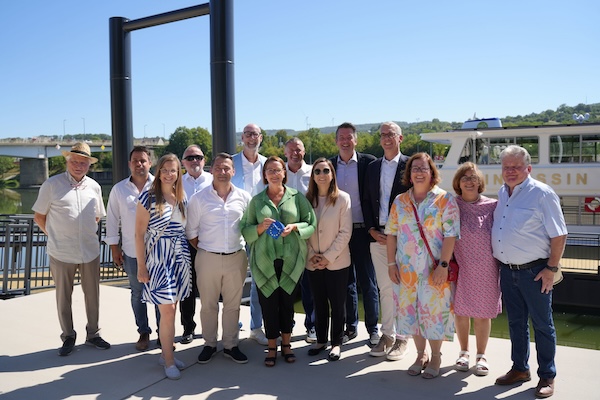
 Group photo;
Credit: MMTP
Group photo;
Credit: MMTP
Luxembourg's Ministry of Mobility and Public Works has announced the inauguration of the new pontoon and berth for the Princesse Marie-Astrid Europa in Schengen, which took place on Wednesday 29 July 2026.
According to the ministry, the new infrastructure is designed to improve safety, comfort and accessibility for visitors while strengthening the appeal of one of Europe's most symbolic historical sites.
The inauguration ceremony was attended by Yuriko Backes, Luxembourg’s Minister of Mobility and Public Works, Lex Delles, Luxembourg’s Minister of the Economy, SMEs, Energy and Tourism, Michel Gloden, Mayor of the Municipality of Schengen, the Director of Luxembourg’s Roads Administration, as well as representatives of the institutions and partners involved in the project.
"Far more than a mooring structure designed to serve the public, this pontoon forms a link between the past and the future. It preserves the memory of a defining moment in European history while offering present and future generations renewed access to this exceptional heritage. Located at the meeting point of Luxembourg, France and Germany, at the heart of the cross-border Greater Region, the Schengen site provides tangible evidence of the values of openness, cooperation and mobility on which European integration is based. These are values that are lived, upheld, renewed and passed on every day," said Minister Backes.
The project forms part of the redevelopment of the European Schengen Museum and the historic Princesse Marie-Astrid Europa, carried out to mark the 40th anniversary of the signing of the Schengen Agreement. The aim is to permanently anchor the historic vessel within Schengen's museum and tourism offering.
"With the inauguration of the pontoon for the Princesse Marie-Astrid Europa in Schengen, the tourism offering is now complete. Schengen, where the Schengen Agreement was signed and which marks the birth of the European Union, is the only Luxembourg site recognised with the European Heritage Label and therefore represents an example of remembrance tourism, a key pillar of our national tourism strategy," said Minister Delles.
Mayor Gloden added: "Today marks an important milestone, as the completion and commissioning of the quay and pontoon conclude the project to modernise the museum and renovate the Princesse Marie-Astrid Europa."
Formerly known as the MS Princesse Marie-Astrid II, the vessel hosted the signing of the Schengen Agreement on 14 June 1985 by Belgium, France, Germany, Luxembourg and the Netherlands. It also served as the venue for the signing of the Convention Implementing the Schengen Agreement on 19 June 1990, making it the only vessel of the five Princesse Marie-Astrid ships to have played a direct role in the creation of Europe's free movement area.
The vessel was acquired in 2021 by the Municipality of Schengen with support from the Luxembourg State and returned to its historic mooring after an extensive renovation under the name Princesse Marie-Astrid Europa. It now forms part of the European Schengen Museum as a place of remembrance dedicated to preserving and transmitting the values underpinning the European project.
The ministry noted that the new pontoon has been designed to ensure the vessel can remain permanently moored under optimal safety conditions while accommodating fluctuations in the Moselle's water level and periods of flooding. The infrastructure also provides safer, more comfortable and more accessible access for visitors, with particular attention paid to universal accessibility and the integration of the structure into its surroundings.