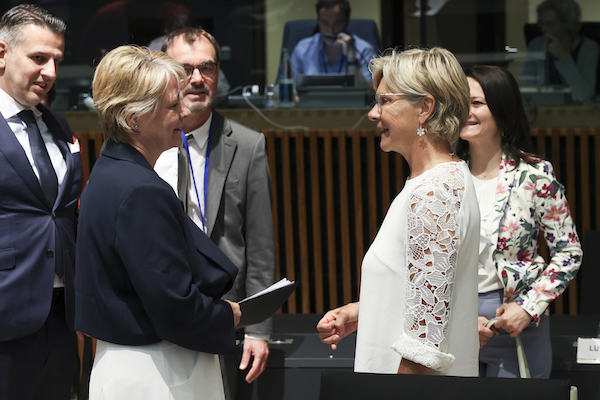
 (L-R) Krisztina Jobbágy, State Secretary, Ministry of Agriculture and Food of Hungary; Martine Hansen, Luxembourg Minister of Agriculture, Food and Viticulture;
Credit: European Union
(L-R) Krisztina Jobbágy, State Secretary, Ministry of Agriculture and Food of Hungary; Martine Hansen, Luxembourg Minister of Agriculture, Food and Viticulture;
Credit: European Union
On Wednesday 24 June 2026, Luxembourg’s Ministry of Agriculture, Food and Viticulture reported on Luxembourg’s participation at the European Union Council of “Agriculture and Fisheries”, which was held on Monday 22 and Tuesday 23 June in Luxembourg.
According to the ministry, ministers held, among other items, a policy debate on the future of the Common Agricultural Policy (CAP) after 2027, as well as an exchange of views on the situation of agricultural markets. The ministers also heard a presentation by Taras Kachka, Deputy Prime Minister of Ukraine, on the difficult situation of the agricultural sector in his country.
At the council, Luxembourg’s Minister for Agriculture, Food and Viticulture, Martine Hansen, reiterated the full support of the Luxembourg Government for Ukraine. She emphasised that Europe and Ukraine are partners in developing sovereign agriculture on the European continent, while stressing the need to take into account the needs of sensitive sectors in Europe.
In the context of discussions on the future CAP, Minister Hansen stressed the importance of a coherent, flexible agricultural policy centred on farmers who contribute to food sovereignty and the maintenance of agricultural activity in rural areas.
Minister Hansen also emphasised the need to continue discussions on the definition of an active farmer and the targeting of aid, in order to direct support more towards holdings that create added value.
The minister recalled that during discussions held on Monday 5 June 2026 with representatives of the agricultural, viticultural and horticultural sectors, it was agreed that the system based on the active farmer, as currently in place, should be maintained in Luxembourg, possibly with some minor adjustments. She also recalled that support for young farmers must remain a priority and called for sufficient flexibility for Member States in the implementation of certain CAP mechanisms. Luxembourg also reaffirmed its commitment to common European objectives, while ensuring respect for the principle of subsidiarity and a smooth transition between programming periods.
Regarding the situation of agricultural markets, Minister Hansen noted that milk prices had fallen significantly during the first half of 2026, and she expressed caution regarding a gradual stabilisation of markets but warned that the ongoing rebalancing could lead to deep restructuring to the detriment of dairy producers, who are among the most vulnerable in the sector.
Minister Hansen also highlighted that geopolitical tensions continued to weigh on agricultural sectors, particularly through rising energy and fertiliser prices. She welcomed the European Commission’s swift response and the measures proposed to support farms, while calling for rapid and pragmatic implementation so that aid can reach farmers without excessive administrative burdens.
Moreover, Minister Hansen recalled the importance of strengthening the autonomy of European agriculture, particularly in relation to inputs, and of continuing work on strategies relating to fertilisers, plant proteins and livestock.