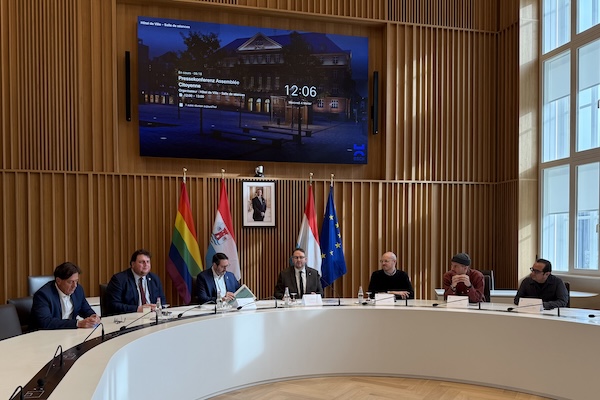
 Launch press conference of the Citizens’ Assembly;
Credit: Ievgenii Karanov, Chronicle.lu
Launch press conference of the Citizens’ Assembly;
Credit: Ievgenii Karanov, Chronicle.lu
On Wednesday 4 February 2026, the City of Esch-sur-Alzette launched its first Citizens’ Assembly, introducing a new participatory process aimed at involving residents in shaping the city’s future.
The launch press conference took place at Esch City Hall and was led by Christian Weis, Mayor of Esch-sur-Alzette, alongside aldermen Bruno Cavaleiro and Meris Sehovic, as well as James MacDonald-Nelson (DemocracyNext), Markus Miessen and César Reyes from the University of Luxembourg.
The Citizens’ Assembly is intended to provide residents with a direct role in shaping the future of Esch-sur-Alzette, allowing them to contribute to discussions on social, urban and environmental challenges facing the city. The initiative seeks to strengthen local democracy by drawing on collective intelligence and encouraging broader citizen involvement in municipal decision-making. The Esch Assembly is the result of a collaboration between the local project Cultures of Assembly, the University of Luxembourg and the international research and action institute DemocracyNext.
In an interview with Chronicle.lu, Mayor Christian Weis said the Citizens’ Assembly was created to reach residents who are rarely involved in traditional participatory processes. Referring to the last elections, he noted that out of around 38,000 residents in Esch-sur-Alzette, only about 12,000 votes were ultimately counted. “We see that elections and public meetings tend to attract the same people, while many others do not take part at all,” he explained, adding that the new format aims to better reflect the diversity of the city’s population.
He said participants would be invited to discuss practical questions about the city’s future, including urban development, spaces for social interaction and how Esch should respond to challenges such as the climate transition. “The idea is to have a representative assembly that can give input and speak directly to politicians, not only on behalf of activists, but in the interest of the city as a whole,” the mayor said.
According to Mayor Weis, around 10,000 randomly selected residents will receive invitations in the coming days, with a final group of about 40 participants to be chosen through a second draw conducted with support from the University of Luxembourg and DemocracyNext. The assembly is set to begin on 16 March 2026 and conclude at the end of June.
Speaking at the launch, James MacDonald-Nelson, Project Lead for Urban Design and Planning at DemocracyNext, explained that the project forms part of a broader international programme supporting cities in developing inclusive decision-making processes. “The goal is to help institutions involve citizens more directly in everyday decision-making,” he said, adding that Esch-sur-Alzette was selected as one of a small number of cities where context-sensitive Citizens’ Assemblies are being developed. According to him, the process will address key local issues, including urban transformation and the transition from an industrial past towards a knowledge- and service-based economy.
According to the City of Esch-sur-Alzette, the Citizens’ Assembly will take place over several months and will be supported by facilitators from Snakke & Co, a Luxembourg-based company specialising in participatory processes. Their role will be to ensure a structured, inclusive and balanced framework, fostering constructive dialogue among participants throughout the process.
Residents who receive an invitation will be able to register either via the online form available at www.assembleecitoyenne.esch.lu or by tel.: 275-2440. Registration requires the personal code indicated on the invitation and must be completed by Friday 27 February 2026. Once registered, participants will be contacted by the City of Esch with further practical details.
The city also announced that a public information session will be held on Monday 23 February 2026 from 18:00 at City Hall. Registration for this session is required via email at assembleecitoyenne@villeesch.lu.
All practical information regarding the Citizens’ Assembly is available online at www.assembleecitoyenne.esch.lu.