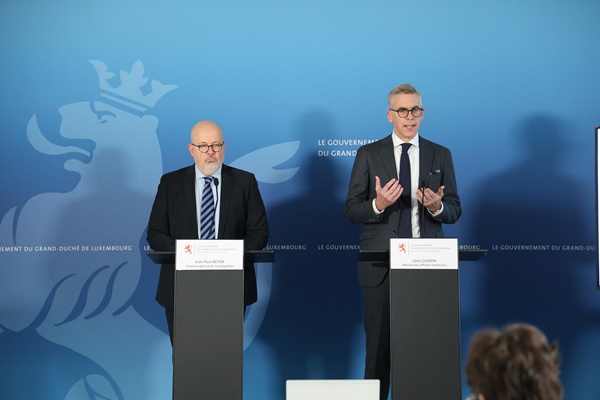
 (L-R) Jean-Paul Reiter, Director General of Immigration; Léon Gloden, Luxembourg's Minister for Home Affairs;
Credit: MAINT
(L-R) Jean-Paul Reiter, Director General of Immigration; Léon Gloden, Luxembourg's Minister for Home Affairs;
Credit: MAINT
On Wednesday 14 January 2026, Luxembourg's Minister for Home Affairs, Léon Gloden, accompanied by Jean-Paul Reiter, Director General of Immigration, presented the draft law implementing the European Pact on Migration and Asylum, the EU's common system for managing migration.
According to the Ministry of Home Affairs and its Directorate-General for Immigration, the EU Pact on Migration and Asylum is a key element of immigration policy, which takes societal challenges into account. The pact aims to ensure:
- an effective system of solidarity and responsibility;
- secure external borders;
- swift and efficient procedures;
- the integration of migration into international partnerships.
The authorities said this will contribute to a fair distribution of asylum seekers within the EU. They added that Luxembourg remains a country of solidarity, fully assuming its responsibilities. Despite having no external land or sea borders, the Grand Duchy has been among the top EU countries in terms of the number of asylum seekers per capita in recent years. It also ranks: second in the EU in terms of reception relative to population and GDP, after Germany; third in secondary migration numbers within the EU, after Slovenia and Belgium; sixth in asylum applications per capita in 2024 and seventh in 2025.
Minister Gloden stated: "People with a genuine prospect of obtaining refugee status must receive a swift response. Otherwise, it is unfair and frustrating. At the same time, they must be supported in their integration. People with no prospect of obtaining refugee status should not be given false hope. Therefore, they should also receive a swift response, i.e. a refusal, and be able to return to their country of origin quickly. The same applies to those who are in the country illegally or who pose a threat to public safety."
The reform comprises eight EU regulations and one directive, which will enter into force on 12 June 2026. Negotiations took place between 2020 and the end of 2023, and the texts were adopted by the European Parliament in April 2024 and the Council of the European Union in May 2024. Its national implementation requires transposition of the EU texts and procedural, technical and infrastructural adjustments.
A main new feature is the screening process, which aims to:
- establish the identity of individuals as quickly as possible (within three or seven days, depending on the case);
- conduct security, health and vulnerability checks;
- direct individuals to the appropriate procedure as quickly as possible.
The reported goal of screening is to simplify administrative procedures and reduce processing times. It is estimated that approximately 350 third-country nationals will undergo screening in Luxembourg each month.
Screening applies to: applicants for international protection without valid documents in the country; undocumented third-country nationals apprehended by police; and applicants for international protection without valid documents at the external border (Luxembourg Airport).
For each case, the outcome will either be an asylum procedure or a return procedure.
According to Luxembourg's authorities, reorganising the criteria and shortening the time limits for determining the responsible Member State will allow faster access to the asylum procedure and reduce secondary movements.
Moreover, the EU pact brings a paradigm shift for asylum appeals in Luxembourg: appeals no longer have automatic suspensive effect, except for the standard asylum procedure. Appeals are thus only possible for the standard procedure and for cases involving the withdrawal of international protection by the minister.