 Credit: ASTA
Luxembourg experienced record-high temperatures for February this year, according to the ASTA weather bulletin.
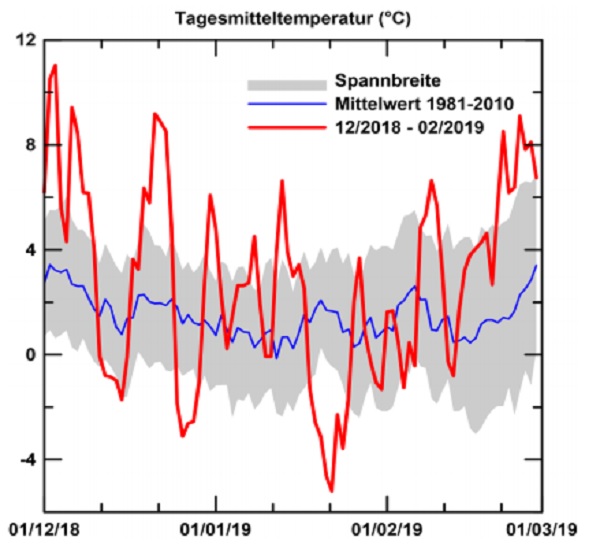
The State Meteorological Service of the ASTA (Department of Agricultural Services - Ministry of Agriculture, Viticulture and Rural Development) has carried out a weather analysis for winter 2018/19, taking into account the period from 1 December 2018 to 28 February 2019. The analysis looked at the network of 32 automatic weather stations across the Grand Duchy.
This year's weather data was compared with the averages of the reference period 1981-2010. A special focus was placed on the following four representative stations Asselborn (north), Clemency (south-west), Remich (Mosel) and Grevenmacher (Mosel). The mean temperatures for each of these regions this winter were higher than the long-term average: +1.6°C in Asselborn, +1.3°C in Clemency, +1.2°C in Remich and +1.1°C in Grevenmacher. More specifically, temperatures were higher on average in both December 2018 and February 2019 than in the reference period. Only January was a bit cooler at all stations.
Nevertheless, winter 2018/19 ended with unusually high temperatures. To illustrate, the City of Luxembourg set a new record for its daily maximum temperature in February, on 27 February 2019, at 21.6°C. This is the highest such temperature for February since registered records began in 1838. The highest temperature of the country, however, was measured at 23.9°C at the Remich station.
Precipitation totals divided the country into two parts; whilst there was a slight rainfall deficit in the Ösling, the rest of the country experienced an overall surplus of precipitation compared to the long-term average. In December, in particular, rainfall totals recorded at all stations exceeded those of the reference period. This was especially the case in the first three weeks of December. Clemency and Remich recorded 196mm and 144mm of precipitation, more than twice that of the reference period (94mm and 71mm, respectively). In contrast, January and February were less precipitous at all four stations than in previous years.
Thus, winter 2018/19 was up to 1.6°C warmer than the long-term average and new records of maximum temperatures for February were recorded across the country. The precipitation totals in winter 2018/19 were lower in the north and higer in the south of the country than the long-term average.