 Credit: LIST
The spring of 2018 was warmer in Luxembourg compared to the long-term average and more precipitous in the east of the country, according to LIST’s seasonal weather bulletin.
This past spring was largely characterised by very cold weather in March, while April and May were often as warm as early summer would be. Indeed, May 2018 has been the warmest May since 1947.
In March, eastern and north-eastern currents increasingly carried cool air masses to Luxembourg, whilst April was mostly characterised by persistent high-pressure areas. As a result, summer temperatures and cloudless skies mainly prevailed, apart from some cool unstable maritime air masses in late April. Meanwhile, May was initially dry and warm and the warm and humid air masses of Luxembourg were often reached from mid-month onwards, which led to an increase in the thunderstorm risk.
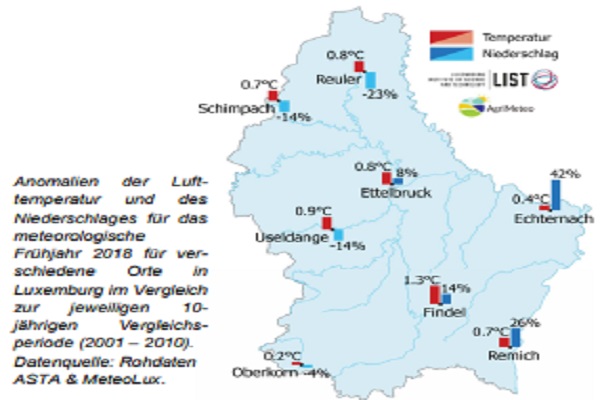
Moreover, spring 2018 saw higher temperatures, on average, recorded by the Administration of the Services Techniques de l'Agriculture (ASTA) and the MeteoLux station compared to those of 2001-2010. The smallest deviation was 0.2 ° C at the Obercorn station (ASTA), while the highest deviation was recorded at the Findel station (MeteoLux) at 1.3 ° C (+ 1.9 ° C compared to the reference period 1981 - 2010).
The absolute maximum air temperature recorded for the spring of 2018 was recorded at 29.4°C on 28 May in Schimpach. Meanwhile, temperatures at Findel were also above those of the comparable periods, especially in April and May. In fact, May 2018 was the warmest May since recordings began at Findel in 1947.
At the stations of ASTA in the east of the country and Findel (MeteoLux), total precipitation was, however, higher than in the comparative period 2001 - 2010. On the other hand, negative deviations were measured in the west and north. Echternach and Ettelbrück recorded the highest levels of precipitation, at around 220m.
The spring ended with heavy thunderstorms and heavy rainfall on the night of 1 June.