The publication of the 42nd General Report on Social Security is part of the tasks to be carried out by the General Social Security Inspectorate (IGSS), namely to collect the necessary statistical data both at national and at international level, while respecting the principles of the European Statistics Code of Practice as a member of the European Statistical System.
The report presents in detail the evolution of the revenues and expenditures of the various social protection schemes, the characteristics of the beneficiaries, an analysis of the beneficiaries as well as the services provided and supported by the various schemes.
Key figures for the year 2016
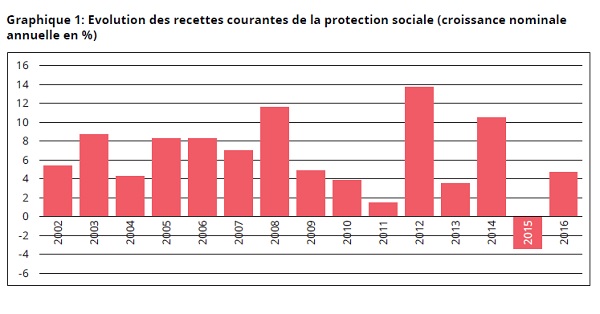
In 2016, current receipts from social protection amounted to €13,155 million, up 4.7% from 2015. Current expenditure reached €11,664 million, an increase of 1.0% compared to 2015. The balance sheet for the year 2016 therefore presents a positive overall balance of €1,491 million, or 2.8% of GDP.
On the benefits side, by adopting the structure proposed by SESPROS (European system of integrated social protection statistics), the benefits of the old-age / survivorship function represent, with a share of 39.5%, the largest expenditure of all benefits provided by the social protection system in 2016. Then, in order, are the benefits of the health / health care function (24.6%), those of the family function (15.4%) and those of the disability function (10.7%), which includes disability pensions, accident benefits and annuities, income for severely disabled people and long-term care insurance benefits.
Unemployment benefits, early retirement benefits and the various measures for employment that make up the unemployment function account for 5.8% of all benefits. Finally, benefits from housing and social exclusion make up 3.9% of benefits. Over the past 15 years, this structure has changed very slightly as a result of economic, demographic and / or institutional changes.
On the revenue side, four sources of financing can be isolated: public authorities, including as employers (49.8%), protected persons (23.3%), employers outside the public sector (19.8%) %) and other sources (7.2%), consisting mainly of property income. This distribution applies to the entire social protection system, but each scheme has its own mode of financing.
The population protected for the health insurance scheme amounts to 813,124 people for an annual average of 2016. Among them, 68% are protected in their personal capacity and 32% benefit from derived rights. Reflecting the particularity of the Luxembourg labour market, which has a significant share of cross-border workers, 66% of the protected persons are residents and 34% are non-residents. These non-residents contribute to the national social protection system just as they benefit from it.