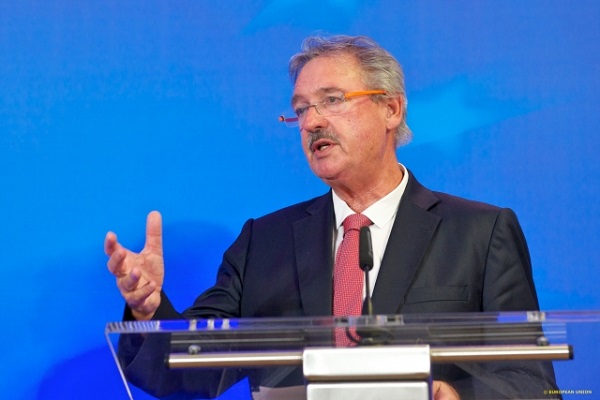
The Luxembourg Minister for Immigration and Asylum, Jean Asselborn, has again been forced to come out in defence of the country's reception process after hundreds of Iraqi asylum seekers conducted a silent demonstration in front of the buildings of the Directorate of Immigration on Wednesday afternoon.
The Iraqi applicants feel that they are being discriminated against, that their applications are taking far longer than requests from Syrian asylum seekers. A similar situation unfolded in February earlier this year and led to a 40-strong demonstration, but this time Iraqis arrived in their hundreds to indicate their frustration.
Minister Asselborn has subsequently released a statement through the Directorate of Immigration, claiming that Iraqi records are highly complex in comparison to Syrian cases. He stated that the law of 18 December 2015 on temporary protection provides that, in complex cases, the six-month period in which the procedure should be completed may be extended for nine more months when intricate factual or legal issues are involved.
The Minister argued that this extension can also be applied when a large number of third country nationals or stateless individuals request international protection at the same time, pointing to the influx of asylum seekers in the Grand Duchy that has seen 374 applications received in September, 381 in October, 423 in November and 429 in December 2015. However this influx has slowed since early 2016.
82.91% of the 632 Iraqi applicants who submitted an application for international protection since July 2015 are still awaiting a decision.
The statement claimed that the Refugee Service conducted an internal analysis of waiting applicants and identified cases of high vulnerability and with a need for special procedural guarantees, such as single mothers, young women travelling alone and families with disabled children.
The statement however conceded that Syrian folders are now shorter, attributing this to the current situation in Syria which means that people no longer need to explain in detail through individual interviews why they fled their country of origin. The main focus is instead on establishing the identity and origin of the applicants.
Minister Asselborn further pointed to a security aspect, namely that all applicants identity documents must be analysed by a special unit of the Grand Ducal Police to establish their authenticity, before promising that the staff of the Refugees Service of the Immigration Directorate are due to be reinforced with seven high-ranking officers so that applicant wait times can be shortened, particularly the cases of Iraqi asylum seekers.
Photo by EU Council (Jean Asselborn at JHA Council)