A new bill presented last week aims to adapt Luxembourg law in order to enable the implementation of the "Opferambulanz" project regarding the forensic documentation of violence.
The project falls under the "Justice", "Equality between Women and Men" and "Health" chapters of the government programme, entrusting the mission of the forensic documentation of violations to the National Health Laboratory in Dudelange which operates under the Ministry of Health.
"In many cases, particularly in terms of physical and sexual violence, including domestic violence, victims of assault are reluctant to lodge a complaint," explained Minister of Justice, Félix Braz.
When victims do concede to inform the relevant law enforcement authorities following several violence incidents, documentation of previous attacks is often lacking. Consequently, the last reported incident may be legally considered as the first assault, which often leaves victims feeling a sense of injustice.
Even if the victim sought medical attention for previous assaults, the related medical documentation was created for healing and therapeutic purposes rather than for a forensic approach and therefore does not contain all the elements necessary for a criminal prosecution. Meanwhile, many doctors who are consulted by victims of domestic violence have not received specific training on domestic violence regarding specialist knowledge in the diagnosis and descriptions of domestic violence.
As medical reports are valuable evidence in court proceedings, they need to be as best documented as possible, allowing the prosecutor to assess the seriousness of the acts of violence and accordingly request the appropriate penalties.
Finally, consulting fees for domestic violence victims are high and the expenses non-refundable, which creates further trauma for many victims to give up the proceedings.
The "Opferambulanz" project therefore servces to document from a purely forensic standpoint the physical injuries of adults which were caused by a criminal offence, regardless of whether it was an intentional or accidental offense. The injury documentation is completely independent of the filing of a criminal complaint which is by no means a prerequisite requested from the victim in order to use the services of the unity of forensic documentation of violence. This service is free for the victim.
"The Opferambulanz project is an essential component to ensure more protection and recognition to victims of domestic violence," commented Lydia Mutsch, Minister of Health and Minister for Equal Opportunities.
The concept was developed jointly between representatives of the Parquets, the police, the Ministries of Justice, Health and Gender Equalirty and forensic doctors of the National Health Laboratory. Two existing laws will be amended by the Ministry of Health and the Department of Justice for the "Opferambulanz" project startup.
In November 2015, the Luxembourg government enhanced its fight against domestic violence by joining the White Ribbon Campaign, an international association for men to demonstrate against gender-based violence.
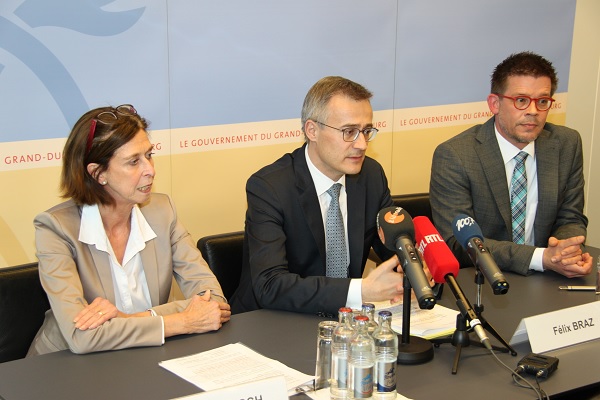
Photo by MJUST (L-R): Lydia Mutsch, Minister of Health; Félix Braz, Minister of Justice; Dr. Andreas Schuff, Forensic Medicine department of the LNS